







February 23, 1945: A Day in Stock Market History

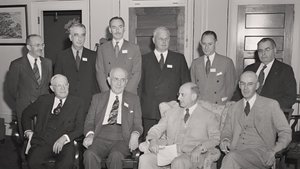
On February 23, 1945, several countries began ratifying the Bretton Woods Agreement, which led to the establishment of the International Monetary Fund (IMF) and the World Bank. These institutions played a key role in post-World War II economic recovery and global financial stability. The Bretton Woods system was a global monetary order established in 1944 during a conference held in Bretton Woods, New Hampshire, USA. This system was designed to create a stable international financial framework in the aftermath of World War II. Delegates from 44 Allied nations gathered to discuss and implement a new economic system that would prevent the economic instability and currency crises that had contributed to the Great Depression and global conflicts. The primary goal was to establish a system of fixed exchange rates, with currencies pegged to the U.S. dollar, which in turn was backed by gold at a fixed price of $35 per ounce.
Global Institutionalisation
The foundation of the Bretton Woods system rested on two newly created institutions: the International Monetary Fund (IMF) and the World Bank. The IMF was established to monitor exchange rates and provide financial assistance to countries experiencing balance of payments difficulties, ensuring global monetary stability. The World Bank, originally called the International Bank for Reconstruction and Development (IBRD), was created to help finance post-war reconstruction and support economic development in struggling nations. Together, these institutions played a key role in shaping the post-war financial landscape.
Under the system, countries had to maintain fixed exchange rates by buying or selling their currencies in foreign exchange markets to keep them within a narrow band against the U.S. dollar. If a country's economy became unbalanced, the IMF could step in to provide short-term financial assistance. This system ensured predictability in international trade and investment, as exchange rate stability reduced risks for businesses and governments. It also reinforced the dominance of the U.S. dollar as the world’s primary reserve currency.
The Aftermath
Despite its initial success, the Bretton Woods system began to unravel in the 1960s and early 1970s due to mounting economic pressures, both domestic and international. The United States, as the central pillar of the system, faced rising inflation, which was exacerbated by the Vietnam War and Great Society social programs under President Lyndon B. Johnson. The cost of war and expansive government spending led to a surge in U.S. dollar supply without a proportional increase in gold reserves, causing fears that the U.S. would not be able to uphold its promise of converting dollars into gold at the fixed rate of $35 per ounce. As concerns grew, foreign governments, particularly France under President Charles de Gaulle, began demanding gold in exchange for their dollar reserves, leading to a steady depletion of U.S. gold holdings.
By the late 1960s, the strain on the system became more apparent. Countries that had previously agreed to maintain fixed exchange rates started devaluing their currencies or leaving the system altogether to protect their economies. The United Kingdom, for example, devalued the British pound in 1967, signaling deep cracks in the Bretton Woods framework. The U.S., attempting to defend the dollar's value, found itself in a dilemma: either raise interest rates to curb inflation (which could slow down domestic economic growth) or print more dollars to finance deficits (which would worsen inflation and further weaken trust in the dollar). As the pressure intensified, central banks worldwide continued demanding gold for their dollar reserves, further accelerating the outflow of U.S. gold reserves.
Recognizing that the system was unsustainable, President Richard Nixon took decisive action on August 15, 1971, in what became known as the Nixon Shock. He suspended the direct convertibility of the U.S. dollar into gold, effectively ending the gold standard. This move was initially presented as a temporary measure, but in reality, it marked the beginning of a new global monetary era. With the dollar no longer tied to gold, the fundamental mechanism of the Bretton Woods system collapsed. The Smithsonian Agreement in December 1971 attempted to create a modified system with wider exchange rate fluctuations, but this too proved unsustainable. By 1973, most major economies had abandoned fixed exchange rates, transitioning instead to a system of floating exchange rates, where currency values were determined by supply and demand in global markets.
The collapse of the Bretton Woods system marked a turning point in global finance, leading to the modern era of fiat currencies, where money is not backed by a physical commodity like gold but instead derives its value from government regulation and market trust. While the end of fixed exchange rates led to increased currency volatility, it also provided governments with greater monetary policy flexibility to respond to economic conditions. However, the legacy of Bretton Woods did not entirely disappear. The institutions it created, particularly the International Monetary Fund (IMF) and the World Bank, continued to play significant roles in managing economic crises, providing financial assistance to nations, and shaping international financial policies.
The Legacy
Today, the Bretton Woods legacy remains relevant in discussions about global financial stability, currency management, and the role of central banks. While no universal fixed exchange rate system has replaced it, the influence of the U.S. dollar as the world’s primary reserve currency continues, reinforcing the importance of American monetary policy on global markets. Debates persist about whether a return to a commodity-backed monetary system or a new form of international financial cooperation is necessary to address modern challenges such as inflation, financial crises, and digital currencies. The rise of cryptocurrencies, central bank digital currencies (CBDCs), and alternative economic alliances signals that the discussion on global monetary systems is far from over.

Dr. Viktor Kalm is a Senior Investment Analyst at Alpha Spread. He has over seven years of experience in corporate finance, specializing in financial modeling, business valuation, and strategic planning services. Previously, as a hedge fund manager, he focused on private equity management, consistently delivering positive returns to his clients.
Dr. Viktor Kalm is a Senior Investment Analyst at Alpha Spread. He has over seven years of experience in corporate finance, specializing in financial modeling, business valuation, and strategic planning services. Previously, as a hedge fund manager, he focused on private equity management, consistently delivering positive returns to his clients.
 GSPC
GSPC
 GSPC
GSPC
 GSPC
GSPC
 GSPC
GSPC
 GSPC
GSPC