
Apple Inc
NASDAQ:AAPL



Decide at what price you'd be comfortable buying and we'll help you stay ready.
|
B
|
BuzzFeed Inc
NASDAQ:BZFD
|
US |
|
P
|
Paragon Union Bhd
KLSE:PGLOBE
|
MY |
|
A
|
Advance Synergy Bhd
KLSE:SYNERGY
|
MY |

|
Hydro One Ltd
TSX:H
|
CA |
|
F
|
FIYTA Precision Technology Co Ltd
SZSE:000026
|
CN |

|
Styrenix Performance Materials Ltd
NSE:STYRENIX
|
IN |
|
Z
|
Zhejiang Jasan Holding Group Co Ltd
SSE:603558
|
CN |

|
Lucid Group Inc
NASDAQ:LCID
|
US |

|
Roto Pumps Ltd
NSE:ROTO
|
IN |
Apple Inc
Wide
Economic Moat
Apple Inc benefits from multiple competitive advantages, including high switching costs, network effects, strong intangible assets like brand identity, and efficient scale. These factors contribute to its wide economic moat, ensuring long-term protection against competitive pressures and sustaining its superior profitability.
Apple Inc
Competitive Advantages
As more users adopt Apple's products, the value of its ecosystem increases, enhancing the experience for all users through services like iMessage, FaceTime, and the App Store, while attracting more developers to create compatible applications.
Apple incurs high switching costs for consumers due to its deeply integrated ecosystem of products and services, including iOS, macOS, and exclusive Apple software, which discourages users from switching to competitor devices.
Apple's robust brand identity and reputation for quality and innovation act as significant intangible assets that differentiate it from competitors and enable premium pricing.
Apple operates in a scale-efficient environment in hardware production and distribution, allowing competitive leverage in negotiating with suppliers and maintaining extensive market reach.
Wide Economic Moat Companies
| Company | Last Price | Price Change | Market Cap | Economic Moat | ||
|---|---|---|---|---|---|---|
|
|

|
NVIDIA Corp
NVDA
|
$188.63 |
+0.9%
|
$4.6T | Wide |
|
|

|
Apple Inc
AAPL
|
$260.48 |
+2.1%
|
$3.8T | Wide |
|
|

|
Alphabet Inc
GOOGL
|
$317.24 |
-0.2%
|
$3.8T | Wide |
|
|

|
Microsoft Corp
MSFT
|
$370.87 |
+1%
|
$2.8T | Wide |
|
|

|
Amazon.com Inc
AMZN
|
$238.38 |
+1.8%
|
$2.6T | Wide |
|
|

|
Taiwan Semiconductor Manufacturing Co Ltd
2330
|
NT$1 975 |
+2.6%
|
$1.6T | Wide |
|
|

|
Meta Platforms Inc
META
|
$629.86 |
+0.1%
|
$1.6T | Wide |
|
|

|
Broadcom Inc
AVGO
|
$371.55 |
-2.1%
|
$1.8T | Wide |
|
|

|
Walmart Inc
WMT
|
$126.77 |
+0.6%
|
$1T | Wide |
|
|

|
Eli Lilly and Co
LLY
|
$939.47 |
-1.3%
|
$888.2B | Wide |
| Company | Last Price | Price Change | Market Cap | Economic Moat | ||
|---|---|---|---|---|---|---|
|
|

|
Advantest Corp
6857
|
¥24 990 |
+7.3%
|
$118.3B | Wide |
|
|

|
Eoptolink Technology Inc Ltd
300502
|
¥508.26 |
+2.7%
|
$73.4B | Wide |
|
|

|
Disco Corp
6146
|
¥66 890 |
+5.3%
|
$46.9B | Wide |
|
|
G
|
Gold Fields Ltd
GFI
|
Zac80 076 |
-1.5%
|
$44.9B | Wide |
|
|

|
Suzhou TFC Optical Communication Co Ltd
300394
|
¥358.9 |
-4.1%
|
$40.5B | Wide |
|
|
|
GE Healthcare Technologies Inc
GEHC
|
$73.18 |
+0%
|
$33.4B | Wide |
|
|

|
Bajaj Auto Ltd
BAJAJ-AUTO
|
₹9 813.5 |
+2.6%
|
$30.1B | Wide |
|
|

|
Hindustan Aeronautics Ltd
HAL
|
₹4 028.5 |
+0.8%
|
$29.6B | Wide |
|
|
F
|
Fortress Transportation and Infrastructure Investors LLC
FTAI
|
$251.42 |
+5.8%
|
$25.8B | Wide |
|
|

|
Lasertec Corp
6920
|
¥41 580 |
+2.4%
|
$25.3B | Wide |
Apple Inc
Glance View
Apple Inc., borne out of the innovative spirit of Steve Jobs, Steve Wozniak, and Ronald Wayne in a modest garage, has steadily crafted its journey from a fledging startup to a titan of technology. This evolution is marked by a unique blend of creativity, innovation, and marketing genius. Apple reimagined personal computing with its introduction of the Macintosh in 1984, changing the way individuals and businesses interacted with technology. Over the years, the hallmark of its success has been the seamless integration of its hardware, software, and services—an ecosystem that captivates customers and locks them into its universe. With each product launch, from the iPod to the iPhone, Apple adeptly combined sleek design and intuitive functionality, setting new industry benchmarks and redefining the consumer electronics landscape. The company's prowess extends beyond product innovation to commanding a global supply chain and retail strategy that reinforces its market dominance. By establishing its retail stores as experiential havens, Apple offers more than just products; it provides an immersive brand experience. Financially, Apple thrives through a trifecta of product sales, services, and rigorous supply chain efficiency. The iPhone remains a substantial revenue driver, complemented by the growth of connected devices like the Apple Watch and AirPods. Meanwhile, its burgeoning services segment—encompassing the App Store, iCloud, Apple Music, and more—continues to expand margins and enhance customer loyalty. This services layer not only augments Apple's top-line but also deepens its engagement with consumers, reflecting a well-engineered strategy to sustain its competitive advantage and foster long-term growth.
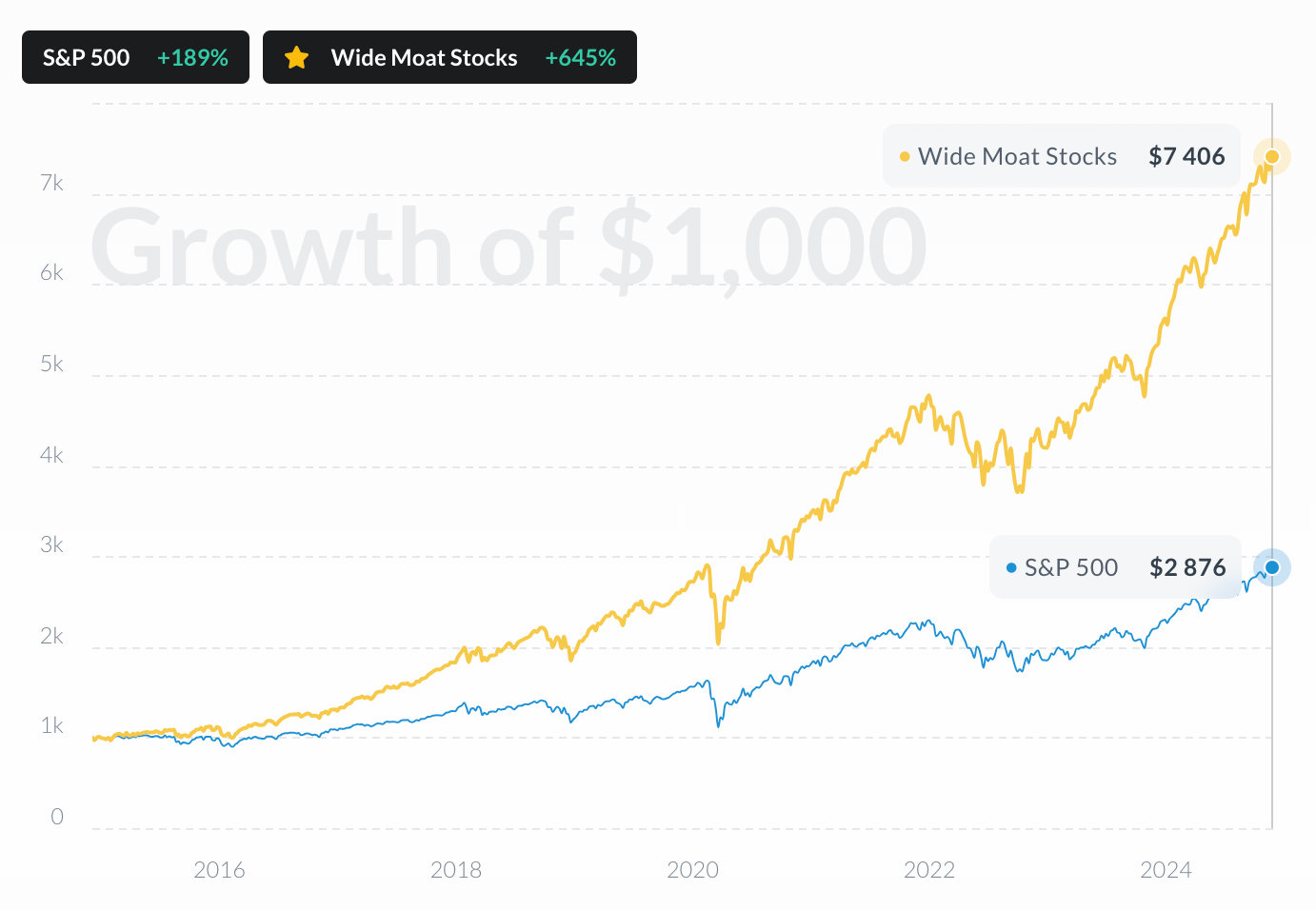
Our research into Economic Moat performance spans the past 10 years and focuses on companies with a wide economic moat. For this analysis, we calculated the average stock price returns of these companies, comparing them to the performance of the S&P 500 index over the same period.
The results were compelling: wide moat stocks achieved a remarkable +645% average return, compared to +188% for the broader market. This difference highlights the long-term benefits of investing in businesses that can maintain their market position and pricing power over time.
Note: This research does not account for survivorship bias. Past performance is not indicative of future results.
Economic Moat