
VF Corp
NYSE:VFC



VF Corp
No
Economic Moat
VF Corp lacks an economic moat, leaving it vulnerable to competitive pressures and market challenges.
VF Corp
Competitive Advantages
Wide Economic Moat Companies
VF Corp
Glance View
VF Corp, a titan in the apparel and footwear industry, boasts a rich legacy that threads back to its founding in 1899. Originally birthed as the Reading Glove and Mitten Manufacturing Company in Pennsylvania, VF Corp has since metamorphosed into one of the world's largest apparel companies. The firm nourished brands like Vans, The North Face, Timberland, and Dickies under its extensive portfolio. VF Corp’s strategy hinges on acquiring and nurturing brands that resonate deeply with distinct customer segments, leveraging their unique identities to capture resilient consumer loyalty. Through both wholesale channels and direct-to-consumer strategies, including a robust e-commerce platform, VF Corp has tailored its operations to meet the diverse demands of global consumers, ensuring its brands are both sought-after and accessible. Financially, VF Corp operates by maintaining a keen focus on efficient supply chain management and sharp cost controls, critical in the notoriously cyclical apparel industry. The company earns revenue through a hybrid approach, balancing wholesale distribution to a myriad of global retailers, alongside robust direct-to-consumer sales through brand-dedicated stores and online platforms. The company's ability to weave brand equity with operational efficiency sets it apart, ensuring profitable growth while scaling its brands across international markets. Innovations in sustainability and hyper-focus on adapting to evolving consumer preferences, such as shifts towards athleisure and outdoor wear, have positioned VF Corp not just as a participant in the market but as an agile and visionary leader navigating its many shifts.
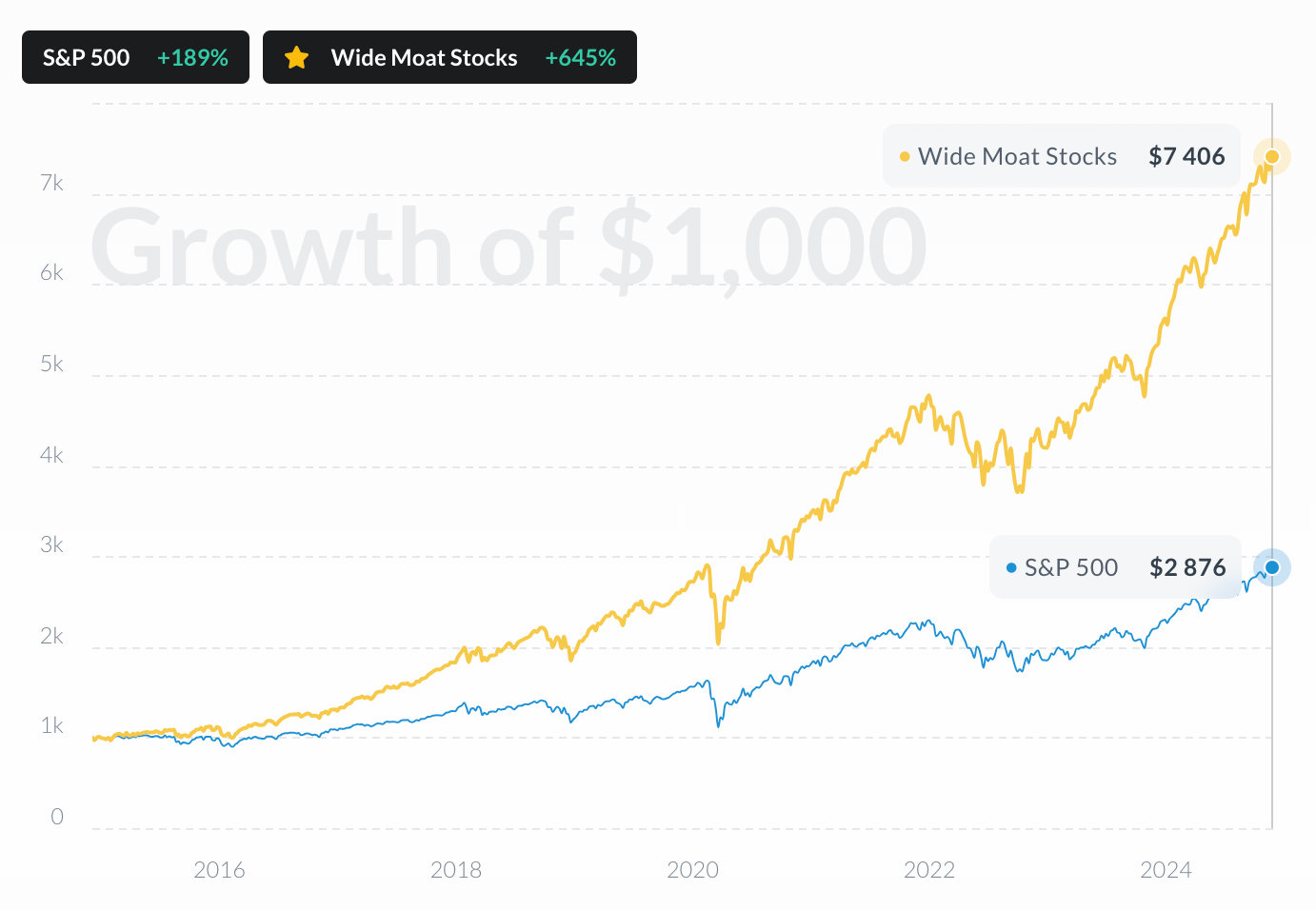
Our research into Economic Moat performance spans the past 10 years and focuses on companies with a wide economic moat. For this analysis, we calculated the average stock price returns of these companies, comparing them to the performance of the S&P 500 index over the same period.
The results were compelling: wide moat stocks achieved a remarkable +645% average return, compared to +188% for the broader market. This difference highlights the long-term benefits of investing in businesses that can maintain their market position and pricing power over time.
Note: This research does not account for survivorship bias. Past performance is not indicative of future results.
Economic Moat