Eiffage SA
PAR:FGR



Eiffage SA
No
Economic Moat
Eiffage SA lacks an economic moat, leaving it vulnerable to competitive pressures and market challenges.
Eiffage SA
Competitive Advantages
Wide Economic Moat Companies
Eiffage SA
Glance View
Eiffage SA, a hallmark in the realm of European construction, thrives on its multifaceted prowess in the industry, stretching its influence across sectors such as construction, infrastructure, energy systems, and concessions. Founded in 1993 through a strategic merger, Eiffage has carved a prestigious reputation by executing some of the continent’s most ambitious projects. The company's operations are as varied as they are vast, encompassing the design, construction, and maintenance of buildings and infrastructures like roads, railways, and bridges. It also excels in energy systems and facilities management, providing an integrated suite of services that underpin its robust revenue streams. This diversification allows Eiffage not only to scale its operations but also to effectively hedge risks inherent in the construction industry, where cyclical economic trends can often dictate the rhythm of business. Fundamentally, Eiffage's financial engine is powered by its concessions division, which operates toll roads and public-private partnerships, generating long-term, stable income. The company owns and manages numerous concessions, such as highways and transport infrastructures, which, over time, have become critical revenue pillars, balancing the sometimes volatile nature of construction projects. Eiffage’s competitive edge is further sharpened by its commitment to innovation and sustainability—principles embedded in its business model. This commitment is evident in its adoption of green technologies and emphasis on energy efficiency within its projects. Thus, Eiffage remains not just a leader in its field but a forward-thinking entity, focused on crafting a resilient future amidst evolving market dynamics.
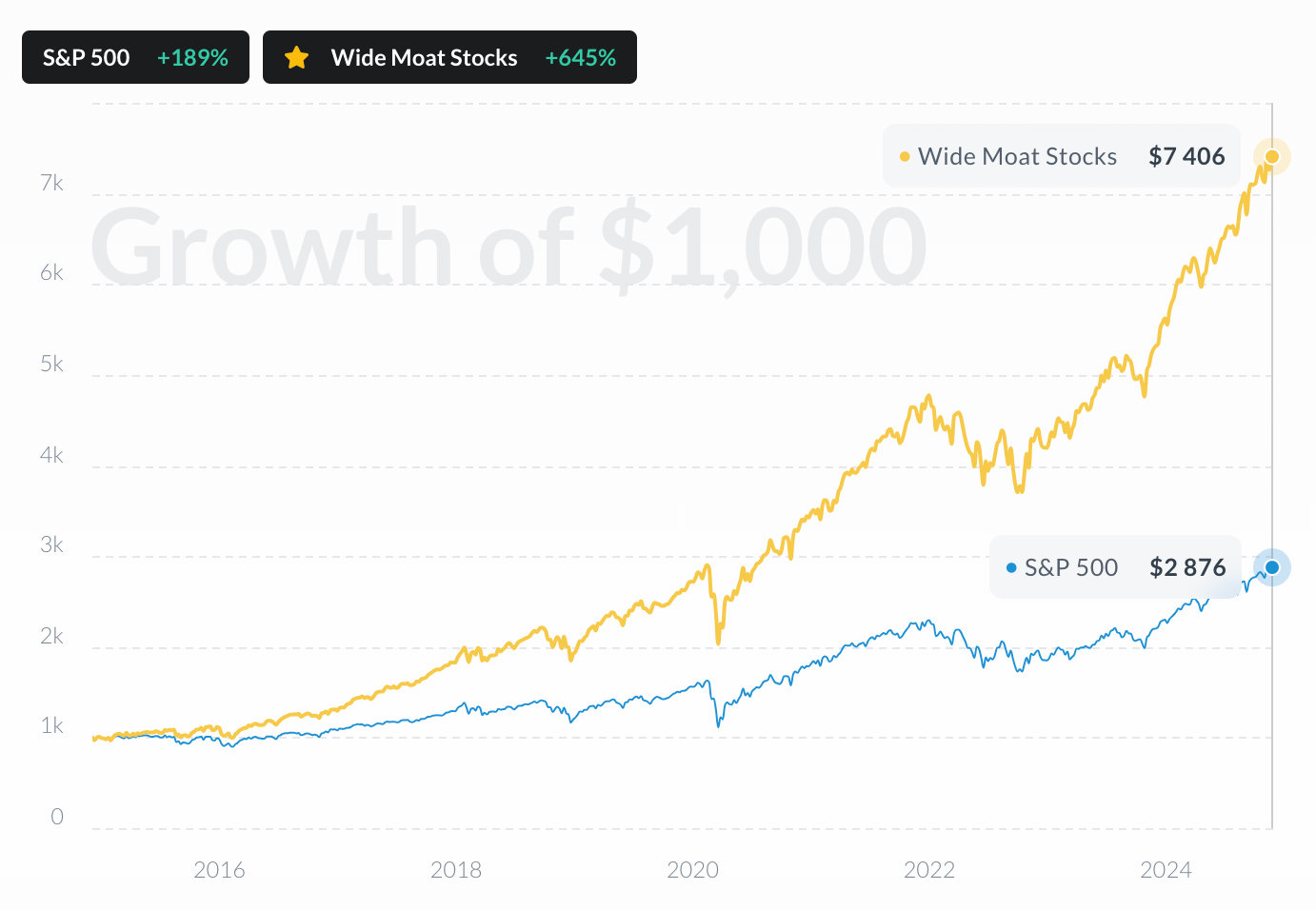
Our research into Economic Moat performance spans the past 10 years and focuses on companies with a wide economic moat. For this analysis, we calculated the average stock price returns of these companies, comparing them to the performance of the S&P 500 index over the same period.
The results were compelling: wide moat stocks achieved a remarkable +645% average return, compared to +188% for the broader market. This difference highlights the long-term benefits of investing in businesses that can maintain their market position and pricing power over time.
Note: This research does not account for survivorship bias. Past performance is not indicative of future results.
Economic Moat