
STRABAG SE
VSE:STR



STRABAG SE
No
Economic Moat
STRABAG SE lacks an economic moat, leaving it vulnerable to competitive pressures and market challenges.
STRABAG SE
Competitive Advantages
Wide Economic Moat Companies
STRABAG SE
Glance View
Strabag SE, a titan in the European construction industry, has crafted a legacy by building beyond concrete. Dating back to its origins in 1835, Strabag has evolved into a diversified construction company, with its pieces firmly set across the continent and beyond. Headquartered in Vienna, Austria, this industry behemoth weaves a tapestry of infrastructure projects, ranging from cutting-edge civil engineering feats to meticulous building construction. Its core operations are underpinned by a strategic prowess that leverages a vast network of subsidiaries and affiliates, ensuring a footprint that spans more than 60 countries. Strabag thrives on large-scale projects like transportation infrastructures — highways, bridges, and tunnels — which showcase its dexterity in engineering ingenuity and project management. At the heart of Strabag's economic engine lies a deep-rooted expertise in public-private partnerships (PPPs), a model fostering close collaboration with governments to deliver vital public infrastructure. Through strategic planning and execution, the company navigates complex regulatory environments and balances financial rigor with sustainable practices, making it a favored partner for diverse stakeholders. Its revenue streams are multifaceted, drawing from building construction, civil engineering, and services like facility management and real estate development. This diversification is complemented by a commitment to innovation, illustrated by investments in digital solutions and environmentally friendly construction techniques. Thus, Strabag stands as a testament to building not just in the physical sense, but in fostering enduring economic, social, and environmental impacts wherever it operates.
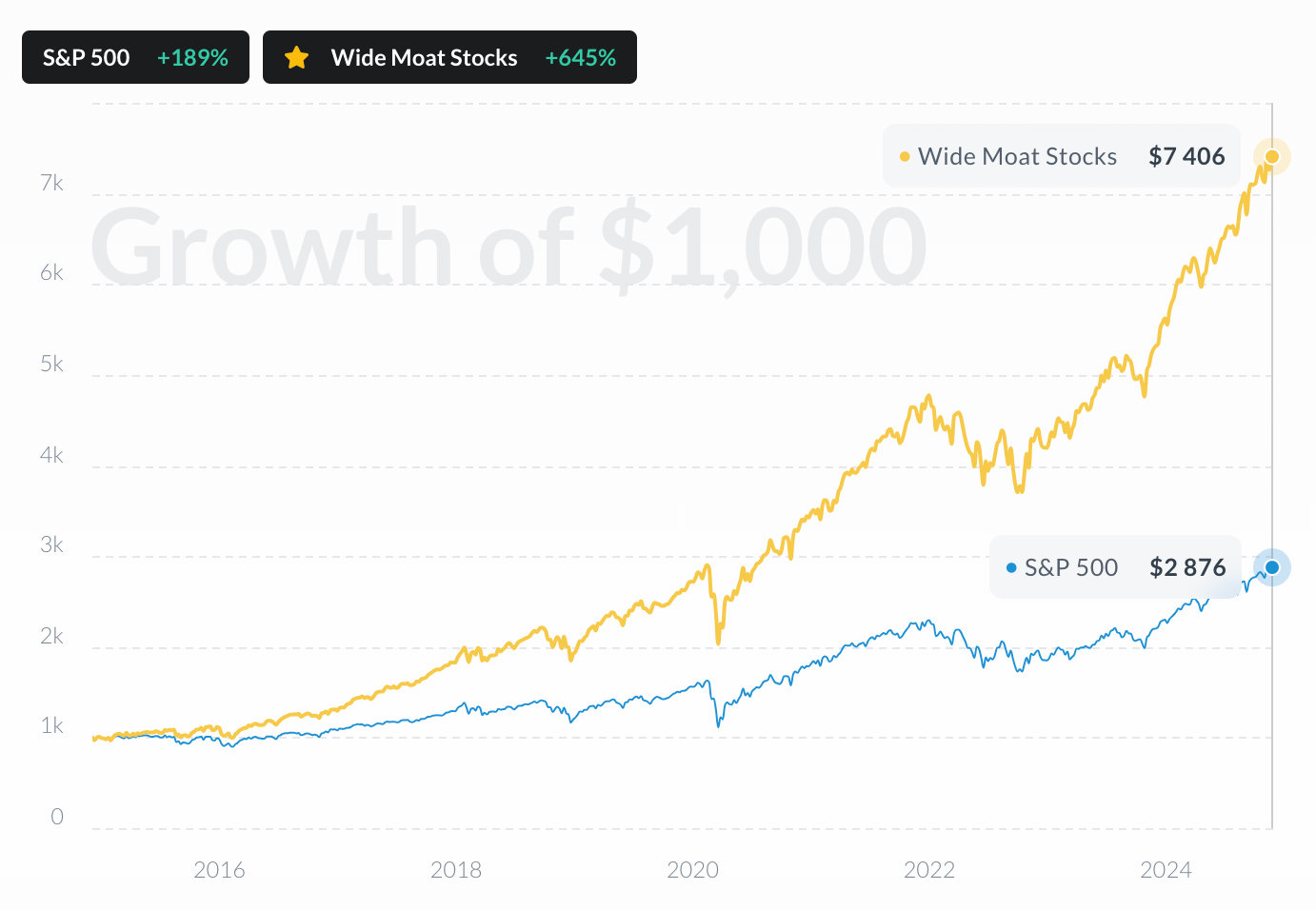
Our research into Economic Moat performance spans the past 10 years and focuses on companies with a wide economic moat. For this analysis, we calculated the average stock price returns of these companies, comparing them to the performance of the S&P 500 index over the same period.
The results were compelling: wide moat stocks achieved a remarkable +645% average return, compared to +188% for the broader market. This difference highlights the long-term benefits of investing in businesses that can maintain their market position and pricing power over time.
Note: This research does not account for survivorship bias. Past performance is not indicative of future results.
Economic Moat