
Automatic Data Processing Inc
NASDAQ:ADP



Automatic Data Processing Inc
No
Economic Moat
Automatic Data Processing Inc lacks an economic moat, leaving it vulnerable to competitive pressures and market challenges.
Automatic Data Processing Inc
Competitive Advantages
Wide Economic Moat Companies
Automatic Data Processing Inc
Glance View
Automatic Data Processing Inc., commonly known as ADP, has carved a niche for itself as a heavyweight in workplace management solutions, with roots that trace back to the back-office needs of payroll processing. The journey began humbly in 1949 when Henry Taub founded the company with the ambition of helping businesses streamline their payroll tasks. Through the years, ADP expanded its capabilities and infused technological advancements into its core services, positioning itself at the forefront of human capital management. The company’s evolution is marked by its ability to adapt and expand beyond just payroll, offering comprehensive solutions like human resources management, talent management, and tax and compliance services. ADP's business model revolves around leveraging its vast client network—spanning small businesses to multinational corporations—to provide subscription-based, cloud-hosted solutions that facilitate seamless HR operations. By offering a suite of products that cater to different aspects of workforce management, such as time tracking, benefit administration, and talent analytics, ADP generates a steady stream of revenue through service subscriptions and client-related add-ons. Its focus on innovation and customer-centric solutions ensures the company meets the ever-evolving demands of modern businesses. Through these diversified offerings, ADP secures its foothold as an indispensable partner for organizations looking to optimize their workforce administration, ensuring compliance and efficiency in an increasingly complex corporate landscape.
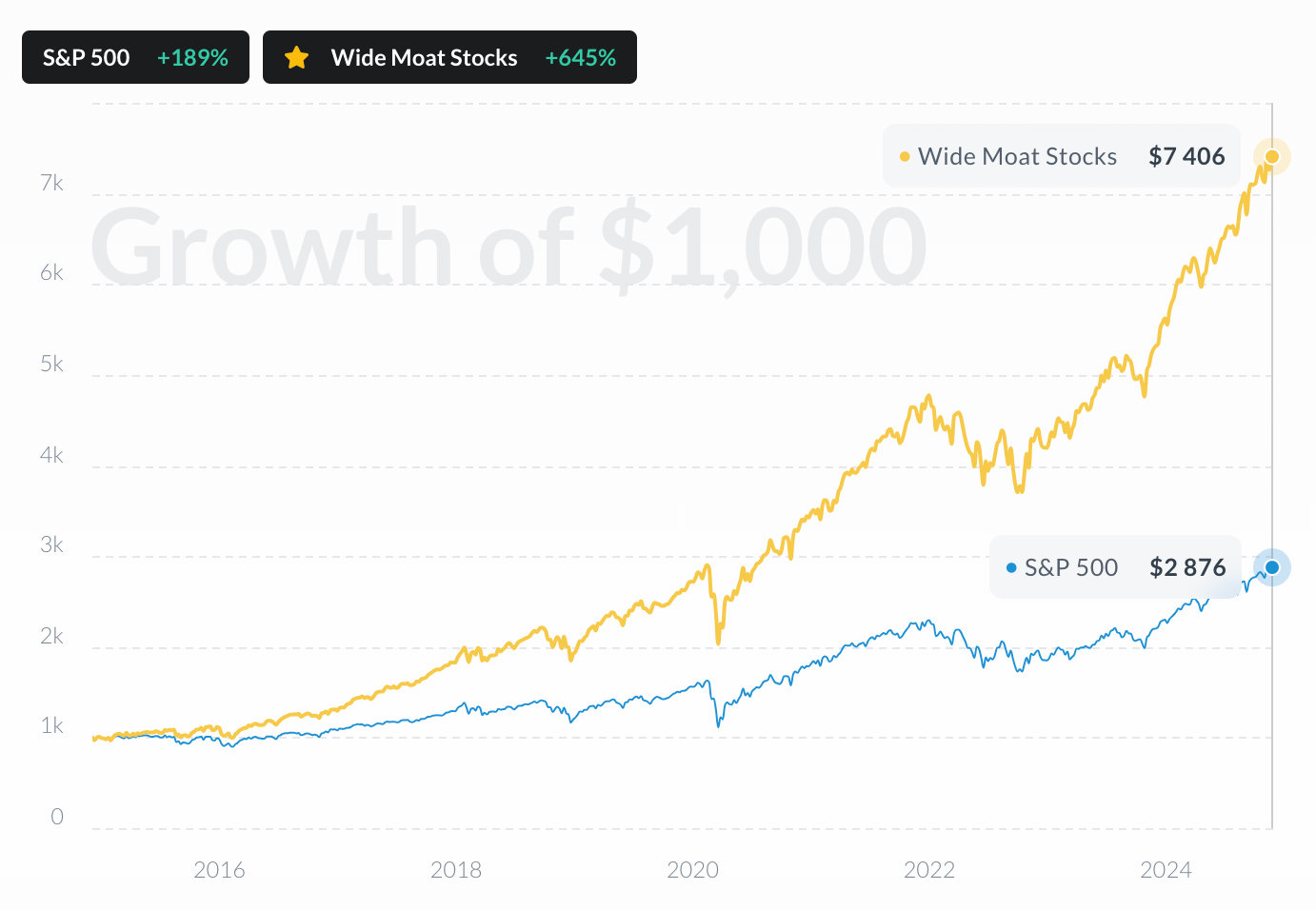
Our research into Economic Moat performance spans the past 10 years and focuses on companies with a wide economic moat. For this analysis, we calculated the average stock price returns of these companies, comparing them to the performance of the S&P 500 index over the same period.
The results were compelling: wide moat stocks achieved a remarkable +645% average return, compared to +188% for the broader market. This difference highlights the long-term benefits of investing in businesses that can maintain their market position and pricing power over time.
Note: This research does not account for survivorship bias. Past performance is not indicative of future results.
Economic Moat