
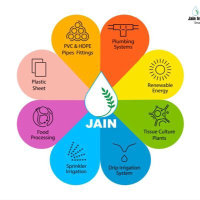
Jain Irrigation Systems Ltd
NSE:JISLJALEQS



Decide at what price you'd be comfortable buying and we'll help you stay ready.

|
Johnson & Johnson
NYSE:JNJ
|
US |

|
Berkshire Hathaway Inc
NYSE:BRK.A
|
US |

|
Bank of America Corp
NYSE:BAC
|
US |

|
Mastercard Inc
NYSE:MA
|
US |

|
UnitedHealth Group Inc
NYSE:UNH
|
US |

|
Exxon Mobil Corp
NYSE:XOM
|
US |

|
Pfizer Inc
NYSE:PFE
|
US |

|
Nike Inc
NYSE:NKE
|
US |

|
Visa Inc
NYSE:V
|
US |

|
Alibaba Group Holding Ltd
NYSE:BABA
|
CN |

|
JPMorgan Chase & Co
NYSE:JPM
|
US |

|
Coca-Cola Co
NYSE:KO
|
US |

|
Verizon Communications Inc
NYSE:VZ
|
US |

|
Chevron Corp
NYSE:CVX
|
US |

|
Walt Disney Co
NYSE:DIS
|
US |

|
PayPal Holdings Inc
NASDAQ:PYPL
|
US |
Q1-2026 Earnings Call
AI Summary
Earnings Call on Jul 26, 2025
Revenue Growth: Jain Irrigation reported around 5% revenue growth in Q1 FY26 despite deflationary pressures, with sales reaching approximately INR 1,550 crores.
Segment Performance: Hi-Tech Agri grew nearly 30%, solar pump sales rose sharply, and exports increased about 40%. Plastics segment fell by 10% due to lower demand and deflation.
Profitability: Overall EBITDA margin improved by 1 percentage point, with Hi-Tech Agri EBITDA at 16.6%. Management expects to maintain or improve these margins going forward.
Debt & Cash Flow: Gross debt remains stable at INR 3,590 crores, with net debt up slightly due to working capital. INR 250 crores in long-term debt is targeted for repayment in the next nine months.
Receivables: Receivables rose due to project closures but half of the increase was recovered in July. Management expects most old government project receivables (INR 500–700 crores) to be collected by mid-2026.
Guidance Unchanged: The company reaffirmed its full-year revenue growth guidance of 15%+ for FY26, expecting a stronger second half.
Value Monetization: Management is seriously pursuing value unlocking for the food processing subsidiary, possibly via IPO in 2026.
Strategic Focus: Expansion in new regions, urban markets, and contract manufacturing are key priorities, with a continued push on exports, solar, and tissue culture.
Despite a deflationary environment affecting both plastic and food commodity prices, Jain Irrigation achieved approximately 5% revenue growth in Q1 FY26. The Hi-Tech Agri segment led the way with almost 30% growth, driven by strong drip irrigation and solar pump sales. The plastics segment saw a 10% decline due to deflation and weaker domestic demand from an early monsoon, though overseas plastic sheet sales were positive. Agro Processing revenue was roughly flat year-on-year.
Overall EBITDA margin improved by about 1 percentage point. Hi-Tech Agri saw EBITDA margin rise to 16.6%, up from roughly 15%. Plastics margin dipped due to lower sales, while Agro Processing EBITDA improved by 1.6 percentage points. Management expects to maintain consolidated EBITDA margins between 13% and 15%, targeting up to 15% as sustainable, with segmental margins for Hi-Tech Agri at 15–17%, plastics at 10–14%, and food processing at 12–13%.
There was a notable increase in receivables and inventory at the end of Q1, primarily because of project closures and seasonality. About half of the receivables increase was recovered in July. Management expects continued improvement in working capital metrics (DSOs) for both inventory and receivables over the medium term, with most old government project receivables (INR 500–700 crores) expected to be collected by mid-2026.
Gross debt remains stable at INR 3,590 crores; net debt is slightly up due to higher working capital needs. Management plans to repay INR 250 crores in long-term debt over the next nine months using internal accruals, and possibly accelerate debt reduction via value monetization of the food processing business. The company is cautious about further equity dilution, emphasizing it will only occur if demonstrably value accretive.
The company is focusing on expanding its dealer network, especially in northern and eastern India, and pursuing urban market growth for piping. Solar pumps and tissue culture are highlighted as growth engines, with solar pump sales jumping from less than INR 2 crores to over INR 50 crores year-on-year. Management is also exploring new business opportunities in contract manufacturing and emerging markets like compressed biogas and spices.
Jain Irrigation reaffirmed its full-year revenue growth guidance of at least 15% for FY26, citing expectations of a strong second half. Over the next three years, management targets doubling revenues, driven by growth in all segments. They also expect a gradual improvement in EPS as debt servicing requirements decrease, especially post FY27.
Management is preparing for potential value monetization of the food processing subsidiary, possibly through an IPO in 2026, which could significantly aid in debt reduction and enhance shareholder value. Other investments, especially in overseas subsidiaries, are expected to be monetized in the next 2–3 years depending on market conditions.
Deflationary trends in raw materials and food prices affected Q1, but plastic raw material price declines appear to have stabilized. The company expects stable-to-firm prices for the remainder of the year. Export demand remains strong, with a 40% increase in export revenue in Q1. Food inflation and commodity cycles continue to impact results, but management believes current low input costs could benefit margins going forward.

Ladies and gentlemen, good day, and welcome to Jain Irrigation Systems Limited Earnings Conference Call hosted by DRChoksey Finserv Private Limited. [Operator Instructions]
Please note that this conference is being recorded. I now hand the conference over to Ms. Jinali Gala. Thank you, and over to you, ma'am.
Thank you. Good afternoon, everyone, and welcome to Jain Irrigation Systems Limited earnings call to discuss the Q1 FY '26 results. Today, we have on call Mr. Anil Jain, CEO and Managing Director; and Mr. Bipeen Valame, Chief Financial Officer. We must remind you that the discussion on today's call may include certain forward-looking statements that may involve known and unknown risks, uncertainties and other factors and must therefore be viewed in conjunction with the risks that the company faces. Future results, performance or achievements may differ significantly from what is expressed and implied by such forward-looking statements. Please note the results and presentation are available on the exchange and on our company's website.
I now request Mr. Anil Jain to take us through company's business outlook and financial highlights, subsequent to which we will open the floor for the Q&A session. Thank you, and over to you, sir.
Thank you. Welcome to everybody, and especially thanks for coming on to the call on Saturday. So we concluded our Board meeting earlier today for the June quarter results. And overall, I think in a deflationary environment where on one hand, resin prices have come down quite a lot. On the other hand, on the food side, onion or the mango prices were one of the lowest we have seen in the last few years. We have still managed to have a positive revenue growth. I think that augurs well for the second half of the year.
Now we see that this particular phenomenon of deflationary pricing on commodities, whether plastics or food, at least on plastic side, it seems to have been arrested over the last 2, 3 weeks. And indications based on certain scenario planning is that things would be stable to firm going forward in the rest of the year. In terms of food processing, I think in terms of lower prices of onion or mangos, that's already factored in, but that would impact the significant growth, which we are planning might -- could be lower because revenue prices would be lower.
But we have tried to process higher level of commodities in terms of quantity to try and make up for some of the deflationary pricing on the raw materials. Business overall, I think we have been able to grow EBITDA also. Now in terms of when you look at business segments, our Hi-Tech Agri segment has managed to have really very good growth rate, closer to 30%. The plastic came down by approximately 10%, where the domestic demand for piping especially got hit very hard due to early monsoon starting mid-May. And -- but we had a positive growth in our overseas plastic sheet business. So overall, as a division, it has come at about still negative 10%. And part of it is, again, is deflation and partly rest, less demand.
Agro Processing for the factors we explained, we almost done almost same level at what we did last year as a company. In terms of overall profitability, when we look at the EBITDA level, I think in Hi-Tech business, we have been able to improve our EBITDA from about 15% to 16.6%. In plastic, EBITDA has slightly come down due to lower revenues, while in Agro Processing, EBITDA has improved by another 1.6%. So all in all, I think we have about -- we gained about 1 percentage point in terms of EBITDA for the overall business for the company.
In terms of the timing of the year and seasonality, this quarter, we have consumed for the future growth in the remainder of 3 quarters, funds have gone into working capital. So you -- in June quarter end, there was substantial increase in the receivables. So there was some amount of increase in inventory as well. But we think all of this would get paid down between now and December. Already in month of July, almost 50% of increment in the receivable, which we had in the June quarter has been recovered in last 4 weeks. So I think it's a temporary short-term phenomenon.
For the medium term, that is up to March '26, we expect to maintain the trend of continued improvement on working capital in terms of DSOs, days outstanding against sales for both inventory as well as receivables, even though in short term in the current quarter, they have gone up.
The things which apart from Hi-Tech Agri business doing well in terms of drip irrigation has done well. Also the solar pumps, we had a good growth. We crossed INR 50 crores sales in the current quarter. So as against same period last year, it was hardly less than INR 2 crores. So that was a big plus.
Our exports have continued to do well. Overall, exports grew in this current quarter from the same period from INR 88 crores to INR 130 crores. So almost registering 40% growth has come in the exports. So exports did well. Solar pumps did well. Drip irrigation overall has done well. Pipe was down. Food was even. That is how I will say, different business segments have played out in total.
When in terms of -- when you look at the projects, projects, we closed one large project this particular quarter. Therefore, project revenue was high. And automatically, that means higher receivable because by the time you would get paid against this particular receivable, it would be another 2 quarters or so.
But overall, I think we are moving in the right direction, whereas we had discussed earlier that sometimes over next 12 months, we expect to close majority of the projects. And between now and next September, most of the overdue funds from the project should be received by the company.
This scale of the revenue of almost INR 1,550 crores, which we achieved this quarter, so approximately 5% revenue growth has meant that the gross debt has remained almost same at the same level as last year was INR 3,590 crores, while net debt has gone up slightly as extra usage of cash has gone into working capital.
This was also a quarter where we got the funds coming in towards the equity for the warrants, which we had issued earlier, almost to the tune of INR 150 crores, and that has gone into building of the working capital. During this period, we have also paid long-term debt overall, while because of the increase in working capital and overall balance sheet, long-term debt is constantly going down as required.
In the remainder period of the 9 months, approximately another INR 250 crores of long-term debt is due for the repayment, which we should be able to do through internal accruals. And in addition, as we start receiving some of the overdue project receivables, we would be able to also pay down 0% NCDs. So that would be in addition to INR 250 crores, which is -- the debt which is falling due for the repayment.
In terms of overall scenario, as we are looking at it now, we expect in the remainder of the year, drip irrigation business to continue to remain buoyant for us. We expect that based on the good monsoon, pipe demand should come back. We are seeing good flows for the solar pump orders also. And overall, I think positive sense, which we -- when we spoke about the year in the last con call, we said for the whole year, we are anticipating to manage growth north of 15% in terms of revenue. I think that guidance still remains despite the fact that first quarter, we have grown only 5% due to mostly deflationary environment and a little bit of lack of demand because of the early monsoon in the plastic and piping segment.
So overall, as a structure, I think we continue to remain strong in marketplace at 16.6% EBITDA, which I talked about at Hi-Tech. This is one of the strongest year we have had on this division in terms of EBITDA. And our cost basis, right, cost structure, which we have, continues to remain very good going forward as well because product mix is changing. We are selling more value-added products on micro irrigation, which is allowing us to compete with a lot of small players and still maintain margins while pursuing the growth.
And production capacities are at reasonable level. In terms of CapEx, we have done some -- this quarter, CapEx -- overall maintenance plus growth CapEx was about INR 44 crores, while depreciation was INR 68 crores. For the rest of the year, maintenance CapEx would be in line with what we have done in earlier years. And we'll be doing some growth CapEx as well.
Especially we are seeing a lot of demand for medium term from the tissue culture planting material division for the urban piping scenario. But we still believe that overall CapEx would still remain in line with the overall depreciation for the company. In food business, we have seen some opportunities for contract manufacturing. We are working on those. And I think by the time we speak about those next Board meeting -- sorry, next results meeting, we will emerge with more clarity how that is going to evolve, but we have started working on that.
We are also seeing newer irrigation opportunities where some large players are working on this compressed biogas and some other things where they need to grow biomass before creating gas, which requires irrigation. So we think that would be an interesting application of our technology and a likely business opportunity in that sector.
And exports have been doing very well. And we continue to have good export orders and maintain a good level of growth in exports also. So exports positive going forward, solar positive. Drip irrigation, along with the new application, I think would continue to do well because as a country, our energy economy is changing, and I think water plays a role and irrigation plays a role because a lot of fuel generation people are now talking using the agriculture crops.
So that's where we can play an important role. The JJM has still not really picked up in the current quarter also, some places, it is there in some states where we are not the direct supplier, but we indirectly supply pipe, but it is quite competitive pricing. So some of that business, because it is so competitive, we have let go. But what business we could capture, we are staying profitable in that business.
So I think this is the background, reasonably good quarter. Second quarter is slowest quarter, usually September for us, but we are really looking at a very strong H2 on a reasonable first quarter. And if you look at 6 business product lines we have, right, drip and sprinkler doing well. Piping was weak, but should pick up in the second quarter. Plastic sheet has done well, which is our overseas business primarily. Tissue culture has registered a good growth for us. Solar pump is doing very good and food processing business was even and should -- India business at least will remain even, but overseas business will continue to grow, especially on the spices side.
That's what we are looking at it. We are looking at a growing year, profitable year with good 3- to 5-year growth scenario. We feel confident and positive that we have all the right, what would you say, ingredients to create a good recipe or right building blocks to build a good journey going forward, not just in terms of revenue growth, but earnings and positive cash flows also.
So with that, I would take a break, and we would like to invite any questions you may have. Thank you again.
[Operator Instructions] The first question is from the line of Nigel Mascarenhas from EverFlow Partners.
A couple of questions from my end. Firstly, what sort of revenue and EBITDA number can we expect to reach at the overall level in the next 3 years?
Okay. So second question. So I'll answer both together.
My second question was, out of this, which segment would be leading the growth? And what would the EBITDA margins for each of these 3 broad segments look like by then, say, 3 years in the future?
Okay. So it's a good question, a broad question, right? And it's linked to the future. So we need to take it with whatever qualification it would need. But we are -- last year, I think overall, we, as a company, did INR 5,800 crores approximately revenue. And we are targeting overall growth in that 15% plus.
So -- when you take into that, that means business in 3 years in terms of opportunity, right, the opportunity is that you could -- between 3- to 4-year type of scenario, you can definitely double the size of the business. If you look at 5 years, you have a chance to make it 2.5, 3x. So that's the opportunity because we had recently worked with a large consulting firm as well to look at what is the opportunity out there and whether Jain can win in that opportunity.
And the answers to both are very positive. Now when I look at which segment will grow more, so each segment is going to grow, some less and some more. So we see piping segment to grow quite a lot, maintain 15%, 17% growth. Definitely. We see irrigation to also maintain a 12% to 14% growth based on a combination of exports and new value-added applications.
We expect plastic sheet business, which is overseas to continue to grow at 8% to 10% because in that business, in those local economies, as you know, are growing 2%, 3% only. So 8% to 10% growth is quite good from that part of business.
Solar pump business, we used to do a lot of solar pumps earlier, and we have recently started again. During restructuring period, we had walked out of that business. We think that business could grow substantially over the next 2 to 3 years because the opportunity is quite large under the KUSUM Yojana of the Government of India.
And food processing business with additional capacity utilization of spices, some contract manufacturing also should grow quite well. So I think on an average, we would like to maintain a 15% growth. Some of the other things come and kick in, you could achieve beyond 20% growth. If you do 18%, right, compounded over 5 years, you double the business. If you do 20%, you can double in 3, 3.5 years.
So I think that's the structure we are going. We have good production capacities. Some specific product verticals, we might have to invest growth CapEx. But I think normal pipe or drip, I think we can grow next 2 to 3 years without any serious CapEx, only maintenance CapEx we will do. So that is quite positive.
I understand. And can you throw some color on the EBITDA as well as the overall and segmental numbers as well?
So I think overall EBITDA, right, this year, we did about 13%. And the breakup, if you see Hi-Tech is 16% plus and plastics is 10% plus and Agro Processing 11.8%. So when you project this, right, globally speaking, all food processing companies are at about 12% to 13%. I think that's what would be maintained in that business.
In plastics, we have been between 8% and 10% historically. But as we utilize better production capacities, higher growth rate, I think we can hit 12% to 14% window there. We are still not there yet. And Hi-Tech, I think we would maintain this 15% to 17%. In an extraordinary year, it could go to 18%, 20%, but I think 15% to 17% would be.
So overall idea would be to stay between 13% to 15%. I think 15% EBITDA on consol business combined, I think, would be a good level, very good level. 13%, we must achieve definitely any year. But I think we will be inching towards 14% going forward.
[Operator Instructions] The next question is from the line of [ Hemal Trivedi ], an individual investor.
First of all, congratulations on good performance. Can you throw some light on value monetization? We've been kind of hearing it for such a long time now and kind of it's not moving forward. That is my first question on value monetization.
And the second question is on the EPS, like from investors' point of view and from the kind of share price point of view, what matters is kind of EPS. So that is stagnant from quite a long time now. So what is the plan in order to kind of grow the EPS so that the investors like us can benefit as well? These are my 2 questions.
Yes. So I think, again, good questions. In terms of value monetization, I think we have recently started working seriously on food processing company, which is a subsidiary. And depending on, again, preparation, the market underlying performance, sometimes in '26, there is a good possibility that you would see value monetization of that business.
In terms of EPS, that is something we are working on. As you know, we have gone through almost -- we have kind of lost half a decade, right, between '20 and '25. And I myself feel that pain and pinch not just as a shareholder, but as somebody who is responsible for delivering results for shareholders and other stakeholders.
I think what work we have done, right, changed our business model and how it functions, we have stabilized a lot of things got cleaned up from the restructuring period. So that's behind us now. And we are looking at super growth over the next 5 years.
And as we solve the balance sheet issues maybe over the next 12 months, I think thereafter, you will start seeing EPS because I think EBITDA has done well, would continue to do well going forward. But still whatever we earn today get absorbed through the servicing of the debt, depreciation, et cetera. And then not much is left for the shareholders. As we go along, I think post -- from FY '27 onwards, you will start seeing measurable improvement in EPS because that's the ultimate goal.
If I can just ask one more question, if that is fine.
Sorry to interrupt. Mr. Hemal, may we request you return to the question queue for a follow-up. The next question is from the line of Amit Agicha from H.G. Hawa.
Sir, my question was connected to the equity infusion. What portion of the recent equity infusion was from promoter versus institutions? And will this -- will there be any further infusions planned?
So the current infusion which happened, almost, I think, out of INR 150 crores, 1/3 came from promoters and the remainder came from the institutions approximately in line with the warrants, which were issued earlier. So as of now, there are no outstanding warrants. But as company is getting on this huge growth path, right, because as I described, we see all the 6 businesses firing going forward over the next few years, might require some additional support on the working capital side.
So at appropriate time, I think post discussions with our Board, we'll be informing all the stakeholders of how we plan to raise any additional funds for that purpose. But as of now, the focus is on underlying cash flows, recovering old receivables, continue to repay the debt, long-term debt and bring it down and improve the EPS.
Yes. Just second point was, sir, connected to the balance sheet. Like as you're saying like long-term debt, almost like almost INR 4,000 crores is the balance borrowings last from like 2014 onwards. And I think so we're also having investments of more than INR 1,200 crores. So is it -- would be possible like to sell off the investments and repay the debt so as to cut down the interest cost?
Yes. So if we -- so if I look at my debt, right, and we have given the debt -- the details in our investor presentation also. So -- and I'll just take 2 minutes of everybody's time. Total debt for the entire group is at about INR 3,500 crores right now. Out of this INR 3,500 crores debt, the long-term debt or term debt is close to INR 1,500 crores.
Now -- sorry, about INR 1,500 crores. Now that INR 1,500 crores has about INR 800 crores debt at 0%, right? So remaining INR 700 crores debt is at, let's say, average 9% to 10%. And that is being repaid as we speak in the next 9 months alone, INR 250 crores of that debt is due, which we'll be paying.
So on the term debt, the debt, I think as it stands, the entire INR 1,500 crores, almost by March '28, almost become 0 in normal course through internal accruals. In terms of if we do any value monetization, right? So for example, I talked about the food company next year. Any of such opportunity, we can, instead of waiting till '28, we can finish that in before '27. So we are on that path.
Now rest of the debt, what you see, approximately INR 2,000 crore debt is working capital debt, where about INR 200 crores would be the overall interest in the year. Currently, that debt is required because when you see individual nature of businesses, whether food processing or irrigation or pipe, et cetera, et cetera. Some of them are working capital-intensive businesses and that debt is required to support the working capital. But as far as term debt is concerned, we are very clear that, that should go away earlier than later, max 3 years, maybe 18 months is what our plan is.
So my question was connected to actually investments also. Like are we generating more on investments rather than repaying on the cost savings which you will do on the debt?
So investments are 2, right? One investment is a major investment is a food processing company, and I talked about already IPO next year, right? And our investment in food processing company, let's say it's about INR 600 crores, INR 700 crores, somewhere around that.
We are hoping IPO value is some INR 3,000 crores, INR 4,000 crores. So I think we can definitely get far more than what we invested when we do value monetization. And the rest of the investment in the overseas subsidiary, which we did when we reduced our debt by INR 2,000 crores outside India, and we merged our business.
So part of that equity is still there and value monetization of that won't happen now. One has to wait for 2, 3 years, depending on the scenario there, what happens there. So -- but whatever investment you see on the books, I think in terms of, again, idea is that in the next 1 to 2 years through value monetization, that would come in to help reduce the debt.
[Operator Instructions] The next question is from the line of [ Praneet ], an individual investor.
So I think we did a great job in terms of generating more EBITDA and all of that. So I was curious on the front of -- in terms of expansion on the ground for the piping segment and micro irrigation segment. So basically, we have -- our dealers level has been constant for the last couple of years. And I understand this churn, but how are we able to expand on that front? And what are the strategies? How successful have been the strategies in terms of expanding that particular chance? And in the last con call, you mentioned about urban expansion also, our pipes going into urban territories and all of that. So how is that going at the moment?
So I think in MIS and pipe, right, where we sell through the dealers, we have been -- while number might remain the same, but we have kind of weeded out a lot of inefficient dealers and more focused on efficient dealers. And some of the inefficient dealers, we have gone -- we have got the new dealers in the existing areas where we sell quite well, which is like Maharashtra or Southern India and Western India.
Where we have added dealers is in Northern India, on Eastern on Northeast parts. And I think there, the original business numbers are small, right? But for example, this quarter alone, in East, we have grown 63% on a smaller number. In Northeast, we have grown 200%, again, on a smaller base.
So that shows that the work has started there and the dealers have started delivering results. But it's a process, right, because it is not that just you appoint the dealers and you will have sales. You changing the concepts of the farmer in terms of how do they go about, right?
So it has taken us a few decades here to build this dealer base in the existing areas, which we are strengthening to sell more in existing areas. But now that we are into a new era of technology, I think things would move much faster. Earlier, what has taken 20 years, I think, can be done now in 3 to 5 years.
So we are very confident that in next 3 years, for example, the East, Northeast and North, which is hardly 5% of our sales in past would become at least 15% to 20%. They would grow that much 3 or 4x and with a larger growth, including growth in the existing areas. So there, we are quite strong, positive. And '21, '22, right, we changed business model to dealers who used to provide 120 days credit. And we said, no, no, now you pay cash in advance, then only I'll supply you.
And it took a hit, right? And now the business is also back to the same level it was before when we were giving 120 days credit. Having achieved this new business model and got everybody comfortable with that model where still everybody makes money and willing to do it. Now we are going into the additional growth into existing areas on the new model.
Your second question about the urban market. Urban market, we have been working to ensure that we have the new dealer network as well as a complete range, which is required, which is different than the, let's say, our existing range, right? Some additional things are required. So you would see -- when I talk about December and March results, we will be able to share with you more precise details about what gains we have made.
It is a tough market because there is a very entrant large players in that market. But Jain has necessary technology and the brand, especially in Tier 2, Tier 3 cities, I think we would succeed much faster, but it is going to take another 2 to 3 quarters.
Understood. So I was wondering one more thing is the tissue culture segment that has a high EBITDA margin that has been contributing, I feel like to the incremental EBITDA growth. So how -- what are the limitations that can hinder? Because we are projecting a very high growth rate going forward in the next 2 to 3 -- 3 to 4 -- 3 to 5 years.
So I was wondering what are the limitations that might hinder that particular growth? And in terms of geography, because it's a bioproduct, is there any limitation in terms of distributing the product across the country? Or are we very concentrated in Maharashtra? Like can you give an idea about that?
Yes. So tissue culture is a biotechnology product. So you make planting materials from the stem of the tree or from the tissue. So our core lab, right, is headquartered here in Maharashtra. But then you do hardening, semi-hardening that you can do in the field. So you need to have greenhouses and shade houses. So we do some work, for example, in our Kurnool facility to cover the Southern India. And we do some work in our Alwar facility, which is in Rajasthan to cover Northern India.
So while the core lab will remain here because you need to secure mother nursery and you need to have all the protocols. But the first primary and secondary level of hardening will be done in the field closer to the market. In terms of our customer base, today, whatever banana plants we sell, most of them are in western and southern parts of the country where banana is prominently grown. While pomegranate, we are doing in Western India as well as we have a big market in Rajasthan also.
Plus now work we are doing on potato seedlings, there, while we are getting them grown apart from the lab work, what we -- field work in Punjab and Haryana, our markets are more into places like Gujarat and UP as well. So it is becoming a national business. It is not remaining purely regional. You asked a question about what are the likely hurdles in the growth opportunity.
So we are seeing, for example, banana opportunity is very big because farmers are making more money. It is -- recently, there was a news that mango is no more a king. Banana has become king because with the help of our tissue culture, farmers are really making money. As a country, we are exporting INR 4,000 crores, INR 5,000 crores of banana, and that creates more demand for our tissue culture products.
So we do not see demand as an issue. But it's a bioproduct, right? It's a tech product. And in the open area with the climate change, there could be things like diseases, which will come on to the product, which will not come from our source material, but can come from air, for example, and it can have an impact on the farmers.
So some of those risks are inherent to the business or to any agriculture planting material or seed type of business. And we are working to see how do we protect ourselves or our customers from those. It's medium- to long-term issue, structural issue. But apart from that, I think production capacity and how do you ensure that normally earlier farmers used to plant, for example, banana only 2 or 3 months. Now we have worked with farmers in different regions so that they plant bananas over a 10-month period.
So then we can continuously produce every month and supply next month and so on. So I think that type of work, which we have been doing, fundamental work, changing how the whole agri economy works for that particular product, I think is creating very positive results. And some of these challenges will come. I would not discount those challenges. But I think we are aware of those working to as much risk mitigation we can do and still manage growth.
So we can -- we are still on the track of reaching 1,000 in the next 3 to 5 years.
Yes, yes, yes.
So I'm sorry, just last question. Regarding the Agro Processing division, I understand that we have various products, which fruits is a major part of it. And from India, I think it's mango. But internationally, how are we seeing overall demand? How is the overall food inflation and impacting our capacities? Is it a benefit for us? Or how is it affecting us our international production facilities? And how do we project the growth of international versus Indian Agro Processing division growth?
So India, right, I think mango is one major. And on the vegetable side, onion is another major product for us. We are seeing when vis-a-vis China and what is happening with China and mistrust around the world, we are seeing there is a large opportunity for garlic as a product. And we are working on it. But again, over the next 2, 3 years, it would become a larger product for us. Already this year, I think we are going to do a good amount of new garlic work.
Garlic, we have been doing in past, but small. I think it is now getting into some recognizable space. Internationally speaking, our business in U.K. is doing very well. It's growing phenomenally well. The business in, I think, even Belgium and Europe is doing reasonably well. The business in U.S. had slowed down because of the whole tariff changes.
People were just being cautious over the last few months. And we have to wait what happens in Northern America over next quarter or 2, some of this dust will settle down on what happens to Mexico, what happens to imports, exports, et cetera. And then it will become more clear what grows into U.S.
The other division, which is quite small for us, which structurally should go globally is spices. Well, we do quite good in spices in our Belgium and U.K. business, but we have not been done much actually out of India. So future growth for India, this business will come from spices as well as garlic, major growth. International market, I think our European businesses will continue to grow. And in our European business today, we are operating only in 4 countries. Overall, EU is 27 countries. So we see growth opportunity there as a combinant of vegetable and spices.
Understood. So in terms of the last question in terms of the cash...
Sorry to interrupt Mr. Praneet, may we request you return to the question queue for a follow-up question. The next question is from the line of Madhur Rathi from Counter Cyclical Investments.
Sir, I joined the call a little late, sir, so I wanted to understand regarding the government receivables. And sir, what is the status of that? And then -- because sir, like when we spoke to you earlier that we were expected to get it by FY '25 then. So what is the status of that currently?
Sir, overall, I think government receivables, what we received in the current quarter and since then, in fact, in July was almost amount of the sales which we have done. That is what we have been able to cover because we were closing a particular project, that's why the billing had gone up as you close the project.
But I think we are on track, right? I think what guidance we have given earlier also that by mid-'26, we should receive most of old government receivables, and that is INR 500 crores to INR 700 crores. I think that will still come through because it all is linked to, one, our ability to complete the last milestones, which we are doing one by one.
Second is the availability of funds with the state government because these are sanctioned projects, so that should be available. But some of the state governments delay because they are giving a lot of this free money here and there. They do not pay contractor. You might have been reading newspapers in states like Karnataka or Maharashtra.
So there could be some delays due to that. But when I talked about that it is going to take 1 year plus somewhere around that time to recover this money, we already factored in some of these delays. So if it happens earlier, well and good. But otherwise, over the 12 months, INR 500 crores to INR 700 crores should flow back.
Sir, so how much money did we get in FY '26? And what is the overall amount that is pending currently?
I think overall amount on the project side is about INR 750 crores approximately. And out of that, I think about at least INR 350 crores should happen before March '26.
Got it. Sir, on the food processing side, sir, it seems that our tissue culture capability is very strong. And sir, there's a company called Hisense Foods where they do contract manufacturing as well as processing together. Sir, so do we have any plans of doing an integrated food processing for our business? Or we haven't thought on that front yet?
No, we are working on some of those issues. I think we'll -- more clarity will emerge over the next 3, 4 months. But we want to see that our capacities get utilized through the year, and we have built a lot of infrastructure that infrastructure should get fully utilized.
And I think some of the integrated contract manufacturing type of scenarios, we are also looking at. And we will have more clarity in H2 on that, how it evolves. But it is something it is definitely on the cards because it's a very seasonal business, right? So you must find a way of using the capacities through the year.
Sir, what kind of...
Sorry to interrupt. Mr. Madhur, may I request you to return to the question queue for follow-up question. The next question is from the line of [ Prashant ], an individual investor.
Yes. So my first question is of the Hi-Tech and the plastic division, if you see quarter-on-quarter, like there is a growth in Hi-Tech and in plastic, there is a degrowth. So I mean, can we further break it down into, I mean, what has been the volume movement and what has been the price movement? Have we taken any price hike if we see on a Y-o-Y or a quarter-on-quarter basis?
So I think in terms of Hi-Tech business, right, Hi-Tech business comprises of 3 major products, drip and sprinkler. It's also tissue culture, it's a solar pump. So solar pump have grown, drip irrigation and sprinkler irrigation has grown. But the SKUs, there are like thousands, right? So it is difficult to talk about the volume growth there.
In the plastic side, we have a degrowth, which is volume as well as the pricing both because pricing because raw materials came down and the volume because early monsoon starting from mid-May, we lost almost 20, 25 days of the season. So that was the reason of the reduction in the plastics volume.
And on the Agro Processing, I mean, how have you been -- I mean, like because the food inflation is generally sometimes high, sometimes benign. I mean, so have we benefited from it? I mean, how has it played out for us?
So food, that's a good point you are making. So not only benign, right? Right now, this was a deflationary. Onion prices at wholesale level where we buy white onions, prices were quite low this season post April.
Mangos, I think we saw the lowest price in the last 5 to 7 years in this season. Now that also impacts your sales, right, because you're selling at lower price because the raw material has gone down so much. But overall, I think what that means is that also it will create demand going forward because overall pricing goes down, people are willing to stock more or place more orders for longer seasons.
So overall, it should be beneficial. But whether it was aberration that there was so much of supply and therefore, prices were down or whether next season again, something happens totally opposite to what happened now, one has to see because food goes from inflation, deflation, especially on some select commodities. But right now, the environment is quite benign and deflationary, which impacts our overall revenue. But I think going forward, it should help us improve margins.
Okay. And my second question is rather an accounting question. If we see the segment assets on segment results on a consolidated basis, we have unallocated assets of around INR 1,800 crores, which is a large number. Now I understand there could be some corporate assets and corporate office and the salary of the senior management and the executive directors, which cannot be allocated. But still INR 1,800 crores of unallocated assets is a large number. So what would be the main items in that? Because, I mean, this -- when we see the segment-wise profitability or ROCE, such a large item in unallocated assets, I mean, distorts the picture.
Yes, I think that's a good question. But as a company, right, for the R&D, which we do and so on, we have a large amount of land between what we have here in Maharashtra or in Tamil Nadu, et cetera. And the total land goes into thousands of hectares. And the value of that land is something we don't allocate specifically to either drip business or tissue culture business or pipe business because all the businesses get benefit of that particular.
So that's the major segment, what you see on the asset side. On the liability side, the loans because they are at corporate level. And the investments we have made, for example, investment in food business or overseas business, which we have, they remain on balance sheet side unallocable. But normal expenses or normal assets like plant building or manufacturing or the people costs, et cetera, they are fully allocated properly to individual divisions. We are very focused on that in measuring each division properly in terms of its P&L, ROCE, et cetera. But some of these like land, et cetera, that remains unallocable.
Understood, sir. Just like, I mean, there is a piece of land and where we are doing a project for all the 3 divisions. But again, I mean, let's -- I mean, some matter, let's say, if we are doing 10 projects out of which 5 projects are for 1 division and 3 for another and second for the third. On some basis, if we can allocate the assets to the individual divisions, it would help us as investors also to see how much resources have been used by each division as well as each division would also get to know that, I mean, because as of now, since it is an unallocated, the divisions feel that they are hardly using capital, whereas the reality is otherwise. I hope you get the gist of what I'm alluding to.
Yes, yes, I get the gist. We will study this matter, right? We'll talk to the auditors. We'll study, see what can be done. Again, let's say, land, which is valued somewhere around INR 1,500 crores, INR 1,600 crores on the balance sheet approximately. Now we did not spend that kind of money to acquire that land, right? What has been spent -- money spent over a long period of time might be INR 100 crores, INR 200 crores. So this is 5, 7 years ago, when the accounting standards were changing, the fair value was -- land was required to be put and that is how that has come. So it is not that, that level of physical investment has gone in from the company side there. But we will try and see how we can allocate the land value.
The next question is from the line of Hemal Trivedi, an individual investor.
Sir, my follow-up question is, again, 2 things. One is kind of you mentioned about further equity dilution. My kind of sincere request would be to kind of have a careful reconsideration on equity dilution because what happens is that equity dilution then kind of adversely impacts kind of the existing investors. I have been invested in 2018 till now and trust me still bleeding a lot, forget about kind of getting a return out of it, but still bleeding. And from 2018 when it was INR 42 crores kind of issued capital to now it is kind of INR 72 crores, already kind of a lot of equity dilution has happened. Sir, so just would kind of suggest to be very mindful on that and your follow-up thoughts on that.
And the second thing, again, a follow-up question on the finance side of it. The market cap, if you see, sir, kind of it's only INR 4,000 crores and kind of having invested since past 7 years and very closely kind of monitoring each and every quarter results of Jain Irrigation and kind of knowing its legacy, trust me kind of, sir, if we manage the finance very well and kind of utilize some of these assets, which we are talking about and kind of do the value monetization and the company can become debt-free and virtually kind of 1 year, 1.5 year maximum and kind of the investors can get a return. But right now, what is kind of -- as an investor, I can tell you what the feeling which we get is that we are -- the company is doing business for the bank and not for the investors. So this is one area where kind of although it's a great turnaround story from debt restructuring side of it, but kind of this is really impacting the investors a lot.
So I agree with your sentiment and not only agree with it, I empathize with the sentiment. We do not wish to do raising equity for the sake of equity. And of course, we do not want to run the business to be unpaid employees of the bank, right? So that is clear for us as well.
If we do equity, and that would be after a thorough serious consideration, only if it can be extremely value accretive, right? Because we are sitting right now after going through a painful restructuring period, after changing the business model, bringing down debt from INR 7,000 crores to INR 3,500 crores. We have done all that.
Now I think when you look at all our 6 major product lines, I think we are sitting on a technology platform, brand equity, ability and intent to have an exclusive growth over the next 3 to 5 years. Now to kickstart that growth, if equity is required, I think that would be in the interest of all the shareholders because rather than just staying in currently like this, we give it a shot because underlying strength company possesses in the marketplace are really very good.
And we are in leading position, and we need to harness all of that goodwill and good work which we have done in the past to create extraordinary value for the shareholders. So please be assured that we are taking any step we take is a very careful choice and creating value for shareholders is the ultimate thing we want to focus on.
And of course, we just don't want to earn EBITDA and pay all that into interest. So repaying any high-cost debt is a part of that story. And as I said, we have brought down debt by 50%. We will further bring it down and then small amount of whatever debt left would be working capital debt, which can be easily sustained by the business.
So idea is to continue to work for the shareholders in the right way. But we are coming out of a very painful 5-year period, and -- but we are looking forward to a very good next 5 years. So thank you for your support, and thank you for your patience.
Ladies and gentlemen, due to time constraints, that was the last question for the day. I now hand the conference over to the management for closing comments.
Thank you again to all the participants. I think we have tried to answer all the questions in a comprehensive way. These are, I think, good times, company is in a strong position going forward. We are looking forward to really good growth for the next 3 to 5 years. And again, all businesses seems to be having sweet growth, especially because of, again, our technological strength, our brand strength and the businesses we are in that space itself will continue to grow.
And we have ability to grow in India. We have ability to grow outside India. We have ability to grow adjacencies, backward forward integration. So I think everything is possible, and that's a good thing. But we want to be disciplined financially in terms of balance sheet, bring down the leverage definitely in terms of debt to EBITDA. At one time, it was 6. I think it is down to 3.5 now. The idea is very soon in next 18 months to take it to less than 2.
So that's where we are working. We, again, thank you, all our shareholders and all the listeners and analysts and other people for your support to the company. Thank you again.
On behalf of DRChoksey Finserv Private Limited, that concludes this conference. Thank you for joining us, and you may now disconnect your lines.