
Deere & Co
NYSE:DE



Deere & Co
No
Economic Moat
Deere & Co lacks an economic moat, leaving it vulnerable to competitive pressures and market challenges.
Deere & Co
Competitive Advantages
Wide Economic Moat Companies
Deere & Co
Glance View
In the rich tapestry of American industry, Deere & Co. stands as a testament to innovation and endurance. Founded in 1837 by blacksmith John Deere, the company began with a simple yet revolutionary self-scouring steel plow. This innovation paved the way for extensive agricultural advancement in the United States. Today, Deere & Co., often branded under the iconic John Deere name, is a leading manufacturer of agricultural, construction, and forestry machinery. It transforms the farming landscape through its advanced technology-driven solutions, including tractors, combine harvesters, and irrigation equipment. The company has seamlessly woven cutting-edge technologies such as GPS and precision agriculture into its core operations, allowing farmers to maximize their productivity with increased efficiency and reduced environmental impact. Deere & Co.'s business model revolves around a robust ecosystem of manufacturing, financing, and after-sales services. Its revenue streams are primarily driven by the sales of equipment, with financial services providing a significant contribution through loans and leasing options to customers under the John Deere Financial arm. This integrated approach ensures the company maintains strong relationships with its clients, offering customized financial and insurance solutions alongside equipment sales. Moreover, the persistent focus on innovation and sustainability aligns John Deere with the evolving needs of modern agriculture, construction, and forestry work, enabling it to maintain a formidable market position. By continuing to adapt and evolve, Deere & Co. not only honors its rich heritage but also sows the seeds for a prosperous future in the global machinery industry.
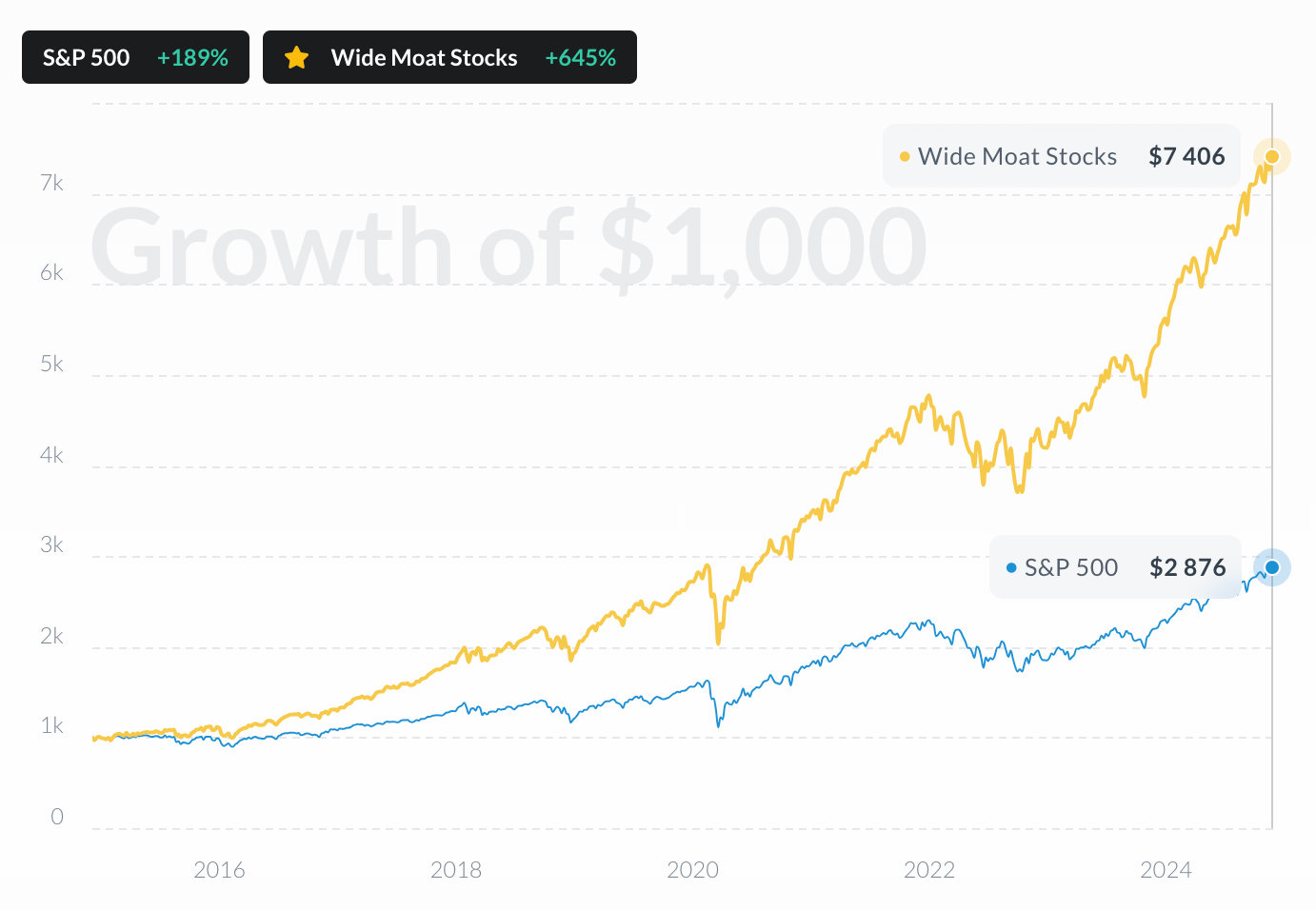
Our research into Economic Moat performance spans the past 10 years and focuses on companies with a wide economic moat. For this analysis, we calculated the average stock price returns of these companies, comparing them to the performance of the S&P 500 index over the same period.
The results were compelling: wide moat stocks achieved a remarkable +645% average return, compared to +188% for the broader market. This difference highlights the long-term benefits of investing in businesses that can maintain their market position and pricing power over time.
Note: This research does not account for survivorship bias. Past performance is not indicative of future results.
Economic Moat