
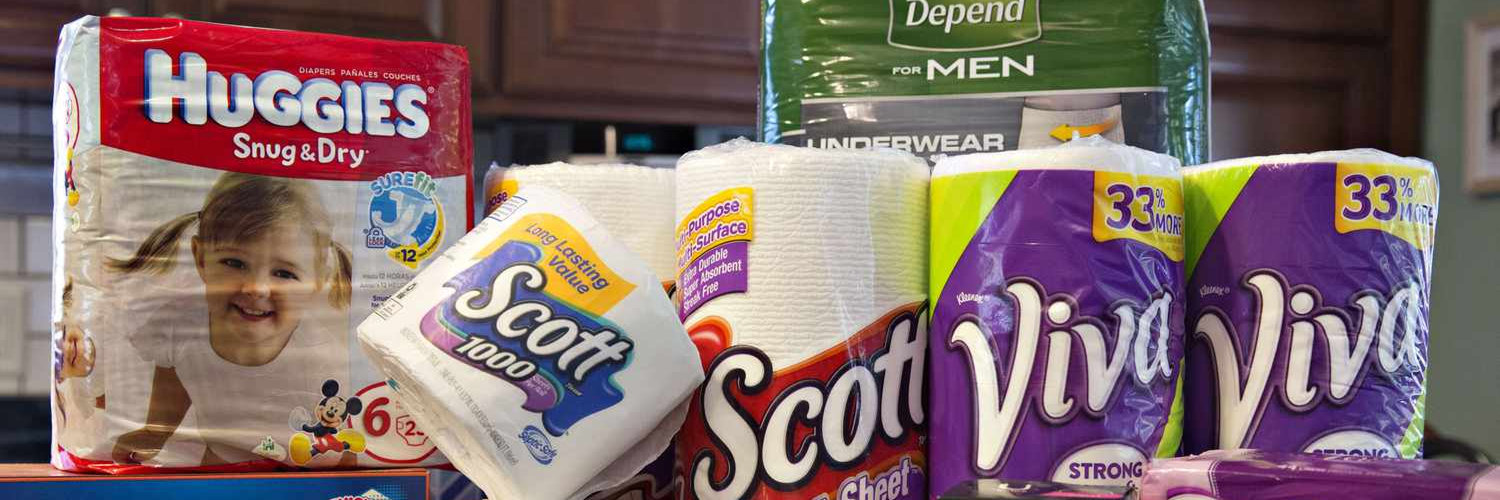

Kimberly-Clark Corp
NYSE:KMB



Decide at what price you'd be comfortable buying and we'll help you stay ready.

|
Johnson & Johnson
NYSE:JNJ
|
US |

|
Berkshire Hathaway Inc
NYSE:BRK.A
|
US |

|
Bank of America Corp
NYSE:BAC
|
US |

|
Mastercard Inc
NYSE:MA
|
US |

|
UnitedHealth Group Inc
NYSE:UNH
|
US |

|
Exxon Mobil Corp
NYSE:XOM
|
US |

|
Pfizer Inc
NYSE:PFE
|
US |

|
Nike Inc
NYSE:NKE
|
US |

|
Visa Inc
NYSE:V
|
US |

|
Alibaba Group Holding Ltd
NYSE:BABA
|
CN |

|
JPMorgan Chase & Co
NYSE:JPM
|
US |

|
Coca-Cola Co
NYSE:KO
|
US |

|
Verizon Communications Inc
NYSE:VZ
|
US |

|
Chevron Corp
NYSE:CVX
|
US |

|
Walt Disney Co
NYSE:DIS
|
US |

|
PayPal Holdings Inc
NASDAQ:PYPL
|
US |
Q4-2025 Earnings Call
AI Summary
Earnings Call on Jan 27, 2026
Volume Growth: Kimberly-Clark delivered its eighth consecutive quarter of solid volume plus mix growth, with notable strength in Q4 and continued share gains across major categories and geographies.
Guidance & Outlook: The company expects to grow at or above global weighted average category growth in 2026, with operating profit targeted at the high end of mid- to high single-digit growth.
Margin Expansion: Management is confident in expanding both gross and operating profit margins in 2026, aiming for at least 40% gross margin and 18–20% operating profit margin before 2030.
Productivity & Cost: Kimberly-Clark expects flat input costs in 2026 and another strong year of productivity savings, helping offset competitive pricing and distribution headwinds.
Kenview Acquisition: The pending Kenview acquisition is on track for a second-half close in 2026, with strong shareholder support and no regulatory surprises so far.
Competitive Environment: The company will face a partial loss of club channel diaper and training pants distribution in North America, representing a 60 bps sales headwind, but this is incorporated in guidance.
International Opportunity: International share gains and margin improvement are seen as major opportunities, especially through premiumization and productivity.
Management described ongoing pressure on consumers, especially in North America, but emphasized that demand for better-performing products at all price tiers persists. Kimberly-Clark is focused on delivering value and innovation across the Good, Better, Best ladder to capture share and drive volume growth, despite a tough and value-driven market.
The company experienced competitive pricing and promotional activity in North America, particularly in the second half of 2025. Kimberly-Clark responded by adjusting activation timing and making targeted investments in pack sizes and pricing, especially in value tiers. Although promotional activity increased, management stressed that such promotions are used mainly to drive trial around innovation, not to rent share, and that end-market promo levels remain below pre-pandemic norms.
Kimberly-Clark highlighted its strongest innovation pipeline in years as a key driver for future growth. Management is bullish on new product launches and is accelerating the pace of science-based innovation and marketing activation. This focus on innovation is expected to support volume plus mix growth and category leadership in 2026 and beyond.
The company expects flat input costs in 2026 after two years of $200 million in cost headwinds. Productivity improvements are expected to reach about 6% of cost of goods sold, helping drive margin expansion. Management reaffirmed its long-term targets of at least 40% gross margin and 18–20% operating profit margin before 2030, with progress expected to be uneven but on track overall.
The Kenview acquisition process is progressing as planned, with a shareholder vote showing over 90% approval and regulatory filings on schedule. The deal is expected to close in the second half of 2026. Management believes the combination offers significant long-term value creation, particularly in the health and wellness space.
A major club retailer in North America has ended branded exclusivity, leading to expected partial loss of diaper and pull-up distribution for Kimberly-Clark starting in Q1 2026. This is expected to be a 60 basis point sales headwind for the year, and management has factored this into its guidance. Channel mix shifts, such as growth in clubs with larger pack sizes at lower unit prices, are also affecting reported pricing.
International markets delivered strong share gains in diapers and fem care, with standout performances in China, South Korea, Brazil, and Indonesia. Management sees substantial margin expansion opportunity abroad, driven by premiumization, productivity, and leveraging global scale. International operations are expected to deliver both volume/mix growth ahead of category and further profit improvement in 2026.

Greetings. Welcome to the Kimberly-Clark 4Q 2025 Earnings Call. [Operator Instructions] Please note, this conference is being recorded.
I will now turn the conference over to your host, Chris Jakubik, Vice President of Investor Relations. Chris, you may begin.
Thanks so much, and good morning, everyone. This is Chris Jakubik, Head of Investor Relations at Kimberly-Clark, and thank you for joining us.
I would like to remind everyone that during our comments today, we will make some forward-looking statements that are based on how we see things today. Actual results may differ due to risks and uncertainties, and these are discussed in our earnings release and our filings with the SEC.
We will also discuss some non-GAAP financial measures during these remarks, and these non-GAAP financial measures should not be considered a replacement for and should be read together with GAAP results. And you can find the GAAP to non-GAAP reconciliations within our earnings release and the supplemental materials posted at investor.kimberly-clark.com.
Finally, I will apologize in advance if there are issues with the quality or delays in our audio today because we are all working remotely due to the winter storms.
So with that, I'll turn it over to Mike for a few opening comments.
All right. Thank you, Chris. Two years ago, we launched Powering Care to unlock Kimberly-Clark's next chapter of growth, building on our 150-year legacy. Now since then, we've made tremendous progress and accelerated our momentum across the board. Our execution of Powering Care is driving strong results even amidst a dynamic external environment.
In 2025, we continued to advance our volume-plus-mix growth model, delivering an eighth consecutive quarter of solid volume-plus-mix performance in Q4. We gained enterprise weighted share, and we marked a second straight year of industry-leading productivity with our fourth quarter being the strongest of the year. The energy across our company is palpable. We are introducing consumer-directed, science-based innovation and breakthrough marketing across brands and markets faster than ever before.
We're exercising cost discipline and deploying our greatest capabilities across the enterprise to optimize our margin structure. And we've rewired our organization for growth, including strengthening our bench of exceptional leaders and pivoting our portfolio to higher growth, higher margin personal care categories.
We've hit the ground running in 2026 and are energized by the opportunity ahead. We've built a robust, achievable plan focused on further differentiating our trusted brands and ensuring we have healthy levels of investment across our value chain. We expect pressure on the consumer and a focus on value to persist. We're confident in our strategy and committed to giving our brands the fuel to thrive.
Powering Care has put Kimberly-Clark on a virtuous cycle of growth and positioned this great American company for a better future. We have the right foundation and a proven playbook to capitalize on our pending acquisition of Kenvue. Acquiring Kenvue is a powerful next step in our transformation that will compound our momentum. It will advance our trajectory toward higher growth, higher margin spaces and create a global health and wellness leader positioned to serve consumers at every stage of life.
We're excited to seize the vast opportunity ahead and confident we will create significant value for our consumers, our partners and our shareholders.
So with that, let's open the line for questions.
[Operator Instructions] And the first question today is coming from Bonnie Herzog from Goldman Sachs.
So I guess I was hoping to hear some color on the state of the consumer and what you're doing different in this environment. Mike, I ask because you're growing volumes, whereas this really has been challenging for others. And then how are you thinking about this going forward? You guided organic sales growth to be in line to ahead of the category in '26. So hoping you could share what your expectations are for category growth this year and whether it will accelerate from the 2% growth currently. I guess, essentially, do you need end market growth to improve to hit your mid-single to high single-digit EBIT growth guidance?
Okay. Bonnie, great question. Thanks for that. I'll open, and I think Russ has a lot more texture that he's raring to inform you all of. And then I might even ask Nick -- Nelson to cover a little bit about how it affects the outlook. But one -- and I think you raised the point that we are growing, and it's a tough environment out there. However, I think the big thing is that maybe 2, 2.5 years ago, Bonnie, we did see that pressure in almost all markets was going to increase on the consumer and especially in North America, kind of given the state of the middle class consumer.
And so we started to focus on was delivering superior propositions that what we said is every rung of the good, better, best ladder, right? And so we've worked really hard to do that, and we continue to see ample opportunity to do that and do that better, and also continue to elevate and expand our categories globally.
A couple of additional comments. We feel consumers remain interested in better performing products, and that's at all price tiers. In this environment, as it's -- I think you're pointing out, Bonnie, strong value proposition is the paramount thing. And so we're growing because what we're doing is strengthening our offerings at every rung. And that means we're continuing to bring great innovation at the top end, and then we are rushing that innovation through into our value tiers. And I think our consumers are really noticing that. We've really worked hard to deliver superiority at a very, very competitive cost.
So we see further opportunity to expand our categories, expand penetration and premiumize over time. And so we've developed a robust pipeline of innovation that the world hasn't seen yet. I will tell you, parenthetically, I'm more excited about our next 3 years innovation than what we've done in our past 3. And so we're really excited about what the company has been working on.
So with that, maybe I'll kick it to Russ and maybe you can provide a little texture.
Yes. Thanks, Mike. Hi, Bonnie. Yes, you're right. I don't think we are expecting, as Mike noted, the consumer focus on value to change anytime soon. And as Mike noted, I really think our mantra has been to meet consumers where they need us. And that's with a combination of innovation, marketing and activation. And like other categories, we are seeing consumers' demand shift across channels. They're looking for different pack sizes.
Purchase frequency in some parts of the world, especially internationally and in developing markets, is being impacted a little bit, and that's clearly led to kind of more choppy month-to-month consumption data. So in terms of your question, I think Mike nailed it, I would just add a little bit more texture on it is that we're really focused on serving consumers on every rung with a compelling value proposition. I think that's the reason why we're growing volumes right now.
We have made a number of targeted price-pack adjustments as well as paying extra special attention to channel participation and ensuring we have really compelling offerings at the good tier as well as the better and the best tier. And we put an extraordinary effort into driving elevated benefits on the trade-up side to maintain that category growth.
And I think in North America, if you pick that as an example, that's really helped us on the volume side. In Q4, as you saw from our results, our volume/mix was up 1.7%. But on a 2-year stack basis in Q4, it was up 3.6%. And then on the full year basis, in North America, volume/mix was up in Q4, 2.1%. And on a 2-year stack basis, it was up 4.1%. And I agree with Mike, '26 should probably be one of our best years for innovation, and we're going to continue executing that strategy and are optimistic we'll continue to be able to deliver what consumers are looking for.
Yes. And then, Bonnie, just to follow up on your -- on the final part of your question. I think our '26 kind of implies, our category outlook is around 2% globally, plus or minus. And there's been -- if you looked at the last 4 quarters, there's been a little choppiness around that. But if you think -- if you look specifically at our categories, we tend to be more resilient and demand tends to be a little more stable because of the categories that we're in.
The next question will be from Lauren Lieberman from Barclays.
Just wanted to follow on, on some of those thoughts and particularly honing in on price and mix. In North America, we've seen pricing took another step back this quarter after being up in 3Q and mix persistently negative. I know you look at vol/mix, but price/mix is decelerating, not improving. So just wanted if you could comment on that and because you mentioned price investments a couple of places in the release.
Do you want me to take that one, Mike?
Yes. Go ahead, Russ.
I would say there's really 3 things going on there on the price/mix. The first thing that I would say is there was a promo dynamic, if you recall, in the third quarter call, we talked about the competitive activity in North America in the second half being some fairly significant promotional activity. And we, as a result of that, rephased some of our planned activation activity around innovation into the fourth quarter. So you're seeing that come through.
And specifically, just to remind you, as Mike said, we're in essential categories. We don't believe that promo drives incremental consumption, but we will use it as a tactic to drive trial, especially related to innovation that is really sensorial. We did have a strong agenda of innovation in 2025, and you probably saw some of that. For example, we did move some of that programming on Snug & Dry, which we have a great innovation. It's the softest diaper in the value tier. Our new Generation 2 core, which provides better protection and more comfort. It was named the #1 diaper with Good Housekeeping, disposable diaper, great consumer rating.
So we wanted to get that in the hands of consumers to drive trial. We had other innovations as well, and we did that in the fourth quarter, and those performed relatively well. I would say just last thing on the promo dynamic before I move on is our in-market promotional activity for the year remains below the category and 2019 levels. And again, we expect that to flow with our innovation.
The other 2 dynamics I'll hit briefly. One is club mix. That's just the consumer moving channels, and that has come through a little bit in our pricing because they're buying larger pack sizes at a lower price per unit. So you see more volume, but a little bit of a drag on the pricing piece there. And again, that's our philosophy of just serving consumers in the channel that they want to shop in.
And then the last thing is we did talk about several times making strategic investments in pack sizes and choices to better align our good, better, best pricing value ladders across the channels, especially ahead of some of the innovation we have coming. And we have made some choices to sharpen the competitiveness of our value proposition.
So over the long term, we're going to stay focused on maintaining PNOC discipline while growing volume and mix profitably. And that will be led by innovation and the focus on category development, and we have a great lineup in '26 to that end. So that's kind of the direction we're headed, and we're excited about it.
The next question will be from Nik Modi from RBC Capital Markets.
Just, Mike, a quick clarification. I didn't see anything in the release regarding any updates on closing timing or regulatory filing timing. So if you can provide any clarity on that, that would be helpful. But my main question is really just the state of the U.S. diaper category, especially the dynamics at play at Costco given Procter is now entering after decades of exclusivity for Huggies. So if you can provide any kind of thoughts on that, is that kind of embedded in your outlook, how are you going to respond, et cetera, et cetera.
Okay. Maybe I'll ask -- Russ, maybe you can talk about the U.S. diaper category, and then I'll come back, Nik, and answer your questions on the acquisition.
Yes, sure. Nik, yes, in terms of diapers, again, we're growing by driving innovation and brand building that grows the category and cascading that to all tiers. And that model has worked well for us around the world and the United States. Before I get to the U.S., I'll just hit a couple of highlights around the world in the fourth quarter. We grew share in many of our key markets, including China, up 210 basis points; Korea, up 30 basis points; Brazil, up 50 basis points; Indonesia, up 230 basis points.
So that strategy that we're executing is working in North America as well. In the fourth quarter, we grew share about 100 basis points, and we've grown share in diapers 2 years in a row. But with -- just with respect to the club situation, the way we look at it is, we're really focused on providing consumers with differentiated brand value propositions no matter what channel they're shopping in, and we're widely available, so is our competition.
However, we did see a major club player has moved away from branded exclusivity in our category. And so we'll see partial loss of diapers and Pull-Ups distribution in the North America club channel, and that will start in the first quarter here. And this is incorporated, to your question, in our full year expectation of growing, as Nelson mentioned, in line or to better than weighted average category growth.
So we're focused on continuing to execute the strategy, and there might be some ebbs and flows over time, but we're very confident in the long term we're going to continue to move in the right direction as our current performance indicates.
Go ahead, Nelson.
Just to clarify for what's built into the forecast, Nik, we -- as Russ mentioned, we expect this distribution loss to commence in Q1. It is reflected in our full year outlook, and it's a headwind of around 60 basis points for the full year.
Okay. And then, Nik, just regard to the Kenvue process, we -- the shareholder vote is on the 29th this Thursday. I will tell you -- I expect the vote to reflect the very positive feedback we've heard from our investors. And so through yesterday, a pretty good chunk of shareholders have already voted, and it's well in excess of 90% in favor. So we feel good about that.
And then with regard to timing of close, we still expect somewhere in the back half. I think the regulatory process is on track and consistent with our initial expectations. And maybe you didn't ask this part, but I will tell you, our IFP transaction remains on track for a midyear closing this year, still subject to regulatory approvals.
And then we worked closely with Kenvue to file -- shortly after announcing the transaction, submitted a U.S. antitrust filing and we'll complete filing all applicable international jurisdictions by early February. And so, again, I think we're on track to close in the second half of this year.
The next question will be from Steve Powers from Deutsche Bank.
Maybe just to round out the top line conversation a bit. Just maybe a little bit more precision around how you expect the overall 2% category growth to shake out North America versus Rest of World. And I guess in light of the 4Q dip that you noted and the overall choppiness we've seen, do you see that 2% backdrop existing pretty steadily in '26, I guess, inclusive of the first quarter? Or will it -- are you assuming that it takes more time to ramp? That would be helpful.
And if I could, I know I'm supposed to have one question, but I'm going to try to get two. Nelson, in the prepared remarks, you talked about visibility in achieving that 40% future adjusted gross margin before the end of the decade. I'm assuming that's -- that target existed before Kenvue. So it's independent of Kenvue contributions. I guess maybe just an update on how you're seeing the primary drivers shaking out there? And then just how much progress roundabout you think you might be able to make in '26?
Okay. Sure, Steve. Let me just open with maybe just an overall comment on the sales outlook. And then Nelson kind of will give you more -- a little more texture on the pacing and then we can hit the margin thing, Steve. But one, I just wanted to kind of emphasize that our volume momentum, and I think Bonnie noted that the volumes were, in our minds, performing well. The volume momentum really this year in -- or last year in '25 really reflects, I think, the compelling offering that we have.
And as I mentioned earlier, we're even more bullish on our innovation and marketing initiatives this year. And so I think our focus on strengthening the value propositions at every tier has been very, very important. We have a very strong pipeline coming this year. And so we expect a meaningful step-up as we get through the year to support our new launches. And so we feel very good about the plan for this year. But I'll let Nelson, you may want to comment a little bit more on the pacing.
Sure, Mike. So a few things, Steve, and I'll unpack a little bit Q4. But to start with, for 2026, as Mike mentioned in his prepared remarks, I mean, we have a very strong, and I'd say the strongest pipeline of innovation and activation programs that we've had in quite a few years across all of our markets. And we are -- our plan is to continue to build the momentum on volume-plus-mix-led growth that we saw play out in 2024 with an acceleration in 2025.
Now as you rightfully mentioned, for the fourth quarter of 2025 on the surface, weighted global average category growth dropped to around 0.6%. And that compares to about 2% that we were staring at right around between Q1 and Q3 of last year. And there were a few discrete factors that weighed on this drop, particularly in North America. And as you know, we had the impact in '24 of Hurricane Helene, the port strikes, panic-related buying and, to a lesser extent, in 2025, there was a little bit of pantry loading in North America diapers in Q3 of '25. So that all kind of played out into the weighted average growth of 0.6% for the category in the last quarter.
For the full year, as I mentioned, category grew weighted right around 2%, and our categories have remained resilient. As we think about the last 4 weeks data that we've got, we're hovering around that 2%. So we think that a good starting point for weighted average category growth for the start of the year is around that level. We are maintaining our disciplined approach to growing the categories and the brands through the innovation, the differentiation, and we expect both North America and our international personal care business to grow in line or ahead of the categories for the full year.
In terms of net sales, we expect both the first half and the second half to be roughly 50-50, so pretty even. But when you look at the growth in terms of quarterly pacing, we are planning for the innovation and the brand support to ramp up as we progress through the first quarter and then into Q2 and the balance of the year. So I would expect, as we built our outlook, to see organic growth to accelerate in the back half versus the first half of the year.
As it relates to the visibility of achieving the 40% before the end of the decade and the drivers and the progress, a couple of things. I mean as we've stated, margin progression is not going to be linear quarterly or year-on-year. However, we've made very strong progress over the last 2 years. We took a little bit of a step back on gross margin in 2025, and that partly was impacted by, one, the inflationary elements that we were dealing with. As a reminder, we had around $200 million of input costs that we dealt with last year, and that included the headwinds, which were unexpected related to tariffs.
As we go into this year, though, we're not expecting that. I mean we're expecting cost actually to be largely flat. So that's one. Secondly, we are expecting to deliver very strong productivity in the year, another year that will hover around 6%, building on what we achieved in 2024 and 2025.
So all in, we expect to expand margins, both gross and operating profit margins, in the year in 2026, putting us well on pace to achieve our objectives of at least 40% before the end of the decade for gross margin and at least 18% to 20% in operating profit before 2030. So well on pace to deliver that. And, again, that excludes any favorability or impact as we carry out the integration of Kenvue, Steve.
The next question will be from Chris Carey from Wells Fargo Securities.
You gave some information just about the model from 2026 kind of through 2028 with phasing and, obviously, implied in there is some medium-term growth expectations as well. You also established some of these expectations in the S-4. And can you just help reconcile or clarify whether there's been any evolution in the expectations as of the S-4 relative to where we are today?
And maybe just because so much of this medium-term CAGR is anchored to an acceleration in 2028, just help us understand the visibility that you have and the confidence that you have that you can achieve those outcomes in a few years from now.
Sure. So from a modeling standpoint, let me walk you through what we had in the S-4 and what we have for 2026 and, to your point, our visibility and confidence in getting to our ambitions before the end of the decade. So firstly, I mean, a couple of things. We've built into the outlook for this year the momentum that we've got based on the innovation and all the activation plans that we've been building on through 2025 and what we have in place as we commence this year.
There are 2 factors that are coming into the picture as we speak for the outlook for the year, and they've come up in the past couple of months. The first one is we've had a bit of softer-than-anticipated fourth quarter in the demand in North America and enterprise markets, and this resulted in a lower base of volumes and EBITDA for 2025, and that's reflected in the outlook.
The second bit is really around the partial loss of the diapers and training pants distribution in the North America club channel that we just talked about, both Russ and myself, which we are not able to fully offset in 2026. And as I mentioned, that will be a headwind of around 60 basis points of growth on the year that is reflected in our outlook. And that, of course, will be a difference that you would see versus what we would have had in the S-4.
That said, our ongoing business is well positioned to deliver results consistent with the long-term algorithm that we laid out in March of 2024. And these 2 factors are reflected in the outlook. On the top line, we -- based on all the innovation plans that we have, the commercial plans, we expect to deliver growth that's at or above global weighted average category growth globally.
We are aiming for operating profit growth that's at the higher end of our mid- to high single-digit range. And as we support a significant step-up in new product activations across key markets, in another year of gross productivity that will approach 6% of cost of goods sold, and we will maintain our discipline on SG&A savings that you've seen flow through in the last couple of years through our Powering Care transformation.
If you look at adjusted EPS, we expect to be in line with 2025 levels on a constant currency basis, Chris. And this will reflect 2 things. One, the underlying growth which will be consistent with our long-term algorithm, but there will be an offset, and that's because of the reduction in income from discontinued operations, which we expect to be roughly half of what we saw in 2025 levels with a midyear projected close of the IFP transaction.
Got it.
And then, Chris, I think you may not have asked this specifically, but I would say from the Kenvue perspective, I'll tell you -- and we've been getting knee deep into the integration management process. I would tell you, we haven't seen anything that would change our view on the potential of this combination. Kenvue, they're going to be set to report the results on their usual timing, I think, which is early to mid-February.
And then if you looked at the S-4 pretty hard, we did take a fairly or a somewhat more conservative view of their outlook, near and midterm financial profile. We plan to make pretty good investments into their brands and their portfolio and capabilities. And so we still see a generational value creation opportunity by putting these 2 companies together. Our focus is on making sure that both companies have great earnings capacity over the long term.
Yes. Keep going.
Yes. You had the question on the visibility, and I'll reiterate that we have strong visibility into our plans on the productivity front to achieve the margin expansion and fund the brand investments that we have for the following years as well as on the top line, our ability to grow at or ahead of the categories, largely driven by the very strong innovation pipeline that we've got for the next few years as well as our executional plans across the globe.
The next question will be from Mike Lavery from Piper Sandler.
I just want to follow up a little bit, I guess, on Steve's bonus question on the margins. Just would love to understand, you called out the significant reinvestment that you're expecting post deal. Just maybe how -- you said, of course, that it's not linear, but maybe how bumpy does it get? And we know some of the synergy pacing and how that plays out. But kind of just maybe how much more can you unpack the path to 40% gross margins and 18% EBIT?
Yes. Michael, thanks for the question. Just a comment, I would say, and I'm presuming you're talking about kind of our stand-alone on that, our path to 40%. I think we're -- overall, we feel like we're making strong progress. We have good -- very good visibility into our path to the 40%, and 18% to 20% OP ROS aspiration by 2030. In fact, I think we're probably pacing slightly ahead of what we originally planned.
Just to confirm or reiterate, Michael, these margin targets are milestones, not a destination. And so we expect to kind of exceed that when we can. And then you'll note that the IFP transaction does create a onetime impact and a better business for both businesses longer term. And we'll update you on that as we get closer to close.
But again, I think we feel very good about our productivity delivery. We feel very good about the innovation that we have in the pipeline that's enabling us to drive positive mix and premiumize at the top end of the category and then grow volume by cascading those features down through the tiers.
So I'll pause there. I don't know if there's anything else you want to click on there.
No, that's really helpful, yes.
The next question will be from Robert Moskow from TD Cowen.
Nelson, the argument for gross margin expanding this year, I think, reflects, hey, you had $200 million of input costs last year you didn't expect, and then it's not going to happen this year. But if I look back to '25, I mean one of the [indiscernible] was that pricing turned negative, the environment got a lot more competitive. What's to stop that from happening again in 2026?
It seems like the environment continues to be really competitive. You're losing some distribution in Costco. You might have to take steps to defend your turf at other retailers. I mentioned the name of the club. I'm just speculating, of course. But -- so how much cushion do you have in the model in case it does get into that kind of environment again?
Yes. So a few things there, Rob. First, yes, as you rightfully say, as you unpack why we expect margins to expand. One, costs are projected to be neutral year-on-year versus 2 years in which we faced about $200 million of costs. Secondly, productivity -- gross productivity is expected to be right around the 6% level, which will be at the high end of our 5% to 6% and, again, another record productivity level for us in the year.
And then on the pricing bit, I think it's very important to go back to what we chatted early last year and what Russ mentioned. We made some strategic price pack architecture and channel price investments, particularly in North America in -- towards the end of Q4 of 2024. So as you head into 2026, we're going to be lapping largely that. So that is going to be something that, again, based on what we've modeled and what we put together, that is one aspect that will be different as we go into the year.
So that changes year-on-year and it's reflected there. The channel mix and all that bit, that will continue to play out to some extent, but that's factored into the model, Rob. So hence why we do see a little bit of a difference between '25 and '26 from that end and why we're, at this stage, confident in our ability to expand margins in 2026 back to where we had modeled before.
And maybe I'll tack on, Rob. I think part of it is also philosophically, we're really not interested in renting share through promotion. And especially, I think Russ mentioned it earlier in the call, which is, it doesn't make sense in a category where consumption is relatively stable or almost fixed in a category like bath tissue or diapers. And so what we're really focused on, and I think we had this in our prepared remarks, is kind of having an operating model and a culture that's driving this notion of the elusive virtuous cycle, which we think is delivering great results.
And that includes innovating at all rungs of good, better, best, especially at the top end and pulling it through the value tiers. And then, as you're kind of asking about, making sure that we can invest for impact. And I think we've done a very good job of increasing our investment over the last several years, but also improving our -- maybe the effectiveness of our advertising and our marketing. And for us, we feel like that's a much more powerful lever to pull than trade promotion.
And so that's kind of where we've been investing and we're really seeing great results. And I think that's leading to -- that's been a driver of our last couple of years of strong volume-plus-mix growth. And we feel very well positioned for more volume and mix growth in 2026. At the same time, to get this virtuous cycle, we have to have leading productivity, which we're delivering. And so we're really proud of. And so I think that's our focus, and that's how we're going to run the play in '26.
Yes. I get it. I guess my question is, Nelson, you said that price realization was lower in '25 because of decisions you made in fourth quarter of '24. But from our modeling, the pricing was weaker than expected during the course of '25 compared to the original guidance. Am I wrong? Or was a down year for pricing always part of the plan? It seems like it was weaker than you thought. That's all I was asking.
We always factored into the plan, one, the pricing actions that we were going to take at the end of the quarter in 2024. And there's always going to be a little bit of shift in programming, Rob, that plays into the year, and that comes up in actuals. But that was largely it. I mean there will be a bit of move across channels, as Russ referred to. But overall, based on what we're planning, we wouldn't see what we saw in '25 at this stage.
And then, Rob, keep in mind, I think Russ had mentioned earlier that -- and we talked about on last quarter's call where because of competitive activity, we held back on some of our Q3 programming, and we shifted it into Q4. So that would explain some of what you're looking at on a sequential basis.
If we could take one more question, that would be great.
And the final question today is coming from Edward Lewis from Rothschild & Co.
Yes. I guess a quick one, just looking at the international business. So good share gains you note again and, obviously, a good end to the year there. And as I look at the results through 9 months on the international gross margins, there's around about a 7 percentage point gap between that and North America. So am I right in thinking that the international gross margin is a big opportunity? And what do you see as the growth drivers there?
Ed, good to hear from you. Yes, international margins are an opportunity. That's something we're focused on improving. I'll let Russ talk a little bit more about it. We feel very good about the progress we're making in international, especially our focus markets.
Yes. Yes. I would say a few things. First, I do think that a key part to the equation for us growing is to meet consumer demand at every tier, and we've talked a lot about the good and the better, but the best is a big opportunity for us. And we've seen that where we've expanded margins in international geographies is developing that premium segment. And we believe that there's very, very significant upside in that, especially in geographies where the consumer is still developing and GDP growth continues to allow people to have more money to spend.
And so that's one. I think the second thing is we've had no less of a focus on productivity internationally, and we've come up with some really great ways through the wiring that we've executed to be able to leverage our global scale that we've got in markets like North America and China in other geographies to help drive costs down. And so that's another big component.
And I would just note that we've been growing significantly, and we've seen that sequentially unfold for us in the markets outside of North America and China. Brazil diapers, organic growth, mid-single digit; South Korea diapers, positive organic growth; Indonesia, positive organic growth; gaining share in Australia so -- in femcare and adult care.
So that's another element to it. It's just the leverage that we'll get as we continue to scale the business. And looking forward to Kenvue, we think that's another really big opportunity potentially for us. So that's kind of what I would say.
And then, Ed, I would -- I'm excited about our share momentum. I mean we did see significant growth across IPC markets in 2025. Just to give you a few examples. I mean, overall, our focus markets, our top 6 markets, in IPC, we're up about weighted share 50 basis points. China was up 270 basis points on diapers. And then outside China, femcare in Indonesia was up almost 200 basis points; Korea was up 60; Australia, up 50; Brazil, up 40. And so I think we're making very good progress across the board.
And then if you think about international in '26, we expect to drive positive volume and mix-led growth ahead of the category. We are targeting weighted share growth again led by our strong innovation and premiumization and then expect operating profit dollar and margin gains reflecting the strong productivity and overhead management that we're doing. So thanks for the question, Ed.
And that does conclude our Q&A session for today. I will now hand the call back to Chris Jakubik for closing remarks.
Great. Well, thanks, everybody, for joining us today. For analysts who have follow-up questions, the Investor Relations team will be around all day to take them. So have a great day. And, again, I appreciate the interest.
Thank you. This does conclude today's conference. You may disconnect your lines at this time. Thank you for your participation.