
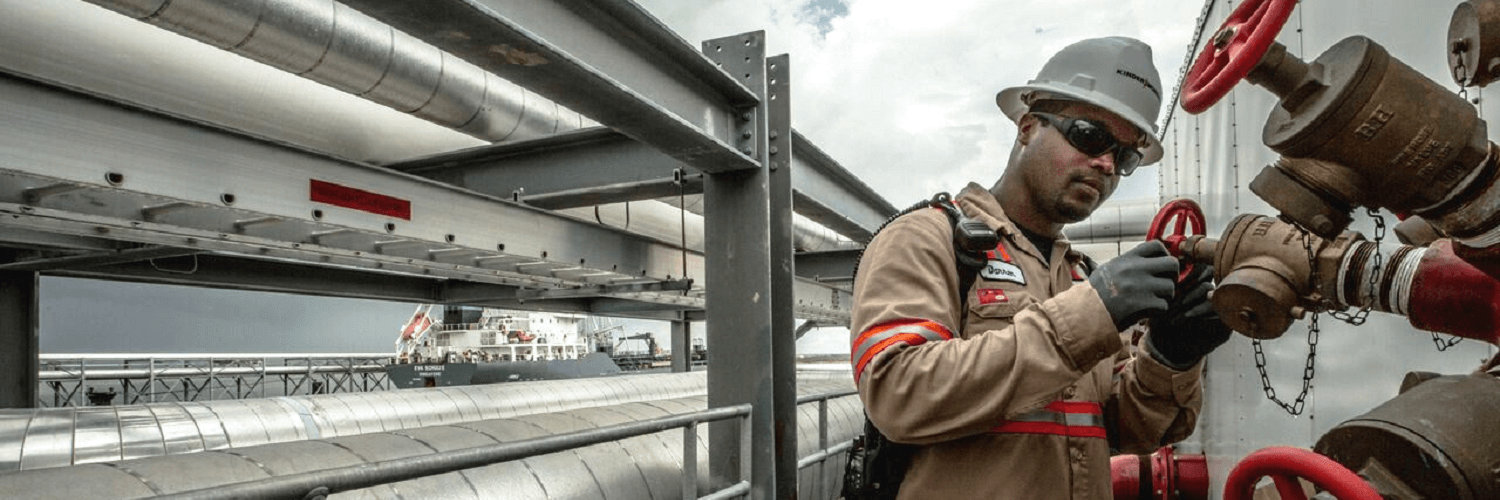

Kinder Morgan Inc
NYSE:KMI



Decide at what price you'd be comfortable buying and we'll help you stay ready.

|
Johnson & Johnson
NYSE:JNJ
|
US |

|
Berkshire Hathaway Inc
NYSE:BRK.A
|
US |

|
Bank of America Corp
NYSE:BAC
|
US |

|
Mastercard Inc
NYSE:MA
|
US |

|
UnitedHealth Group Inc
NYSE:UNH
|
US |

|
Exxon Mobil Corp
NYSE:XOM
|
US |

|
Pfizer Inc
NYSE:PFE
|
US |

|
Nike Inc
NYSE:NKE
|
US |

|
Visa Inc
NYSE:V
|
US |

|
Alibaba Group Holding Ltd
NYSE:BABA
|
CN |

|
JPMorgan Chase & Co
NYSE:JPM
|
US |

|
Coca-Cola Co
NYSE:KO
|
US |

|
Verizon Communications Inc
NYSE:VZ
|
US |

|
Chevron Corp
NYSE:CVX
|
US |

|
Walt Disney Co
NYSE:DIS
|
US |

|
PayPal Holdings Inc
NASDAQ:PYPL
|
US |
Q3-2025 Earnings Call
AI Summary
Earnings Call on Oct 22, 2025
Strong Quarterly Growth: Kinder Morgan reported EBITDA up 6% and adjusted EPS up 16% year-over-year, driven by natural gas expansion projects and the Outrigger acquisition.
Guidance Exceeded: Management expects to surpass its full-year 2025 budget, though outperformance is moderated by weak RINs prices and lower RNG volumes.
Robust Growth Pipeline: The company maintains a $9.3 billion project backlog and is pursuing over $10 billion in additional natural gas-focused opportunities, highlighting significant demand from LNG exports and power generation.
Financial Strength: Balance sheet improved with net debt to adjusted EBITDA at 3.9x, and Fitch upgraded Kinder Morgan’s credit rating to BBB+.
Dividend Growth: Quarterly dividend increased 2% from 2024 levels, now at $0.295 per share.
Market Position: Kinder Morgan transports over 40% of US natural gas and is well positioned to benefit from rising LNG and power sector demand.
Management emphasized the dual drivers of future natural gas demand: surging LNG export facility growth and increasing electricity needs from AI data centers. There is consensus that US LNG feed gas demand could double by 2030, supported by multiple projects already sanctioned this year. Natural gas is positioned as the most viable source to meet these needs given limitations with renewables and nuclear.
Kinder Morgan’s project backlog remains steady at $9.3 billion, split roughly evenly between natural gas and refined products tankage. The company is actively working to convert a $10+ billion pipeline of additional natural gas opportunities—mostly in the Southern US and tied to export, power, and industrial demand—into future backlog. Many projects are supported by take-or-pay contracts for stable cash flows.
Natural gas transport and gathering volumes posted robust growth, up 6% and 9% year-over-year, respectively, with the Haynesville and Eagle Ford systems leading. Gathering volumes are expected to average 5% above 2024 levels for the year. The refined products segment was flat to slightly down, while terminals showed strong leasing and utilization, and CO2 segment saw small declines in oil and CO2 volumes.
The balance sheet further strengthened, with net debt to adjusted EBITDA dropping to 3.9x. Year-to-date, net debt rose primarily due to the Outrigger acquisition and capital spending, but strong operational cash flow and prudent capital allocation underpinned a Fitch credit upgrade. Management highlighted ample financial capacity to fund additional projects and maintain a stable dividend.
Management discussed the competitive environment for new projects, noting that Kinder Morgan’s existing footprint and track record make it well-positioned to win its share. Most new opportunities are smaller in size but some are $1 billion-plus, spanning from Arizona to Florida, and often serve power and LNG export demand. The company expects to sanction significant projects in 2026.
Recent regulatory improvements, such as streamlined FERC project approval processes, were credited with shortening capital deployment cycles, making project execution more efficient and timely.
While RNG volumes are recovering, weak RINs prices are a headwind. Management does not intend to invest significantly behind the meter for data centers, preferring to support such projects through infrastructure and gas supply. The CO2 segment faces ongoing volume declines and requires high risk-adjusted returns for new investments.
Management expects to beat its original 2025 budget, with adjusted EBITDA and EPS growth outpacing initial forecasts. Looking to 2026, tailwinds include project ramp-ups, contract escalators, and lower interest rates, though commodity prices and CO2 segment volumes remain uncertainties.

Good afternoon, and thank you for standing by. Welcome to the Third Quarter 2025 Earnings Results Conference Call. [Operator Instructions] Today's conference is being recorded. If you have any objections, you may disconnect at this time. It is now my pleasure to turn the call over to Mr. Rich Kinder, Executive Chairman of Kinder Morgan.
Thank you, Michelle. As usual, before we begin, I'd like to remind you that KMI's earnings release today and this call include forward-looking statements within the meaning of the Private Securities Litigation Reform Act of 1995 and the Securities Exchange Act of 1934 as well as certain non-GAAP financial measures. Before making any investment decision, we strongly encourage you to read our full disclosures on forward-looking statements and use of non-GAAP financial measures set forth at the end of our earnings release as well as review our latest filings with the SEC for important material assumptions, expectations and risk factors that may cause actual results to differ materially from those anticipated and described in such forward-looking statements.
I think we all recognize the positives and negatives of publicly traded companies. One of the biggest pitfalls is the undue concentration on quarter-to-quarter or even day-to-day issues, many of which are relatively inconsequential in terms of long-term success of the enterprise. With that in mind, I thought I'd take this opportunity to stress 2 important substantive factors that will impact the future of Kinder Morgan, the natural gas story and the long-term strategy of our company. Obviously, the 2 are intimately related.
On the natural gas demand front, there are 2 huge drivers. The first is the continued rapid growth in LNG feedgas demand driven by the enormous expansion of export facilities, primarily along the Gulf Coast. While industry experts differ somewhat, there's a pretty broad consensus that demand will at least double between 2024 and 2030. In fact, S&P's Commodity Insights recently estimated that increase at 130%, which implies a demand of 31 to 32 Bcf a day in 2030. As an example of this growing demand, 6 LNG projects have reached FID so far in 2025. Feedgas demand for those facilities alone when completed will be 9 Bcf a day.
Now there's more variance in assessing the impact of the second driver, which is the increasing demand for electricity, primarily to serve AI data centers. There will clearly be huge additional demand for electricity, but how much of that will be captured by natural gas? Let's look at the alternatives. Certainly, renewables will play a major role but can't handle the entire load given AI needs for uninterrupted power 24/7, not just when the sun is shining and the wind is blowing. But can't this be fixed by pairing wind or solar farms with massive batteries to store power and release it in a steady stream when needed? Well, that sounds intriguing, but there are serious drawbacks to this option because batteries are expensive and limited in the time they can cover, and renewables of the size to serve AI centers require enormous space.
A recent article in the New York Times, of all places, estimated that to continuously produce just 1 gigawatt, a solar farm would need 12.5 million solar panels, enough to cover 5,000 football fields, and wind turbines would require even more space. Another source of power is nuclear, which generates steady power from a relatively small footprint, but this is an industry that unfortunately has been basically dormant for over 40 years and new nuclear facilities are very expensive and would likely take 7 to 10 years to come online.
This means that AI sponsor would not have the facilities when needed and would be gambling billions of dollars, that the demand will still be there a decade or so from now. That leaves natural gas, which is abundant and reasonably priced, and the infrastructure to produce power from natural gas is relatively quick to build. [ Reasonably ], like I've just outlined, is why we believe that AI data center needs will supplement in a very meaningful way the tremendous increases in LNG feedgas demand. And in combination, the 2 drivers will ensure a huge and growing market for natural gas in the years and decades to come.
Now let me conclude by again emphasizing the long-term strategy at Kinder Morgan. We are a prolific generator of cash and are fortunate to have the majority of our assets employed in a true growth segment of the energy business, namely the transportation of natural gas. These 2 characteristics dovetail nicely. The tremendous growth in natural gas demand drives the opportunity for expanding and extending our pipeline and terminal networks and adding new facilities as evidenced by the $9 billion plus of projects already approved by our Board, and we generate the cash internally to fund those projects while maintaining a healthy and modestly growing dividend.
Now to be clear, we have to complete these projects on time and on budget, but our track record in that regard is good, and we're benefiting from a federal regulatory process that is more supportive of projects like ours. While our base business is relatively flat, these capital projects will drive substantial growth in EBITDA and EPS for years to come. This is a simple, but in my mind, very compelling strategy.
And with that, I'll turn it over to Kim.
Okay. Thanks, Rich. We're pleased to report another strong quarter with EBITDA up 6% and adjusted EPS growing 16% year-on-year. These results reflect the strength of our underlying business and the continued execution on our growth projects. We currently expect to exceed our full year budget due to the contributions from the Outrigger acquisition. This outperformance would be greater if not for lower than budgeted D3 RIN prices and RNG volumes. Currently, the RNG volumes are much closer to budget, but RIN prices remain weak. The natural gas segment, which accounts for 2/3 of our business, is outperforming its budget, even excluding Outrigger.
Our expansion backlog remained flat at $9.3 billion with the approximately $500 million of new projects offset by projects placed in service. The backlog multiple continues to be below 6x, consistent with our disciplined approach to capital deployment. The mix of new projects added to the backlog this quarter is split roughly 50% natural gas, primarily supporting power generation, and 50% to refined product tankage. Looking ahead, our opportunity set remains exceptionally compelling. We're actively pursuing over $10 billion in potential projects, primarily in natural gas, underscoring the continued demand for our services and the strength of our platform.
As I mentioned last quarter, the scale of opportunities we're evaluating today is comparable to when our backlog stood at just $3 billion, highlighting the consistency and the resiliency of our growth pipeline. Our gas infrastructure, more than 66,000 miles of pipeline connecting all major basins and demand centers, positions us as a critical player in energy infrastructure. Today, we transport over 40% of the natural gas in the United States, including more than 40% of the volume headed to LNG export facilities. 25% of the gas fueling U.S. natural gas power plants and 50% of the gas exported to Mexico.
Looking forward, our internal projections estimate 28 Bcf a day increase in natural gas demand by 2030, driven primarily by growth in LNG exports as well as power and exports to Mexico. Wood Mackenzie forecast a similar trend, projecting 22 Bcf a day of growth in overall natural gas demand. With our strategically located assets, we are well positioned to capture a meaningful share of this expansion. Our current $9.3 billion backlog is a strong foundation for long-term high-quality growth. A very significant portion of this backlog is supported by take-or-pay contracts, providing both stability and visibility into future cash flows.
And as we continue to advance our development pipeline, we expect to convert a portion of the $10 billion opportunity set into additional backlog, further reinforcing our growth trajectory. We remain confident in our strategy, our execution and our ability to deliver long-term value for our shareholders.
And with that, I'll turn it over to Tom Martin to walk through the business performance in more detail.
Thanks, Kim. Starting with the Natural Gas business unit. Transport volumes were up 6% in the quarter versus the third quarter of 2024, primarily due to LNG deliveries on Tennessee Gas Pipeline, new contracts from expansion projects placed into service on the Texas Intrastate system, and increased Permian deliveries to Waha and Mexico on our El Paso Natural Gas system. Natural gas gathering volumes were up 9% in the quarter from the third quarter of 2024, with growth across all our G&P assets, the largest impacts from our Haynesville and Eagle Ford systems. Sequentially, total gas gathering volumes are up 11%.
We experienced a significant ramp from our producer customers during the quarter to meet the growing LNG demand. The gathering volume growth trend continues in the early days of the fourth quarter, most notably on our Haynesville system as it is approaching new daily volume records in October. For the full year, we now expect the gathering volumes to average 5% above 2024. And looking forward, we continue to see significant incremental project opportunities across our natural gas pipeline network to expand our transportation and storage capabilities in support of the growing natural gas market. For example, we are exploring more than 10 Bcf a day of natural gas opportunities to serve the power generation sector.
In our Products Pipelines segment, refined product volumes were down 1% in the quarter compared to the third quarter of 2024. For the full year 2025, refined products volumes are forecasted to be about 1% higher than 2024 and in line with our budget. Crude and condensate volumes were down 3% in the quarter compared to the third quarter of 2024. More than all of that decline is driven by taking Double H out of service earlier this quarter for the NGL conversion project.
On Monday, Kinder Morgan and Phillips 66 launched a binding open season for transportation service on the Western Gateway Pipeline, a newly proposed refined products pipeline system that will facilitate the movement of products from origin points in Texas to key downstream markets in Arizona and California with connectivity to Las Vegas, Nevada. This open season is scheduled to run through December 19. Following the successful open season, the Western Gateway Pipeline and KMI's SFPP East Line will be jointly owned by KMI and Phillips 66. We believe this project provides an attractive refined products alternative for markets in Arizona and California, given the decline in California refining market.
In our Terminals business segment, our liquids leased capacity remains high at 95%. Market conditions continue to remain supportive of strong rates and high utilization at our key hubs in the Houston Ship Channel and New York Harbor. Our Jones Act tanker fleet is fully leased today through the remainder of 2025. Assuming likely options are exercised, the fleet is 100% leased through 2026 and 97% leased through 2027. We have opportunistically chartered a significant percentage of the fleet at higher market rates and extended the average length of firm contract commitments to nearly 4 years.
The CO2 segment experienced 4% lower oil production volumes, 4% higher NGL volumes and 14% lower CO2 volumes in the quarter versus the third quarter of 2024, with the full year 2025 oil volumes are forecasted to be 4% below 2024 and 1% below our budget.
With that, I'll turn it over to David Michels.
Thank you, Tom. In the quarter, we're declaring a quarterly dividend of $0.2925 per share or $1.17 per share annualized, which represents a 2% increase over our 2024 dividend. For the third quarter, we generated net income attributable to KMI of $628 million and EPS of $0.28 per share, both in line with the third quarter of 2024. Last year's results included favorable mark-to-market impacts on hedges and a onetime noncash tax benefit, both of which we treat as certain items. Excluding those items, adjusted net income and adjusted EPS grew 16% year-over-year, delivering strong double-digit growth.
This growth was driven by greater contributions from our natural gas expansion projects placed in service, the Outrigger acquisition and strong demand across our natural gas footprint for natural gas capacity and related services.
Moving on to the balance sheet. As we've continued to take a disciplined approach to capital allocation, our balance sheet has strengthened. Our net debt to adjusted EBITDA ratio has improved to 3.9x at the end of the third quarter, down from 4.1x at the end of the first quarter, which was immediately following the Outrigger acquisition. Year-to-date, our net debt has increased by $544 million, and here's a high-level reconciliation. We've generated cash flow from operations of $4.225 billion. We've paid out dividends of $1.95 billion. We paid -- or spent $2.245 billion of total capital.
The Outrigger acquisition was $650 million, and all other items were a source of cash of approximately $75 million, which gets you close to that $544 million increase for the year. The rating agencies have recognized our strengthened financial profile. And in August, Fitch upgraded our senior unsecured rating to BBB+. We were already on positive outlook by both S&P and Moody's, and we look for a favorable resolution of those in the near term. As Kim mentioned, we expect to exceed our 2025 budget. As a reminder, we budgeted to grow adjusted EBITDA by 4% and adjusted EPS by 10% from 2024. So with the outperformance, we expect to deliver even larger year-over-year growth.
As we mentioned last quarter, the budget reconciliation bill delivers meaningful tax benefits for us, primarily from full expensing of investments. In addition, recent adjustments to the corporate alternative minimum tax are expected to provide additional substantial tax savings beginning in 2026. So we are poised for a very strong full year 2025. We're on track to beat our budgeted -- excuse me, our budget and deliver double-digit earnings growth. We've sanctioned additional high project -- high-return projects that will support future growth. We've improved our balance sheet, resulting in enhanced credit ratings, and we expect meaningful cash flow benefits from tax reform, which will generate additional investment capacity.
And with that, I'll turn it back to Kim for Q&A.
Okay. Michelle, if you'll come back on and we'll take questions.
[Operator Instructions]
Our first caller is Theresa Chen with Barclays.
I wanted to go back to your growth outlook and specifically the over $10 billion opportunity set in unsanctioned projects under development, up, I think, from the previous $7 billion to $11 billion range. What has driven the seemingly improved outlook over the past few months? How quickly do you think you can commercialize these growth opportunities? And where are you seeing the most interest for expansion projects amongst your customers?
Sure. So on the $10 billion, that's all the opportunities -- that's the opportunities that we're pursuing right now. It's mostly natural gas. It supports the themes that we've mentioned here today, so export LNG, power, but there's also projects that support exports to Mexico and industrial growth. And as I said, the opportunity set is very similar to when our backlog was at $3 billion. So we haven't seen any diminishment in the projects that we're looking at. These projects are mostly across the Southern U.S., so they go all the way from Arizona to potentially Florida. And most of them are smaller in size, I'd say less than $250 million, but there are a few that are $1 billion plus.
So it's all over the board. It's power in Arizona, power in Texas, power in New Mexico, power in Florida. It's -- we need more egress from all the producing basins, the Haynesville, potentially the Marcellus/Utica. We need more gas moving to LNG. As Rich said, we have 9 Bcf of gas demand from the projects that have FID-ed recently. So I mean, it's across the board. And then today, we have potential projects we're working on with respect to Western Gateway. So there's a lot of different opportunities out there.
And on that last point, Kim, following this week's announcement of your open season for Western Gateway, can you talk about your project positioning relative to 1 Oak's competing Sunbelt project? And assuming that Western Gateway solicits sufficient commercial interest during the open season, can you talk about potential gating factors, regulatory or otherwise that Kinder and Phillips may need to address before the project can be sanctioned?
Sure. So relative to the competition, I think their pipeline just goes into the Phoenix market. Currently, the Phoenix market is fed by us from the West as well as from the East. The project -- the proposed project with P66 and us would reverse our West line, build a new pipeline from Borger to Phoenix. And so we would be sending barrels from the East into the Phoenix market and reverse our West line so that you could potentially -- barrels could move on into the California market and potentially into the Las Vegas market. So I think it's -- from our perspective, it's a very good project for Arizona. Arizona is a growing market, so it gives additional capacity to serve the Arizona market.
Arizona is no longer dependent on California, where California has got some closing refineries. California gives potentially additional barrels coming to the California market to the extent there are additional closures in California. And I think it's a great project because you're accessing multiple markets. You're not just going to one market. So in terms of the -- open season ends on December 19. And then from there, we'll need various regulatory approvals, and we would target a 2029 in-service date.
Our next caller is Jeremy Tonet with JPMorgan.
Just want to follow up on some of the comments you had said there with KMI seeing an opportunity set more robust at any time in the company's future. And I just wanted to, I guess, see if we could expand upon that in any way. And just wondering how you think about the landscape? Given Kinder's competitive positioning, it seems like it's a competitive market out there. And any thoughts that you could provide around that? And I guess, what could be the cadence of how this capital could fall into plan at a high level over time?
Yes. So a couple of things. I think I walked through some of the background on the $10 billion in opportunities. But with respect to -- on competition, look, we're not going to win all these projects, but we're going to get our fair share. And what makes us very competitive is our existing footprint, which provides us with opportunities to build off of that footprint, and we can provide our customers services that other competitors can't offer, and so -- including storage. And so that's really, at the end of the day, what differentiates us from our peers.
We also have a good track record on bringing projects in on time and on budget, which I think is helpful when time is important to our customers. And that's especially true, I think, for some of the data center and power customers. So I think in terms of how this comes, how this -- the cadence of bringing these to FID, that is -- that's hard to project. And so I can't tell you exactly what that's going to look like, but I think we'll bring significant projects to FID in 2026 based on that $10 billion backlog.
Got it. That's very helpful. And then just a smaller question for me as it relates to the guide. It just seems like the language changed a little bit with how much you're going to exceed the guidance by Outrigger in the 2Q versus 3Q, and it seems like it's a little bit less at this point. Just wondering what other, I guess, changes in the backdrop you see versus the 2Q?
Yes. I mean there was a slight change on that, and it's really related to the RNG volumes and the RINs price weakness.
Our next caller is Julien Dumoulin-Smith with Jefferies.
Maybe just picking up where the other guys just left off here. Can you elaborate a little bit on how you're seeing the opportunities emerge as it pertains to the shadow backlog? I know you gave some of these examples, smaller and larger, but maybe regionally and how they pertain. I mean, obviously, we've seen examples recently in the last week here with a private-backed pipeline FID in the Gulf Coast. Could you elaborate a little bit on the power opportunities, both in -- as it pertains to Texas, and also maybe as it pertains to the backlog opportunity in the Southwest? I mean, obviously, we saw what your peer announced in the last few months. But how do you think about the future on the gas side in the El Paso system?
Yes. I mean I think there's continued power development. A lot of it is for data centers, but there's other things that are driving power development, coal retirements that some of those have pushed out some, but some of them are still happening. And so what we see -- and there, you need more peakers to back up renewables, which is what we're seeing in Texas, and so on the data centers and the power conversions. I mean, we're seeing that in New Mexico. We're seeing it potentially in Arizona, some places where maybe the pipeline that got announced recently doesn't go, wouldn't serve. We're seeing some in Colorado. We're seeing some potentially more in Arkansas, in Florida.
Again, I'll just repeat some of these and then Sital come in. We're seeing opportunities to build out of the Haynesville to get gas further to the market, get more volumes potentially coming out of the Marcellus/Utica. So there's a lot of different opportunities. Storage is a huge factor right now. People need a lot of storage. And so we're looking at some opportunities to expand our storage and some new greenfield opportunities.
So one thing I'll add, especially out West, is we have strong connectivity to Mexico. So when you think about the power demands there, those are also rising, and not only from the base organic power, but Mexico also is evaluating their own data centers. And so our footprint, especially out West, is very well connected along those lines. And then when you look out in the Southeast, you've seen the IRPs that have been put out by all the various states. Clearly, there's demand that's coming. And as you all know, we're well positioned in that market to try and capture some of that growth.
When I go to the Gulf Coast, we continue to debottleneck and the plumbing to be able to get the molecules from the supply zones to the consuming markets. I think that's something you can kind of take away on things that we're working on. And then all of this gets put together with our -- when we evaluate storage and how to integrate storage and then supply access to these consuming markets. Those are kind of the big themes that we're seeing on the horizon.
Got it. And if I can nitpick a little bit, I know you just alluded to the Southeast, opportunities on SNG. Does that line up with what we're seeing right now in the generation resource planning? I mean, obviously, they've upticked it pretty meaningfully here of late. Is that presently reflected? Or is there a little bit of a mark-to-market to happen on your side? And then also on the Western Gateway, if you could just clarify what the ultimate economics are on your side, or at least the total dollars are?
So I'll take the first question, and I'll turn it over to Kim and Mike on the second one. So Southeast, look, in terms of what we're -- in that $10 billion that Kim is referring to, that is -- taking into account some of the IRPs that are out there, especially in the Southeast. I mean that's what we see as infrastructure that's needed. And so I think to answer the first question, that is a subset of that $10 billion. And then I'll turn it over to Tim and Mike for the second piece.
I mean in terms of the cost to build that pipeline, we're not going to get into that because it's -- as you know, there's a competitive project out there. And so we don't want to compromise that position at this point in time.
Our next caller is Michael Blum with Wells Fargo.
I wanted to ask about Hiland Express, the NGL conversion project. Just in terms of where do you stand on committed initial volumes? And where do you think that can go? And then I noticed in the press release, you talked about potentially some takeaway out of the Powder River as well. So I'm wondering if you can expand on that.
Yes. So sticking to our previous discussions, it's on track. We're on track to be ready first quarter next year for our initial commitment. Obviously, you all know we're also in a very aggressive competition with the incumbent there, so I won't get too much into the details on what's next. That being said, we have some assets that we're effectively repurposing to be able to position ourselves to draw incremental barrels to the pipeline. And I will leave it at that until we actually have the next set of announcements to make, hopefully, very soon.
Okay. Fair enough. And then I wanted to ask you about the behind-the-meter opportunities. I know in the past, you've talked about maybe coming up with a solution with partners. So I just want to see where that stands and if that can be a meaningful driver, and if that's part of that 10...
If you're talking about investing in power, I think the answer is still that's not something that we're interested in doing. I think we've got plenty of opportunity, plenty to take rates over in our existing infrastructure business. That is what we are good at, what we know how to do. And therefore, the growth that we're projecting is very high-quality growth, as I said, largely backed by take-or-pay contracts. I think maybe where we're missing a little bit is, I think in the past what we said is, if there was a data center or something that wanted us to invest for some reason, maybe we might make a very small investment there. But that would just only be to facilitate a project getting done. That is not where we want to invest our dollars. And so what I would say is it is unlikely that we invest behind the meter.
But what I -- but to add on to what Kim just said, we are looking at working with our partners to supply gas in certain instances to be able to support a consortium of folks to be able to provide reliable power. I mean I think that's the way you would look at our participation in the opportunity. We would be looking to build the infrastructure to be able to support that.
We'll supply the gas.
Our next caller is John Mackay with Goldman Sachs.
I'm going to go to the shadow backlog, too, I guess, not to keep running through the same thing. But I guess I just want to ask one more way. When you're looking at this $10 billion, how much of this is, look, it's a competitive environment, we'll see what we win, we have a lot to bring to the table versus really waiting for actually that demand to materialize, the next LNG FID, some larger power build-out across the Southeast, et cetera. Maybe just what are the kind of buckets between the 2 in terms of what you see in front of you?
Yes. I mean these are projects where we are actively talking to customers about them. And so I think we're having conversations with people. We are putting together estimates on what things would cost. We're looking at returns. These are all things that are active conversations internally.
That's fair. Maybe just a follow-up second question. I appreciate the comments on the guide around the RNG side being softer. Can you talk about the rest of the business? I mean, gas was relatively strong. Any more kind of one-offs in there? Or is this a kind of healthier run rate?
I think gas is very strong. We didn't have much of a winter or much of a summer. And they're still -- even if you take out the Outrigger acquisition, they're still going to nicely beat their budget. Terminals is also doing very well this year and should exceed its budget. Products, I'd say, is kind of right on its budget, slightly short, but it's pretty small. And then where the weakness is, is really in RNG and a little bit on CO2.
Our next caller is Spiro Dounis with Citi.
I wanted to start with the 2026 outlook. I know we're going to be getting a formal update from you guys in a few weeks. But maybe just at a high level, if you could just talk about some of the variables you could see impacting the various segments, and maybe any reason 2026 growth wouldn't at least sort of match up the 2025 growth rate?
Well, I think we're going through a process right now, and so I think it's too early to talk about what the growth rates might be, but -- in terms of if you want to go tailwinds, headwinds, something like that. Tailwinds, we've got expansion projects. You've got a full year of the '25 that we'll get in '26. And then you've got partial year '26 growth project. We've got contract escalators in our Terminals business and our Products business. Interest rates are coming down, so that should be a tailwind for us. We're not expecting significant increase in taxes given what we've seen on the Big Beautiful Bill and the bonus depreciation. As always, we see a little bit of decline potentially in oil volumes. And then what's unknown is, I think, commodity prices at this point in time. We'll just have to see where those come out.
Yes. Fair enough. Second one, if you could believe it, I do have another follow-up on the opportunity set. And so just curious how we should think about the time frame that either the $10 billion -- or the 10 Bcf a day captures. And I'm asking from 2 different perspectives. To the extent these are all opportunities you're sort of chasing within the decade, is there an opportunity here to see investment per year CapEx go up above $3 billion? And then conversely, how should we think about your ability to maybe deliver more short-cycle cash flows? A lot of these projects done later dated, great projects, but just curious if you could sort of fill the front end up more, too.
Yes. So I think if you think about -- these are going to be both unregulated projects and regulated projects. And so the regulated projects now have a shorter time cycle than they have in the past. And so that's very good. I think the FERC has gotten rid of 871. So that 5 months has gone -- that 5-month waiting period is gone. And I think they're working really hard to get permits delivered more quickly. So that's going to shorten -- that should shorten up your capital cycle some. I think the gating item is probably going to be compression. And so that's going to -- that will limit how much you can probably shorten it up.
But I think in general, the FERC projects are going to be 3 -- a little over 3 years probably, from the time you sanction them to the time you're in service. And I think shorter capital will be on the gathering side and then on all the Texas intrastate projects, all the pipelines in Texas, and then potentially other intrastate pipelines in other states. So generally, I think you're going to start filling up the out years, but you may have some near-term capital, which increases '27, '28 CapEx somewhat. But I think we have plenty of free cash flow and balance sheet capacity to be able to handle any increases that we see above $2.5 billion or $3 billion, if you think about it. I'm not giving any guidance here. I'm just throwing out a rough number.
If we have $5.5 billion of DCF and you've got $2.6 billion of dividends, you've got $2.9 billion of cash flow to support the expansion projects, then our balance sheet right now is sitting at 3.9x. Every 0.1x is $800 million. I don't -- we're probably not going to run it up to 4.5x, but you've got $3 billion-ish at least of room there. And then over time, that debt-to-EBITDA is going to come down more as we bring these projects online. And so that balance sheet capacity is going to increase over time. And then I think there is also very attractive third-party capital out there if we wanted to access it. So I think we've got -- I'm not worried about capacity to finance these expansions. I think they are good return projects, and we will find ways to do them without compromising our balance sheet.
Our next caller is Keith Stanley with Wolfe Research.
Just wanted to follow up on Western Gateway, and I know you don't want to say a total capital cost, but my questions are more on the structure. So if Phillips is building the new pipe, and I think your capital investment is just a line reversal and maybe some tankage. Is it fair to think your portion of the CapEx is a lot smaller in this project? And then the second question is the structure of the JV. So you're contributing SFPP, they build Western Gateway, and then is it roughly like a 50-50 JV from there?
Yes. I think it's going to be around a 50-50 JV. And so yes, because we're contributing assets, our capital expenditure for the new assets would be a little bit less than what P66 would have to contribute.
Okay. Great. And then second question, I think, Kim, you referred to potential TGP projects that would add egress out of the Appalachia region. I think there's been a few capacity reservations for projects. Can you just talk about what you think is possible or doable to increase capacity out of Appalachia on TGP?
Yes. So this is Sital, Keith. Yes, we've been working diligently on trying to find ways to get incremental egress out of the basin. As these consuming markets develop with the demand that Rich, Kim talked about earlier, it's incumbent on us to get incremental gas out of the basin. We're -- in terms of what that capacity amount is still being worked on, but needless to say, I would say just rough numbers, north of 0.5 Bcf is what we're trying to get, but still early, and I take that as a grain of salt until we're done with all the diligence.
Our next caller is Zack Van Everen with TPH.
Maybe going over to the Haynesville, it sounds like volumes continue to grow there. I think on the last few calls, you guys had mentioned you're getting close to capacity. Maybe an update there? And then is this from your largest customer on that system, or are you seeing private start to flow volumes as well?
Yes. So one, we are -- as Tom mentioned earlier, we are pretty much at capacity. We're just waiting for when we cross the record, hopefully, any day now. But I think it's not only our largest customer, but there are a few of the other privates that are also looking to increase their drilling in response to the demand that's coming our way. And so we do see meaningful ramp-up next year in the Haynesville.
Yes. And I think, quarter-over-quarter, the Haynesville volumes are up 15%. So we're seeing our customers bring on these volumes. And you might remember, we announced last quarter $500 million investment in the Haynesville, which is -- it's a lot of treating capacity, but also some incremental pipe capacity to be able to accommodate our customer volumes.
Got it. That makes sense. And then maybe moving over to...
The other thing I'd say on the Haynesville is it is -- we expect it to be one of the strongest, probably the fastest-growing basin. Our internal projections are it's going to grow almost 11 Bcf a day between 2024 and 2030. So it's going to go up to probably 23 Bcf a day in terms of production. So I think we're seeing opportunities today, but I expect we'll continue to see opportunities over time, both to invest in the Haynesville and to take molecules away from the Haynesville.
Got you. No, that all makes sense. I appreciate the color. And then maybe one on the Permian West expansion open season. It looks like that gas is heading westbound. Just curious if that could be upsized if the demand is there? And then maybe some color on the customer mix. There's obviously some data centers where that expansion is heading. Is there demand also beyond Texas as well?
Yes. Look, I mean, I think -- I believe you're referring to the smaller open season that we've got out there going west. That is to serve power. And obviously, as the open season closes, we'll evaluate the bids and look at what we can do to accommodate the capacity. Clearly, in and around that area and then if you kind of flip over one state over into New Mexico, there's a lot of activity on the power side. And so we're just going to have to evaluate how the bids come across.
Our next caller is Brandon Bingham with Scotiabank.
Just one quick one here for me. I would just be curious as to what you guys think the longer-term market dynamics are in California for the refined products market and whether or not there's upside potential for Western Gateway or any other future growth into that market? Just any high-level thoughts you have?
Yes. I'd say we wouldn't want to speculate on the California markets and what's happening there. But if you think about our reversal of the West line and that volume needing now to be filled through the new gateway line into Phoenix, you've got this access into California. So depending on what that California refining market does, you've got the capacity across that West line to continue to grow with changes in that market. And then as we've talked before, you also have access beyond through our Calnev line into Las Vegas, Nevada.
Our next caller is Jason Gabelman with TD Cowen.
I wanted to ask about the shadow backlog as well, and you mentioned both kind of large scale and smaller projects. And I was hoping to get a bit more color on the larger projects. If I look at the backlog that you have right now in projects in execution, it's kind of 3 large projects that are all serving Texas and Southeast. Should we assume the large projects in the backlog are kind of similar in markets they serve? Or is it kind of a bit different? I noted, for example -- you mentioned Mexico a couple of times and wondering if that's one of the larger projects in the backlog.
Well, so all these projects are competitive, almost every one that we're working on. And so that's why we haven't given -- we've tried to be very broad in how we describe the backlog. So what I would say about the larger projects in the backlog is generally, they are around the themes of supporting export LNG and supporting power.
Okay. Understood. And then my other question is just on M&A. Given they're starting to see, once again, a bit of a larger multiple dispersion between natural gas and liquids [ names ] and given you do have a decent-sized non-natural gas business, I wonder if there's opportunities out there or holes in the portfolio that you'd be interested in filling, especially if crude oil prices fall and some other companies become available.
So you're talking about buying?
Yes.
So look, I mean, I think acquisitions -- M&A is always opportunistic. And so we will look at opportunities for assets that fit our strategy, which is owning energy assets -- energy infrastructure assets, fee-based. And we can do it on returns that we think are appropriate on a risk return basis and that we can do within -- keeping our balance sheet within the metrics of 3.5x to 4.5x debt-to-EBITDA. So I don't -- again, I think our view is there's unlimited capital for good return -- good risk return opportunities, and so we'll continue to look at those.
We've done some in the recent past. We haven't done anything that is huge, but we did one at the end -- the beginning of this year in Outrigger. We did one last year as well. And so those things are hard to predict. But I think we either have the capital depending on the size or can find the capital to pursue those when they come about.
Our next caller is Dave Winans with Prudential.
Thank you for taking my buy-side question. I appreciate it. You guys got a great opportunity set in natural gas, but just kind of switching gears a little bit here to the CO2 business. At least one operator is talking about potentially using CO2 sweeps in some of these tight plays out in the Midland and Delaware Basins and such. Is that something you guys have looked at? Does that represent a business opportunity for Kinder Morgan? Or do you need to see more proof of concept around something like that?
Are you talking about participating in that, Dave, or are you talking about supplying the CO2?
;
Either.
And I think on the -- with regards to supplying the CO2, we certainly would be interested in that. I think in terms of the other side of that, I think we would have to look at that a lot more closely and really seriously look at the risk return opportunity there before we would consider investing.
Yes. And it depends on -- my understanding on a lot of these, Anthony (sic) [ David ] is it depends on how they frac that field to begin with, so whether they would be successful CO2 candidates. And I think any time you're doing something new, you need to get a much higher return on that to compensate for the risk of doing something that you haven't spent a lot of time doing before. Obviously, we know what we're doing in CO2, but we haven't done a lot of flooding of these previously fracked fields.
Our next caller is Jean Ann Salisbury with Bank of America.
I just wanted to follow up on the comments that you've made about needing to build pipelines from kind of Tier 2 basins, not the Haynesville to the LNG that's coming online. One issue, I guess, that I had been thinking about is that it's a little bit unclear who would be willing to underwrite these contracts with the LNG builders kind of being linked to Henry Hub and the E&Ps maybe not wanting to take long-term contracts. So I was just wondering if you could give any color on if you see that being kind of a constraint to these being built? And just if you think it will be a mix of end users, E&Ps and marketers on those kinds of pipelines?
Yes. I mean on second-tier basins, something like the Eagle Ford, I think, is very well positioned. And I think there's -- one, that would be great for us because we've got a great position in the Eagle Ford. And I think that is a basin that could grow more than what is in a lot of the current projections, and a place where infrastructure is relatively easy to build. And then I think the Haynesville has a lot of growth to come to support this. But, Sital?
Yes. When we look at this, I think as the markets start figuring out what -- where they can actually get a molecule, that will drive. So I would -- the way that I would answer the question right now is that would be driven primarily by the market, pulling from the supply and then some of the producing base -- producers kind of complementing. It's going to take a little bit of both, especially in the second-tier basins. And I think that's going to evolve over time as the plumbing gets kind of discovered where we can get gas, where you can source gas and how that moves through the networks to the grid, the pipeline grids, to be able to get to the consumer. That's the way I would think about that.
And at this time, I am showing no further questions.
Okay. Michelle, thank you very much, and everybody, have a good evening.
Thank you. This concludes today's conference call. You may go ahead and disconnect at this time.