
Mastercard Inc
NYSE:MA



Mastercard Inc
Wide
Economic Moat
Mastercard Inc holds a wide economic moat primarily due to its powerful network effects, substantial intangible assets, and high switching costs, which collectively provide robust protection against competitors and ensure sustainable high returns on capital.
Mastercard Inc
Competitive Advantages
Customers of Mastercard, especially financial institutions, face high switching costs due to the integration of Mastercard’s payment systems into their own infrastructures, making it costly and complex to switch to an alternative provider.
Mastercard possesses strong intangible assets in the form of brand identity and customer trust, enhancing its market position and deterring potential competitors.
Mastercard benefits significantly from network effects, as its payment network becomes more valuable with each additional user and merchant joining. This creates a reinforcing cycle of adoption and usage.
Wide Economic Moat Companies
Mastercard Inc
Glance View
Mastercard Inc., a titan in the global payments industry, operates at the heart of the digital economy's relentless march forward. Established in the 1960s, the company initially started as a consortium of large banks seeking to offer a new kind of financial service—a plastic card that could be used universally and significantly ease the burden of carrying cash. Fast forward to the present, Mastercard has transformed into a technology company in the global payments space, facilitating transactions across a vast network that spans over 210 countries and territories. The company connects consumers, financial institutions, merchants, governments, and businesses worldwide, offering not merely a payment card but an intricate web of products and services that aim to make transactions faster, easier, and more secure. The genius of Mastercard’s business model lies in its "four-party" system: it connects the cardholder, merchant, issuing bank, and acquiring bank with precision and efficiency. Mastercard does not issue cards itself; instead, it licenses its brand and technology to banks and financial institutions, which in turn issue the cards to consumers. The company earns revenue primarily from transaction processing fees whenever a Mastercard is used, as well as additional fees for services related to fraud prevention, data analysis, and consulting. This model allows Mastercard to capture value by facilitating and securing transactions, taking advantage of the network effect where more cardholders and merchants fuel usage, thereby increasing volume and boosting revenues. As the world increasingly shifts to cashless transactions, Mastercard finds itself in a favorable position, acting as a key player and enabler in this global transformation.
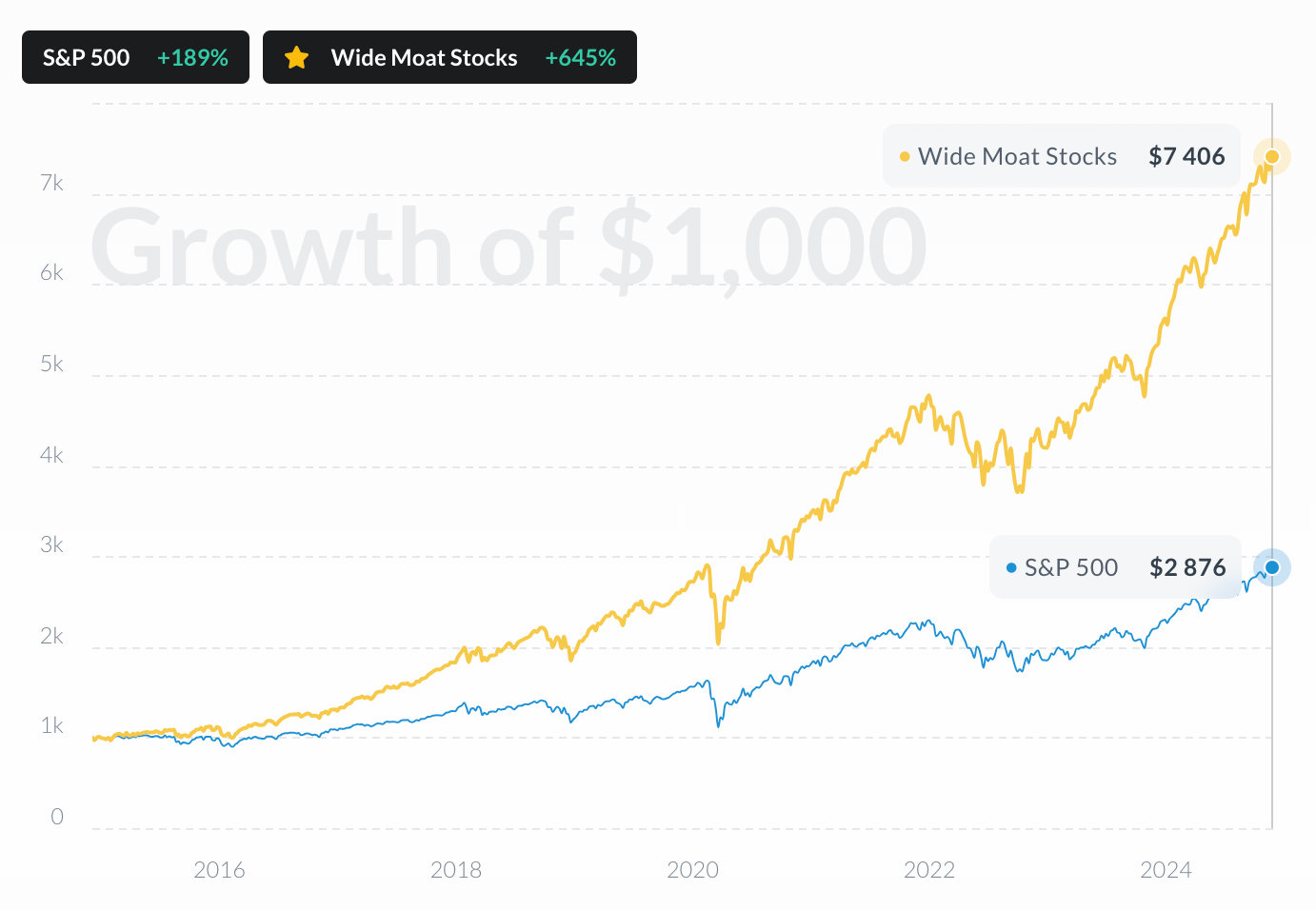
Our research into Economic Moat performance spans the past 10 years and focuses on companies with a wide economic moat. For this analysis, we calculated the average stock price returns of these companies, comparing them to the performance of the S&P 500 index over the same period.
The results were compelling: wide moat stocks achieved a remarkable +645% average return, compared to +188% for the broader market. This difference highlights the long-term benefits of investing in businesses that can maintain their market position and pricing power over time.
Note: This research does not account for survivorship bias. Past performance is not indicative of future results.
Economic Moat