Procter & Gamble Co
NYSE:PG



Decide at what price you'd be comfortable buying and we'll help you stay ready.

|
Mediwound Ltd
NASDAQ:MDWD
|
IL |

|
Qingci Games Inc
HKEX:6633
|
CN |

|
TPG Telecom Ltd
ASX:TPG
|
AU |

|
Itron Inc
NASDAQ:ITRI
|
US |
Procter & Gamble Co
Wide
Economic Moat
Procter & Gamble Co has a wide economic moat, supported by its strong intangible assets in the form of powerful brand names and its position in a market characterized by efficient scale, limiting competitive threats.
Procter & Gamble Co
Competitive Advantages
Procter & Gamble possesses strong brand identity through its portfolio of well-known consumer brands like Tide, Pampers, and Gillette, which provide significant barriers to entry for competitors.
The consumer goods market is dominated by a few major players, including Procter & Gamble, limiting the entry of new competitors due to high competition and established market demand.
Wide Economic Moat Companies
| Company | Last Price | Price Change | Market Cap | Economic Moat | ||
|---|---|---|---|---|---|---|
|
|

|
NVIDIA Corp
NVDA
|
$183.905 |
+0.9%
|
$4.5T | Wide |
|
|

|
Apple Inc
AAPL
|
$260.505 |
+2.1%
|
$3.8T | Wide |
|
|

|
Alphabet Inc
GOOGL
|
$318.475 |
-0.2%
|
$3.9T | Wide |
|
|

|
Microsoft Corp
MSFT
|
$373.02 |
+1%
|
$2.8T | Wide |
|
|

|
Amazon.com Inc
AMZN
|
$233.11 |
+1.7%
|
$2.5T | Wide |
|
|
|
Taiwan Semiconductor Manufacturing Co Ltd
2330
|
NT$1 940 |
+2.5%
|
$1.6T | Wide |
|
|

|
Meta Platforms Inc
META
|
$628.34 |
+0.1%
|
$1.6T | Wide |
|
|

|
Broadcom Inc
AVGO
|
$355.23 |
-2%
|
$1.7T | Wide |
|
|

|
Walmart Inc
WMT
|
$129.205 |
+0.6%
|
$1T | Wide |
|
|
|
Eli Lilly and Co
LLY
|
$955.84 |
-1.3%
|
$903.6B | Wide |
| Company | Last Price | Price Change | Market Cap | Economic Moat | ||
|---|---|---|---|---|---|---|
|
|

|
AstraZeneca PLC
AZN
|
GBX15 276 |
-0.1%
|
$319.6B | Wide |
|
|

|
Kweichow Moutai Co Ltd
600519
|
¥1 459 |
+1.7%
|
$265.4B | Wide |
|
|
|
Novo Nordisk A/S
NOVO B
|
kr237.1 |
-1.8%
|
$166.1B | Wide |
|
|

|
Zhongji Innolight Co Ltd
300308
|
¥688.14 |
+2.5%
|
$111.1B | Wide |
|
|

|
GE Healthcare Technologies Inc
GEHC
|
$73.02 |
+0%
|
$33.3B | Wide |
|
|

|
Hindustan Aeronautics Ltd
HAL
|
₹4 033.7 |
+0.8%
|
$29.7B | Wide |
|
|

|
Bajaj Auto Ltd
BAJAJ-AUTO
|
₹9 484.5 |
+2.5%
|
$29.1B | Wide |
|
|

|
Adani Green Energy Ltd
ADANIGREEN
|
₹1 032.5 |
-2%
|
$18.7B | Wide |
|
|

|
ABB India Ltd
ABB
|
₹6 624 |
+2%
|
$15.4B | Wide |
|
|
|
Trent Ltd
TRENT
|
₹3 857.5 |
-0.2%
|
$15.1B | Wide |
Procter & Gamble Co
Glance View
In the mid-19th century, Procter & Gamble Co. began its journey as a small soap and candle manufacturer in Cincinnati, Ohio, founded by British candlemaker William Procter and Irish soapmaker James Gamble. These two immigrants saw the booming demand for reliable household essentials, a niche that would eventually fuel the company into the global powerhouse it is today. The firm navigated through the Civil War era, supplying the Union Army with soap and candles, which not only bolstered its reputation but also established a nationwide footprint. Over the decades, Procter & Gamble expanded its product line, becoming a master of brand management and consumer goods innovation. Through savvy marketing strategies and a keen focus on consumer research, P&G transformed a burgeoning chemical industry into a portfolio of legendary brands, including Tide, Pampers, and Gillette, winning the hearts of consumers worldwide. At its core, Procter & Gamble operates by understanding and responding to the daily needs of consumers with scientific precision and marketing acumen, building an empire of high-frequency consumer products. Its economic engine is fueled by a diverse array of personal health, household, and beauty products sold in over 180 countries. Leveraging economies of scale, P&G capitalizes on global brand recognition to optimize its supply chains and cost structures, ensuring competitive pricing while maintaining healthy margins. The company is a paragon of operational efficiency, continuously investing in research and development to propel product innovation and sustainability initiatives. This vigilant focus allows P&G to maintain a leadership position in the fiercely competitive consumer goods space, generating revenue through both sales of its flagship brands and strategic acquisitions that expand its market reach.
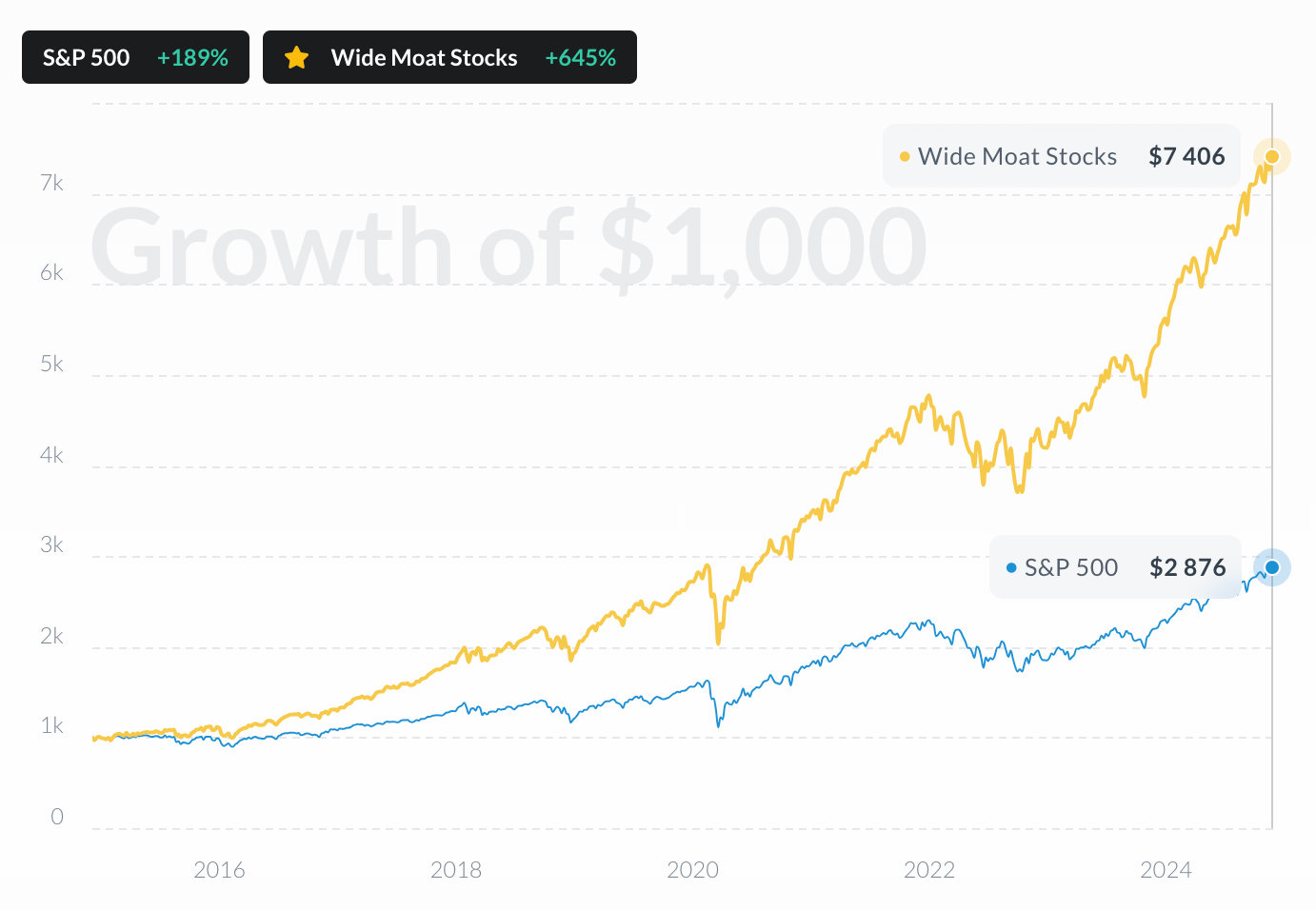
Our research into Economic Moat performance spans the past 10 years and focuses on companies with a wide economic moat. For this analysis, we calculated the average stock price returns of these companies, comparing them to the performance of the S&P 500 index over the same period.
The results were compelling: wide moat stocks achieved a remarkable +645% average return, compared to +188% for the broader market. This difference highlights the long-term benefits of investing in businesses that can maintain their market position and pricing power over time.
Note: This research does not account for survivorship bias. Past performance is not indicative of future results.
Economic Moat