
Ternium SA
NYSE:TX



Decide at what price you'd be comfortable buying and we'll help you stay ready.

|
Johnson & Johnson
NYSE:JNJ
|
US |

|
Berkshire Hathaway Inc
NYSE:BRK.A
|
US |

|
Bank of America Corp
NYSE:BAC
|
US |

|
Mastercard Inc
NYSE:MA
|
US |

|
UnitedHealth Group Inc
NYSE:UNH
|
US |

|
Exxon Mobil Corp
NYSE:XOM
|
US |

|
Pfizer Inc
NYSE:PFE
|
US |

|
Nike Inc
NYSE:NKE
|
US |

|
Visa Inc
NYSE:V
|
US |

|
Alibaba Group Holding Ltd
NYSE:BABA
|
CN |

|
JPMorgan Chase & Co
NYSE:JPM
|
US |

|
Coca-Cola Co
NYSE:KO
|
US |

|
Verizon Communications Inc
NYSE:VZ
|
US |

|
Chevron Corp
NYSE:CVX
|
US |

|
Walt Disney Co
NYSE:DIS
|
US |

|
PayPal Holdings Inc
NASDAQ:PYPL
|
US |
Q4-2025 Earnings Call
AI Summary
Earnings Call on Feb 18, 2026
Cost Savings: Ternium delivered $250 million in cost reductions for 2025, supporting profitability amid challenging steel markets.
EBITDA Margin: EBITDA margin reached 10%, with management aiming to increase margins further and potentially return to a 15% range by the end of 2026.
Profitability Outlook: Management expects profitability to improve in 2026, driven by higher margins and shipment growth, especially in Mexico.
CapEx & Growth: CapEx peaked in 2025 at $2.3 billion cash from operations; expected to decrease to $2 billion in 2026 and $1.2 billion in 2027.
Dividends: The Board proposed an annual dividend of $2.70 per ADS for 2025, unchanged from the prior year, implying a yield over 6%.
Market Environment: Trade protectionism and antidumping measures in Mexico and Brazil are creating a more favorable competitive landscape, with gradual expected price benefits.
Strategic Projects: New cold rolling and galvanized lines are ramping up in Pesqueria; construction of a new slab plant remains on track to start up by year-end.
Volume Guidance: Shipments are expected to grow in 2026, particularly in Mexico due to market share gains and new capacity.
Ternium implemented a cost savings and efficiency program that delivered $250 million in savings in 2025 compared to 2024. Initiatives included improving blast furnace operations, renegotiating service contracts, optimizing iron ore sourcing, and logistics improvements. Management emphasized ongoing efforts to further reduce costs in 2026 as a key driver for margin improvement.
EBITDA margin was 10% for 2025. Management cited persistent headwinds from steel price declines and one-time impairments, but expects margins to rise sequentially in 2026, especially in the first quarter. The long-term target remains a normalized EBITDA margin of 15–20%, with 15% seen as an achievable level by the end of 2026, barring major changes in trade agreements.
Significant trade actions in the US, Mexico, and Brazil are reshaping the steel market. Mexico raised import tariffs on steel from 25% to 35%, and Brazil implemented new antidumping measures. Management expects these actions to gradually benefit local producers and improve pricing, although the effects will be felt over time. There is still uncertainty about the USMCA renewal, with most of the positive impact from any deal expected in 2027 or later.
Ternium completed major downstream expansions in Pesqueria — including a new cold rolling mill and galvanized line — and is advancing the construction of a slab plant set to start up by year-end. CapEx was high in 2025 but is expected to moderate to $2 billion in 2026 and $1.2 billion in 2027. These investments aim to boost capacity, especially for the automotive sector, and improve cost efficiency by reducing reliance on imported slabs.
Steel demand in Mexico fell sharply in 2025, with apparent consumption of flat products down 14% year-over-year. Despite this, Ternium gained market share. For 2026, demand in Mexico is forecast to rise by 4%, with the company anticipating even higher shipment growth due to increased local market share and new capacity. Brazil and Argentina are expected to show stable to modest growth, with Argentina recovering in the latter half of the year.
The annual dividend was maintained at $2.70 per ADS for 2025. Management reaffirmed its commitment to shareholder returns, even during a period of high capital investment. Net cash position is expected to decline in 2026 due to CapEx and dividends, but management plans to restore cash generation as major projects wind down. There is no current intention to launch a buyback or acquire remaining minorities in Usiminas, though growth in main markets remains a strategic priority.
The company reported fatal accidents at operations in Mexico and Brazil during 2025, which management called unacceptable. In response, Ternium is reinforcing safety programs and preventative actions, especially around critical risks. Additionally, the company secured a $1.25 billion green loan to support expansion projects, which won several sustainability awards.

Thank you for standing by. My name is Jordan, and I'll be your conference operator today. At this time, I'd like to welcome everyone to Ternium Fourth Quarter 2025 Results Call. [Operator Instructions] I'd now like to turn the call over to Sebastian Marti. Please go ahead.
Good morning, and thank you for joining us. My name is Sebastian Marti and I am Ternium Senior Director. This morning, we released our results for the fourth quarter and full year 2025. Today's call is intended to add context to that presentation. Joining me today are Maximo Vedoya, our Chief Executive Officer; and Pablo Brizzio, the company's Chief Financial Officer, who will review Ternium's operating environment and performance. .
Following our prepared remarks, we will open up the floor to your questions. Before we begin, I would like to remind you that this conference call contains forward-looking information and that actual results may vary from those expressed or implied. Factors that could affect results are contained in our filings with the Securities and Exchange Commission and on Page 2 in today's webcast presentation, you will also find any references to non-IFRS financial measures reconciled to the most directly comparable IFRS measures in the press release issued today. With that, I'll turn the call over to Mr. Vedoya.
Thank you, Sebastian, and good morning, everyone. We appreciate you being here today in our conference call. Ternium delivered resilient results in 2025 overcoming challenging market conditions by adapting rapidly and acting actively to protect profitability. Company's cost reduction and efficiency program generated $250 million in savings in 2025 over 2024. Key initiatives included enhancing blast furnace stability, negotiating service contracts, optimizing iron ore sourcing and improving logistics.
As a result, our EBITDA margin reached 10%. Our performance, however, was affected by a fatal accident at Ternium Mexico in 2025 and another at Ternium Brazil during this quarter. Usiminas also experienced a fatality in 2025. We take safety extremely seriously and consider these events a significant setback. Such outcomes are unacceptable, prompting us to reinforce our safety programs. In response, we are ramping up preventing actions with a special focus on critical risk.
Let me now review the latest changes in the global trade environment. The United States took significant trade measures in 2025 to counter unfair trade practices from China and other Asian countries. And this is reshaping the global steel market as other countries around the world are following a similar path.
In Mexico, the government recently raised import tariffs on more than 1,400 tariff lines for countries without a free trade agreement. In the case of steel, import tariffs increased from 25% to 35%. Meanwhile, negotiations arising in the North American region trade framework are ongoing. Many stakeholders from both sides of the Board continue to engage in discussions. We have taken an active role in sharing the concerns and priorities of the manufacturing industry throughout this process.
I see broad support for public policies that promote greater regional integrations. The aim is to keep trade fair addressing balance, avoid transshipment and reinforce rule of origins. It is important to mention that an agreement to intensify trade flows should avoid restrictions on interregional trade like those based on Section 232. As the USMCA joint review take place, removing restrictions to trade among its member will be essential to ensuring the benefit of deeper integration. Ternium is also doing its part in this process of greater regional integrations. Since our arrival in Mexico over 20 years ago, we have significantly expanded our footprint in the country. investing in state-of-the-art technology to offer a wider range of high value-added products to our customers in the region's manufacturing industry.
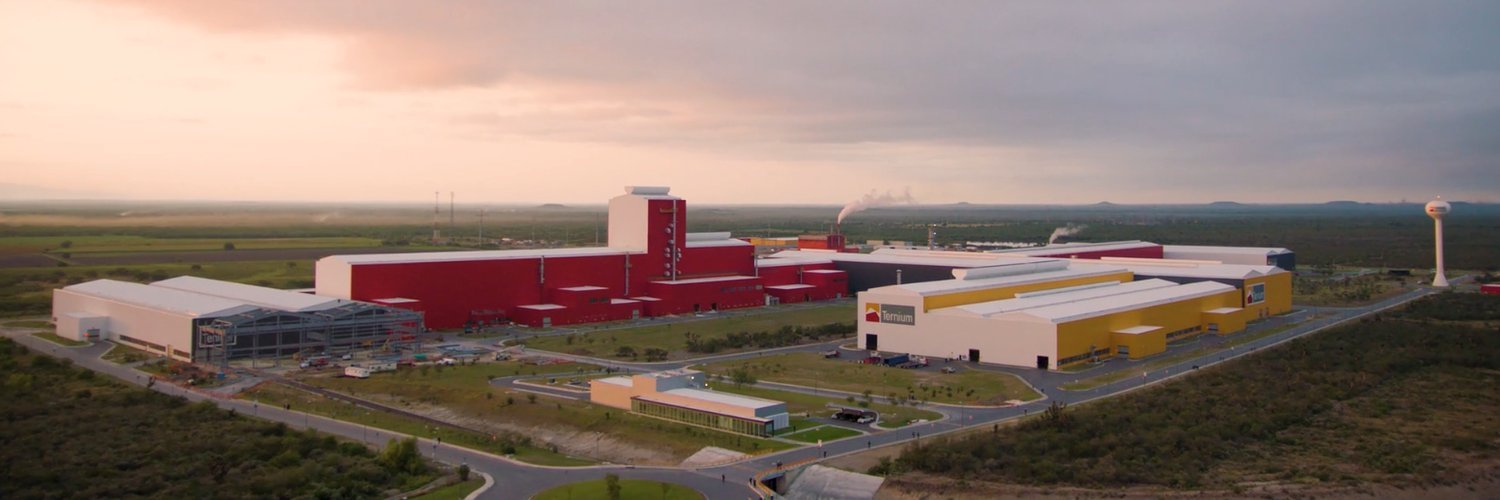
In this line, I am pleased to share some exciting news. We have started production in our new cold rolling mill and also in our galvanized line at the Pesqueria facility. This achievement completes our downstream expansion at the site made possible by outstanding teamwork. The entire project also added a picking line and a finishing line center. All these facilities are now operational with the cold rolling and the galvanized lines starting the ramp-up phase.
Meanwhile, construction of the slab plant is moving ahead as planned, as we expect to start up the facility by the end of the year. This new plant will allow us to produce high-quality automotive steel with lower CO2 emission per ton in the industry. Adding a touch of color, in 2025, we secured a $1.25 billion loan through a green financing facility to support this project. The loan received several awards last quarter, including IFR's sustainable loan of the Year, GBM awards Sustainable Loan Deal of the Year in Latin America and Caribbean and arable mention from Latin Finance.
Turning to Brazil. The recent implementation of antidumping measures and the increase in import taxes of 9 steel products represent a significant shift in the market environment. This decisive action signals a stronger government commitment to support local producers and achieve a balanced competitive landscape. Looking ahead, it will be key to monitor the market closely to prevent attempts to circumvent these measures, ensuring that this new environment continue to support fair competition.
In Argentina, growing concerns have emerged regarding a fair trade practice from China. In this situation, the new trade agreement between Argentina and the United States is important because both countries have agreed to work together to address unfair trade purchases from other nations. While we believe Argentina should further integrate with the global economy, it is crucial to approach this process with cautions, particularly in view of China's excess production capacity and predatory trade tactics.
Saliba, I'm optimistic about Ternium outlook for the coming years. I expect Ternium profitability to improve in 2026, starting from the first quarter. On 1 hand, we will continue working on reducing costs and enhancing operational efficiency. On the other, although there are still several important trade issues to be worked out, I am encouraged by the ongoing support of market economy governments around the world for addressing unfair trade practices. A discussion between the United States and Mexico advance, I'm confident that a mutually beneficial agreement will be reached as a well structured agreement is good for all parties involved. Mexico has demonstrated its commitment to reinforce regional defenses against unfair trade practices and encouraging investment within region, align its strategy with that of the United States in ongoing negotiations.
In addition, promising changes in Brazil steel market environment and advanced and economic reform in Argentina give us hope for the future in South America. In this context, we have reached an important milestone in the largest industrial expansion in our company's history. Together, this development will put us in a unique position as they will help create a stronger foundation for talent growth across the region. Thank you all for your attention. And before handing over to Pablo, let me thank especially our colleagues in Brazil, all the analyst there who made it join us during the Carnival season. So I hope you have a very good holidays. So Pablo, please go ahead.
Thanks, Maximo, and thanks, everybody, for being today with us in this conference call. So let me begin with a review of our operational and financial performance. If we move to the Page 3 in the webcast presentation, you can see that adjusted EBITDA declined slightly sequentially in the fourth quarter, which was in line with our expectations. EBITDA margin remained relatively stable, and there was a small seasonal decrease in shipment. As we move into the first quarter of 2026, we anticipate a sequential higher adjusted EBITDA mainly driven by an increase in EBITDA margin as well as growth in our shipments.
Let's move to the next slide. Net income for the fourth quarter totaled $171 million in the fourth quarter. We saw a lower operating income, mainly impacted by onetime charges, mostly related to an impairment in Les, 1 of our mining operations in Mexico. On the other hand, we had a better income tax refund, along with stronger financial results. In the sequential comparison, we had deferred tax write-down is in mine receptor in the third quarter.
Let's turn to Page 5 to review the performance of our Steel segment. Shipment declined mostly during the quarter, primarily due to weaker volumes in other markets, mainly in the U.S. and in Brazil, reflecting seasonally lower activity. This effect were mostly offset by higher volumes in Mexico and in the Southern region. In Mexico, we saw better volumes to the commercial market as a result of government measures aimed at curbing unfair trade practices.
Looking forward to the first quarter, we anticipate a sequential increase in shipment, mainly as a result of the stronger demand in Mexico. Turning to Page 6. still cash operating income decreased sequentially, driven by slightly lower sales volume and a decline in realized steel prices, which was partially offset by reduced raw material purchase slab costs together with efficiency gains.
Turning to the next slide. The mining cash operating income increased sequentially, driven by stronger shipments and higher realized iron ore prices partially offset by higher unit costs. We will review our cash performance and balance sheet performance on Page 8. We will see that in the fourth quarter, we record another solid level of cash generation by operations, supported by a reduction in working capital, primarily driven by a decrease in trade and other receivables, partially offset by a decrease in trade payables and other liabilities.
We are now past the peak of our capital expenditures, which in the fourth quarter totaled $463 million primarily reflecting continued progress in the construction of new facilities at the Teen Industrial Center in Peoria, Mexico. Our net cash position remained stable in the fourth quarter of the year, and we have a neutral free cash flow. In addition, dividend payments to shareholders and minority interest were largely offset by an increase in the value of financial securities. Let's now turn to the final slide to summarize our full year performance. In a challenging year for the steel industry, we were able to defend profitability as we proactively to mitigate the impact of the drop of steel prices and volumes. And as a result, our EBITDA margin achieved a 2-digit level.
In 2025, cash generated by operations reached strong $2.3 billion, allowing us to finance demanding CapEx requirements as we completed the downstream project in Pesqueria and keep working on the slab facility. Looking forward, we anticipate a decrease in CapEx in 2026 to a level of around $2 billion. In this context, Ternium's Board of Directors has proposed an annual dividend of $2.70 per ADS for fiscal year 2025, keeping at the same level as for the year 2024.
Of this total, we have already anticipated and paid $0.90 as an interim dividend in November. The proposal shows our confidence in the company's prospects, even though we are currently undergoing a state of significant capital expenditure at the current market price, Australian, this implies a dividend yield of over 6%.
With this, we conclude our prepared remarks. So please, let's go to the Q&A session. So please, operator, let's begin with it. Thanks.
[Operator Instructions] Your first question comes from the line of Rafael Barcellos from Bradesco BBI.
So firstly, I would like to get a bit more color on your outlook for the Mexican market. So demand today is still running well below the peak levels we saw a few years ago. So I'm trying to better understand how do you see the recovery path from here, specifically, I mean, with the recently announced Ternium Mexico, I mean how should we think about the potential impact on demand growth for 2026? And other than that, I mean, how are you thinking about the likelihood of the timing of USMCA deal, what impact is a significant part of this impact could be captured in 2026? So if it's a more story for 2027 and beyond could be helpful.
And as a second question, turning to Brazil, I would like to get your thoughts on the recently announced antidumping measures. I mean how do you expect these measures to place into pricing dynamics over the past few quarters, should we think about a relatively quick as through into domestic prices or is the impact to be a more gradual depending on inventories and competitive behavior? And if you could even like give some color on the magnitude of a potential hikes here?
Thank you, Rafael. I'll start with the first question, the Mexican market and demand. You're quite right, demand is very low. It was very low in Mexico in 2025. Apparent consumption of steel decreased 10%, it's a huge decrease. I've never seen something like that index ago, to be honest. And this was even worse if you separate long products and flat products. The apparent consumption in flat products, which is our main market, was 14% below that of 2024.
So this is a huge decrease. Ternium in that sense, our shipments in Mexico were a little bit -- the decrease was smaller because we managed to gain market share in the flat products. So it was an important measure. I think in 2026, the estimation of Cana sero is that the market is going to grow 4%. But I think all these measures are going to allow the local steel mills to gain more market share against imports. You have to remember that in Mexico, there's still a huge amount, almost 9 million tonnes of finished products that are imported in Mexico. So our target with all these measures is to gain more market share as we did in 2025.
And although the market is not growing as much as we expect a gain in our shipment with the market share. In 2026, so the timing -- then the timing in the USMCA, it's very difficult at the moment. I mean there is a target that in July, USMCA should be renewed. I really don't know at this moment is that it's going to be achievable. In our projections, we are not seeing a lot of increase of the timing of the USMCA for 2026, and we're putting that more into 2027.
I mean, of course, we hope that they see sooner, but we have to expect or we are making our plans in order that it's a little bit later.
Then the second question was regarding Brazil and the dumping measures, I mean, to give a little bit of color, I think this is a very important step. If you remember, we haven't been -- Brazil hasn't been very much advocate in the last years of defending industries, against unfair trade policies against the present tactics by China. But this change with 4 dumping cases, the plate one, the prepainting and last week, the cold rolled and the galvanize. So this is a very important news, a very important first step that Brazil joined most of the rest of the economies. I mean, from Europe to India to Mexico to the U.S., all the countries are fighting unfair trade from China and from Asia.
Impact on prices, I think the impact will be gradual. I don't expect a huge increase in prices because of this. Again, this is the first step, but it's going to be a more gradual as you said, impact in the future. I think, Rafael, I answered your questions, but I don't know if you want more clarity?
That's perfect. Thank you -- thanks a lot. .
Your next question comes from the line of Carlos De Alba from Morgan Stanley.
Maybe Maximo clarification. You said that Canasta demand up 4% or down 4% in during 2016?
Up 4% in 2026.
Okay. And then my 2 questions will be, first, on USMCA. What would be in the event that there is not a renewal of USMCA and see Mexico cannot reach a commercial agreement stand-alone with the U.S. What would be turning plan be given that a lot of the -- particularly on the auto side, your volumes go into that sector and then Mexico exports a significant amount of the cars that are producing in the country. And my second question, if you can give us maybe a little bit of an outlook on how do you see turns volumes performing in 2026? Where are the expectations in terms of volume growth in the different countries where you -- or operations where you are actively right now?
Yes. Can you repeat the first question on the USMCA -- because we didn't hear very well.
Yes, sorry. Just what would be -- what is Ternium plan B? What would be your strategy? If there is not a renewal of the trade agreement? And also Mexico doesn't reach an agreement exclusively with the U.S.
Yes. I mean, we operate all 2025 with these premises. There's no -- I mean, on a sense, the USMCA, if it's renewable, the great benefit is that the Section 232 is going to disappear between Mexico and the U.S. I don't see a renewal of agreement with the 232 on board. And that would be the biggest benefit of the renewal. So in 2025, we operate without -- it is a USMCA but the 232 in steel, derivative and a lot of products made it the way to operate if there's not a renewal. Again, I think that some of these measures are going to be taken away, although if the renewal is postponed. So we are operating in this environment, Carlos. The volumes of 2026...
Okay. Let me take that one, Matt. As you know, you hear in our outlook, we are expecting volumes to start increasing already through the first quarter and in this case, mainly coming from Mexico. So let me divide the answer to this question into a different market where we are because we have different situation. In South America, the first quarter is the seasonal lower quarter of the year. So you are not seeing any increase during the first part of the year during the third quarter.
And the opposite situation is in Mexico where the seasonality is coming at the last part of the fourth quarter. So taking into consideration what Maximo said, that the expectation is at least an increase of 4% in free consumption for the year and the possibility of further increases in our market share because of the volumes that we will be able to increase and produce with the new facilities. And even without taking into consideration the possible outcome of the USMCA unitization and the consequences of that, we are positive that the increase in the Mexican shipments will be above at least the numbers that Maximo mentioned an expectation for the Mexican market.
In the case of Argentina, our Southern region, we know that volumes were replaced, especially at the beginning of the 2025 because we were getting out from refer in Argentina. So numbers tend to recover -- volumes tend to recover in the second part of the year. So we are expecting to have a positive number coming out in the Solenis initiating in the second quarter of the year, not during the first quarter.
Differently the situation in Brazil, where we saw volumes at healthy level during 2025 and going with the increase of the GDP growth of the country. So the expectation for Brazil is to keep growing at lower levels. So volumes will be more related to these changes in the general economy of the country.
Your next question comes from the line of Timna Tanners from Wells Fargo.
I wanted to drill down, if I could, please, on the EBITDA margin. In the past, you've guided to a normalized level of 15% to 20%. And in the second quarter call, you had said you expected at 15%, the low end by the fourth quarter. I'm just wondering, the last 2 years have been challenging, I acknowledge that. But just trying to get a sense of what it makes to get back to that 15% to 20%. Could we see that in 2026? What are going to be the puts and takes to get there again?
Emma, this is Pablo. So let me try to answer the question, which first of all, you're right, we were expecting further recovery in the last part of last year that at the very end, didn't materialize because among other things, the impact of certain things that are happening in the different markets, the impact on in Brazil because of the imports, especially coming from China, and the lack of antidumping measures at the moment, so depressing prices in that market, the impact on the changes in the new rules of trade coming from the U.S. that impacted especially in industrial sector during the second semester of the year. And the increase of the 232 margin during the year.
So that put a lot of pressure on margins, and this will allow us to reach the original expectation. In the meantime, taking that into consideration, we implemented a cost reduction program, but as Maximo explained, yield more than around $250 million during the year. And clearly, we will continue doing that. So the kind of explanation why we were not able to reach the number that we were expecting. I probably will say exactly saying that we have the chance to reach the number by the end of this year because we we will not reach that number during the first part of the year for sure, though even we are announcing and we our very clear on that, that we will increase the margins during this first part of the year, because of increases in prices across the board, of course, that will also have an impact on cost that will be also increased, but we are expecting to have better margins during the first part of the year.
We will continue to work, as I mentioned, in further cost reduction program to further increase this margin. But a lot will depend on what we have been discussing until now and Maximo described at length, which is the consequence of the situation related to the negotiations of the 2 of the impact that this we have. So again, not initially, we will not be able to reach that number. We have a chance, and we will work for that to reach that number, which is, as you know, our goal. You mentioned between 15% to 20%. All I'm saying is to take reach initially 15% and keeping working on that.
As you know, the company is always working with that goal and trying to find ways to reduce our costs and to be able to take advantage of the situations that appear in the market. So again, hopefully, this year, we will revise.
Okay. Very helpful. If I could follow up on that. I saw with interest in the RCCL yesterday, you had the announcement that Mexico is doing a dumping investigation into cold rolled imports from the U.S. And I guess it just prompted me to think that it isn't enough to have the trade action so far in Mexico and Brazil, especially when you have 50% tariffs in the U.S., but also the 50% coming in steel action plan in Europe and the CBAM, of course, already implemented.
So even if the Mexico and Brazil started some actions, the rest of the world is taking even more aggressive actions. So I'm just wondering if you think these are enough to move the needle as much as necessary to reach those goals you've just enumerated?
You made a very good point. I think all the things that you're saying are very positive. I mean, again, I think that, as I said before, Brazil, this is a very good first step. As you say, the U.S., Canada, even Mexico, Europe are much more ahead in these trade measures against unfair trade than Brazil. But it changed a lot from last quarter to this one. Call this change of Moody in Brazil. Mexico, the dumping case against the cold rolled, it's not only from the U.S., it's U.S., Malaysia and China, remember. And I think, again, we will continue presenting dumping cases if we see that they're worth pursuing, in this case we think it is and the Mexican government accept deputation to open it. So they see some merit or they see merit in this investigation. .
But Mexico is also going to continue probably with some measures to not duplicate but trying to be similar to the U.S. market. And so all these measures are accounting, and I think more are coming. So you're right. They're not sufficient, but they are in the right path.
Your next question comes from the line of Jon Brandt from HSBC.
I first wanted to ask about CapEx. I know you said $2 billion for 2026. Presumably, that continues to fall as we go into 2027 and 2028. So I'm hoping you can give us a little bit of guidance as to what those numbers might be? Or what normalized CapEx number might be as the major CapEx is rolling off and the projects are completed. And then what then does that mean for the additional free cash flow that you have, right? I mean you've paint a good picture of increasing demand, increasing prices, improving profitability. Following CapEx means there's some free cash flow, some I'm wondering about capital allocation. If we should see -- your net cash position has also fallen over the years as these -- as CapEx has ramped up, should we expect the net cash position to rise? Or are there other alternatives for this cash?
And I guess my second question is just kind of related to that now that you've sort of completed the acquisition of Nippon stake and in -- is there any sort of additional consideration about potentially taking out the minorities in Usiminas? Have you analyzed what sort of benefits or cost savings you would have if you own that 100%? Anything on your thoughts there would be great.
Thank you, John. CapEx. CapEx, as you said, this year will be around $2 billion, 2027 will be around $1.2 billion, so it's decreasing. And then in 2028, we don't have an exact number, but it's going to be around $800 millions the CapEx. That's a regular CapEx. This is including Usiminas. So you're right, the capital allocation for probably the end of 2027 we are going to have a different view. Today, 2026, we still are going to have a huge CapEx and probably we have to increase our working capital because the last 3 weeks -- 3 quarters, we have a decrease in capital. So I don't know if -- I don't think it's going to change a lot. But I don't know if you want to add something Pablo to that?
Yes, okay. Let me add a little bit into that because 2026 for sure will be a year in which we will be using cash and capital because if you add up the $2 billion in CapEx, the dividend that we are paying and the amount that we , as you mentioned, already paid for the shares of Usiminas from Nippon. So this add up more than or close to $3 billion and most probably, the cash generation that we were describing will be in line with this year or even higher, but also take into consideration that we will reverse the reduction in working capital and probably we will need to allocate certain cash over. So for sure, we will be reducing our net cash position that we end up at the end of 2025 with $700 million of net cash. This will be reversed.
So we will move to a net debt position, but again, at very low levels. And then moving to 2027, as Maximo mentioned, we will be reducing our CapEx. We will be -- we will not know yet how the outlook for the working capital will be. We will continue with the dividend payments. So probably, we will cease little bit or reduce the net debt position at this moment. But we are not seeing significant changes in our capital allocation at the moment. We will continue with the CapEx. We will continue with the dividend and we already made an investment in the case of Nippon. So clearly, 2026 will be near to use that and probably 2027, we begin to recover a little bit of cash. But Maximo, I think that you have -- it was the second part of the question from John.
Yes. Then the Nippon and the minority shares of Usiminas Today, we are not considering launching a tender offer or buying the rest of the shares of Usiminas to be clear. But Brazil, for us, for Ternium, is a very important market. We have already a significant footprint in the country with our stake in Usiminas with our operation in Ternium Brazil in Rio de Janeiro. You also know we have a huge commitment to the community, investing $45 million in the new technical school for the community of Santa Cruz, near our plant in Rio de Janeiro, so we will continue looking to other opportunities. As I said, we don't have any plans today of doing anything, but we are continuously looking for new opportunities to grow. I hope, John, I answered the question there.
[Operator Instructions] Your next question comes from the line of Enrique Marquez from Goldman Sachs. .
I just wanted to get more details on the upstream project in Pesqueria, I think that in the end, increasing volumes relied a lot on the market situation, but do you think there is room for higher steel volumes when you finish the project? And also, if you could share more details on how much you expect to save in terms of cost with your own slab production versus third-party purchase would also be great?
Yes. Remember, the Pesqueria project, the upstream project was always focused the automotive industry. As you remember, when the USMCA was negotiated, there was a clause for 2027, where most of the automotive industry has to have melt and pool for gaining origin. So this project is going through that. Probably, it's going to allow us to sell even more volume to the automotive industry that we are selling today. We have a footprint of around 2 million tons for the automotive industry. And probably with this project, we will be able to sell much more. These 2 million tons today comes from slabs that we made in Brazil, and we shipped to Pesqueria for the hot roll controlled and galvanized.
So we are changing that and probably will allow us to replace more volume from Japan, from Korea, from other regions, from even Europe that are selling in Mexico. So it's not a safe cost. Then again, we have more capacity today of hot rolled. So if the market improves, we will be able to serve other different sectors with our spare capacity. We have today in Mexico. I hope Enrique this was clear or if you want more on this?
Yes. I just -- sorry, I think I just wanted to better understand like when you're producing these slabs in Mexico, like how much of that could action like save you in terms of cost, in terms of logistics, maybe just to try to better understand the -- I know it's -- the mode of the project is also strategic, but just to try to get like the benefits from the upstream project, that's apart from increasing volumes in the auto industry?
It's Pablo. Let me try to add a little bit to that. As I was explaining, we are substituting slabs that we are bringing from some other places or even from Brazil or the ones that we will produce. So there, you will gain part of that margin because you will move from buying to produce, which is very a important savings, then this will be very efficient and sophisticated facility. And also, this will allow us to produce product that we were not able to produce before with our own facility. So that will also add savings in logistics, savings in the way we produce and also will leave the possibility, of course, probably this will take a little longer to be realized the possibility to increase volumes of sales because we have a higher capacity than the 1 that we are utilizing today for the auto sector. And if the market continues to grow as we expect, after a good negotiation of USMCA, this could allow us to further increase volume. So all in all, it's a key project for Ternium for many different reasons. And among that reason is because of the savings and the reduced cost that we will be able to take from that process. .
Your final question comes from the line of Caio Greater from UBS.
Two follow-ups from me. The first 1 I'll talk to Tim's question. I wanted to understand what do you guys see in terms of margin potential for Ternium that doesn't rely on the U.S. removing or lowering Section 232. So what level of -- so how much more do you see EBITDA margin rising over the next couple of quarters. Again, assuming that Section 232 is not withdrawn or is not lowered by the U.S.
And the second question, also a follow up to John's question on capital allocation. So -- thank you guys for the visibility that you provided for 2026 and 2027. That's really helpful. But I think it would be interesting to hear your thoughts for turning post 2027. So we still have a hard time understanding what the company looks like in the next 5 years and the next 10 years, in what are management's priorities. And we do know that in the past, you have talked about corporate simplification, especially with focus on Argentina again, John asked specifically about the Usiminas minority stake. I wanted to know if any of these -- again, are your priorities or used to have or other priorities going forward being that growing through in the NA being that doing -- working on other projects in Mexico organic projects. And -- or is all of this management still has little visibility on all of this provided that we still don't have visibility on the USMCA agreement and so on. became hear your thoughts on this.
Thank you, Caio, you take the first one.
Relationship to emerge after the good negotiation of. First of all, Caio thanks for your question. First of all, the -- as already was mentioned during 1 of the answers, the real impact of a good negotiation recency probably will be seen not during this year or just at the very end of this year or fully during 2027. So if that's the case, there should be an adjustment on pricing environment in the North American market, where there needs to be a reaction of the impact of the tariff, and this will help reducing that one and increasing margin for Ternium, of course, we never know where this will end up being.
And also, if that's the case, there should be and this is not margin, but this is volumes and increase in volume that will help us numbers of Ternium going forward. Again, there is still a lot of discussion negotiations to be -- that needs to take place. And that is something that we will see during this year. There is a certainty on the timing on the agreement, there's uncertainty on the expected results of that agreement.
So we are positive on the outcome as Maximo explained very clearly. And so we are positive on the outlook and the possibility of Ternium increasing and enhancing margins. And again, this was part of the answer, as you mentioned, to Finland, which we are expecting that margins to increase and to get back to the places or the place where we used to be in the past. And regarding the capital allocation, Caio, for the further -- or the long term, as you put it, 5, 10 years, simplification is still a goal that we have. And we always -- we are going to see when is the best moment on when or when it can be done dependent with part -- but it's always in our to-do list in a sense.
I think that return to shareholders will always be a priority in our capital allocation. And I do see further opportunities then in the long term on the medium term, both in Brazil and Mexico. As you know, both markets are growing and as I said before, Mexico has a huge opportunity of growing against imports and the market -- our customers are very willingness to buy from us. So I think there are still opportunities over there. I think it's too early to try to put them on a paper or make it public, but we are always analyzing these opportunities in Ternium, Brazil and Mexico.
I think Caio that answer your question.
Yes, or it's great. So just -- just maybe 2 follow-ups, if I may. Pablo, I think you mentioned that you see margins recovering towards the normalized range of 15% to 20% and I'm just not sure if you mentioned that, that's including the upside potential from USMCA renegotiations or if that's excluding those factors? My question was assuming the current environment stays, so assuming that nothing changes regarding the USMCA agreement. What level of margin -- what level of margin upside do you to still see that Ternium can reach without that specifically?
Yes. Sorry. Sorry, probably I didn't answer it correctly, what you were asking for. But my intention was that because we believe, as Maximo said, that the impact of the USMCA is positive, as we believe, will not be during this year. So this is more for 2027. So my answer before our intention for answering that we will work and we will be enhancing our margin that we have -- we could have a possibility of reaching the 15% of the lower part of the rates that we're looking for, worse without taking into consideration any impact of the negotiation.
We are already expecting and enhance on our margin during the first part of the year, of course, not reaching 15%. And we will continue working. And we think there is a chance and the possibility for Ternium to reach by the end of the year, weather margin than the 1 that we will have during the first part, hopefully reaching that target by the end of the year.
Of course, after failing on differentiation. -- last year, we will be more conservative and cautious on making the same 1 during this year, but the chance exists.
Understood. And since I'm the last question, I'll take the opportunity and ask another follow-up and to Maximo on capital allocation, maximum. So from your answer, I can understand that the company still see great opportunity for growth at its main markets. So is that going to be a priority instead of potentially raising dividends further or creating a dividend policy that could maybe increase the company's dividend potential going forward or even a buyback program?
Thank you, Caio. I think that the 2 priorities for us increase dividends I mean returning to shareholders and looking opportunities in our main markets that we know that we can value a lot of profitability or added to our business growing in those markets. I think they're both. I don't think, as we have discussed in the past, I don't think the share buyback is something we are going to do because of how much shares are in the market. But the other 2 are 1 of our priorities, both are priorities for us. Caio.
Thank you very much, guys. .
We actually have 1 more question from Jon Brandt from HSBC.
Caio's question actually got me thinking a little bit. You mentioned there were some opportunities to grow in the main markets, and that's kind of 1 of the things you're looking for. And I think I know the answer to the question, but I'll ask it anyways. CSN have said they are looking for a potential partner or to do something with their steel assets in Brazil. I'm wondering if -- is that a potential opportunity for you to grow? Or can you sort of rule out any tie with them?
Thank you, Jon. Yes. We heard what CSN is doing. Its main focus is the cement, and I think this restructure assets they have. Regarding the steel, we -- at this moment, we are not analyzing any thing with CSM. But as I said before and I said several times, Brazil is important for us. So we are always open to analyze different opportunities if they appear. But at this time with CSM, we are not analyzing anything. .
That concludes the question-and-answer session. I'd now like to turn the call back over to Ternium's CEO for closing remarks.
Okay. Thank you all for joining us today, and please feel free to share any comment with us. And goodbye, and have a good day. Thank you very much. .
That concludes today's meeting. You may now disconnect.