
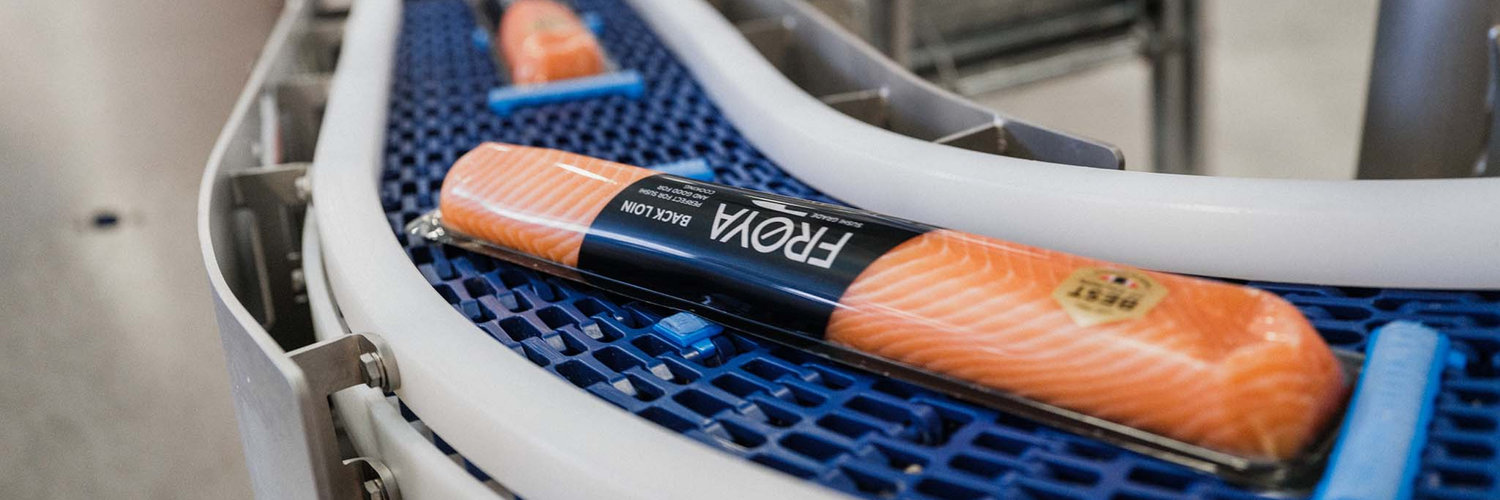

SalMar ASA
OSE:SALM



Decide at what price you'd be comfortable buying and we'll help you stay ready.

|
SalMar ASA
OSE:SALM
|
NO |

|
Newfield Resources Ltd
ASX:NWF
|
AU |
|
Charter Communications Inc
NASDAQ:CHTR
|
US |
|
C
|
Cosa Resources Corp
OTC:COSAF
|
CA |
|
I
|
Israel Discount Bank Ltd
TASE:DSCT
|
IL |

|
Flag Ship Acquisition Corp
NASDAQ:FSHP
|
US |
SalMar ASA
SalMar ASA, a key player in the global aquaculture realm, began its journey in 1991, on the rugged coasts of Norway. Founded by Gustav Witzøe, the company has forged its reputation by pioneering sustainable fish farming practices. In a world of increasing demand for protein, SalMar specializes in the farming, processing, and selling of farmed salmon. This simple yet demanding business model starts in the fjords of Norway, where SalMar utilizes modern biotechnological advances and cutting-edge marine engineering to nurture Atlantic salmon in optimal, controlled sea environments.
The company's operational strategy revolves around vertically integrated operations. From its hatcheries and sea farms to its state-of-the-art harvesting and processing facilities, SalMar ensures the highest quality standards at every step. By maintaining control over the entire production chain, SalMar not only upholds sustainable practices but also capitalizes on efficiencies and cost synergies. This end-to-end approach allows SalMar to generate robust revenue streams, appealing to both domestic and international markets hungry for premium seafood. SalMar's adeptness at aligning economic profitability with environmental stewardship has fortified its position as a leading harvester of the ocean's bounty, ensuring the company remains buoyant amidst the tides of global demand shifts.
SalMar ASA, a key player in the global aquaculture realm, began its journey in 1991, on the rugged coasts of Norway. Founded by Gustav Witzøe, the company has forged its reputation by pioneering sustainable fish farming practices. In a world of increasing demand for protein, SalMar specializes in the farming, processing, and selling of farmed salmon. This simple yet demanding business model starts in the fjords of Norway, where SalMar utilizes modern biotechnological advances and cutting-edge marine engineering to nurture Atlantic salmon in optimal, controlled sea environments.
The company's operational strategy revolves around vertically integrated operations. From its hatcheries and sea farms to its state-of-the-art harvesting and processing facilities, SalMar ensures the highest quality standards at every step. By maintaining control over the entire production chain, SalMar not only upholds sustainable practices but also capitalizes on efficiencies and cost synergies. This end-to-end approach allows SalMar to generate robust revenue streams, appealing to both domestic and international markets hungry for premium seafood. SalMar's adeptness at aligning economic profitability with environmental stewardship has fortified its position as a leading harvester of the ocean's bounty, ensuring the company remains buoyant amidst the tides of global demand shifts.
Financial Weakness: 2025 was a financially weak year for SalMar, with headwinds from downgraded fish, lower market prices, and biological challenges in certain regions.
Operational Improvements: Despite financial softness, SalMar saw record-high biomass at sea, lower cost levels, and strong biological metrics including reduced mortality and improved fish welfare.
Q4 Rebound: Operational EBIT in Q4 rose to NOK 1,834 million, nearly half the annual total, as higher market prices and lower costs supported results.
Dividend Proposal: The Board proposed a NOK 10 per share dividend for 2025, representing an 81% payout ratio.
2026 Guidance: Harvest volume guidance for 2026 remains unchanged for Norway and Iceland, but was reduced for Scotland. Total expected harvest for 2026 is 318,000 tonnes, up 6%.
Sustainability Recognition: SalMar was ranked the world’s most sustainable food and beverage producer at the World Economic Forum in Davos.
Improved Cost Structure: Cost per kilo was down 8% from last year, with further reductions expected in 2026 and a lower planned CapEx.
