
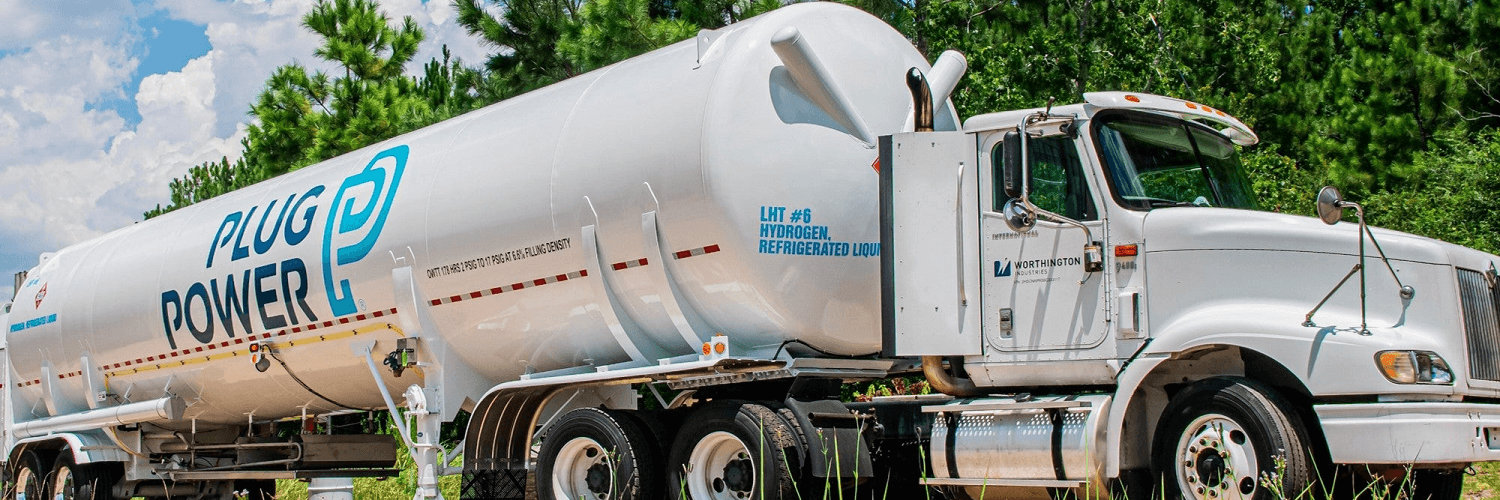

Plug Power Inc
NASDAQ:PLUG



Decide at what price you'd be comfortable buying and we'll help you stay ready.

|
Johnson & Johnson
NYSE:JNJ
|
US |

|
Berkshire Hathaway Inc
NYSE:BRK.A
|
US |

|
Bank of America Corp
NYSE:BAC
|
US |

|
Mastercard Inc
NYSE:MA
|
US |

|
UnitedHealth Group Inc
NYSE:UNH
|
US |

|
Exxon Mobil Corp
NYSE:XOM
|
US |

|
Pfizer Inc
NYSE:PFE
|
US |

|
Nike Inc
NYSE:NKE
|
US |

|
Visa Inc
NYSE:V
|
US |

|
Alibaba Group Holding Ltd
NYSE:BABA
|
CN |

|
JPMorgan Chase & Co
NYSE:JPM
|
US |

|
Coca-Cola Co
NYSE:KO
|
US |

|
Verizon Communications Inc
NYSE:VZ
|
US |

|
Chevron Corp
NYSE:CVX
|
US |

|
Walt Disney Co
NYSE:DIS
|
US |

|
PayPal Holdings Inc
NASDAQ:PYPL
|
US |
Q1-2025 Earnings Call
AI Summary
Earnings Call on May 12, 2025
Revenue: Plug Power reported Q1 revenue of $134 million, in line with guidance.
Q2 Guidance: The company expects revenue between $140 million and $180 million for the second quarter.
Profitability Path: Margins improved and cash burn was reduced by nearly 50% year-over-year, with further reductions expected due to the Quantum Leap cost program.
Capital & Liquidity: Plug raised $280 million in equity and secured a $525 million structured financing facility, with nearly $300 million in unrestricted cash at quarter end.
Europe Opportunity: Europe is described as the most dynamic electrolyzer market, with Plug tracking over $21 billion in opportunity across 2025 and 2026; the company is well positioned for multi-gigawatt bookings.
Tariff Impact: Recent U.S. tariffs on Chinese imports have some cost impact, but mitigation plans are in place and key electrolyzer products are minimally affected.
U.S. Policy & 45V: Management remains engaged on U.S. hydrogen policy, noting both opportunities and uncertainties around the 45V tax credit, with Texas project safe harbor strongly considered.
Material Handling Momentum: Renewed momentum in material handling with a $10 million initial order from a major customer tied to over $200 million in future opportunities.
Plug Power delivered first quarter revenue of $134 million, which met its guidance. For the second quarter, the company projects revenue between $140 million and $180 million, and management reiterated its commitment to providing clear, quarter-by-quarter guidance rather than annual breakdowns.
Margins improved and cash burn was reduced by nearly 50% year-over-year, attributed to the Quantum Leap cost-savings program targeting over $200 million in annualized reductions. Most of these savings have already been executed, spanning manufacturing, logistics, sourcing, and SG&A. Further reductions in cash burn are expected in future quarters.
Plug Power raised $280 million in equity and established a $525 million structured financing facility, which contributed to repaying convertible debt. Alongside a $1.66 billion DOE loan guarantee, these steps have strengthened the company’s liquidity. At quarter end, Plug held nearly $300 million in unrestricted cash and does not anticipate raising additional equity in 2025.
Europe is described as the most dynamic electrolyzer market globally, with strong regulatory and financial support. Plug is involved in major projects in Denmark, France, Portugal, Spain, and the U.K., benefiting from enforceable mandates and long-term subsidies. The company expects Europe will be a multi-gigawatt contributor to bookings and revenue over the next 18 to 24 months, with meaningful margin contribution as projects move forward.
Recent increases in U.S. tariffs on Chinese imports have affected costs for some core product components. Plug is executing a four-pronged mitigation plan, including adding surcharges for customers, dual sourcing, engineering redesigns, and geographic diversification. The electrolyzer platform is minimally impacted by tariffs as it was developed with non-Chinese content.
There is ongoing uncertainty about U.S. clean energy policy, specifically the future of the IRA and Section 45V hydrogen tax credits. Plug is working to ensure its Texas facility qualifies for tax credits via safe harbor provisions and is actively engaged with policymakers to advocate for a stable hydrogen policy framework.
The material handling business saw renewed momentum in Q1, with a $10 million initial order from a key customer tied to over $200 million in future opportunities. There is growth with both existing and new customers, including expansion in Europe with companies like BMW and STEF.
Plug’s hydrogen production facilities in Georgia, Louisiana, and Tennessee are performing well, with the Georgia site achieving record production and improved operational consistency. The Louisiana plant reflects design improvements, and the focus is now on starting construction of the Texas facility by year-end.

Greetings, and welcome to the Plug Power First Quarter 2025 Earnings Call. [Operator Instructions] Please note, this conference is being recorded.
I will now turn the conference over to Teal Hoyos, Vice President, Marketing and Communications. Thank you. You may begin.
Thank you. Welcome to the 2025 First Quarter Earnings Call.
This call will include forward-looking statements. These forward-looking statements contain projections of our future results of operations or of our financial position or other forward-looking information. We intend these forward-looking statements to be covered by the safe harbor provisions for forward-looking statements contained in Section 27A of the Securities Act of 1933 and Section 21E of the Securities Exchange Act of 1934. We believe that it is important to communicate our further expectations -- our future expectations to investors.
However, investors are cautioned not to unduly rely on forward-looking statements, and such statements should not be read or understood as a guarantee of future performance or results. Such statements are subject to risks and uncertainties that could cause actual results or performance to differ materially from those discussed as a result of various factors, including, but not limited to, risks and uncertainties discussed under Item 1A Risk Factors and our annual report on Form 10-K for the fiscal year-ending December 31, 2024, our quarterly report on Form 10-Q for the quarter ended March 31, 2025, as well as other reports we file from time to time with the SEC. These forward-looking statements speak only as of the day in which the statements are made, and we do not undertake or intend to update any forward-looking statements after this call or as a result of new information.
At this point, I would like to turn the call over to Plug's CEO, Andy Marsh.
Good afternoon, everyone. Thank you for joining today. I am here with Paul, Sanjay and Jose.
I'm happy to report that in Q1, Plug met the financial and operational targets we set out, delivering a quarter of solid execution in a still turbulent macro environment. Revenue came in at $134 million, in line with guidance. But more importantly, we made real progress on our path to profitability, improving margins, reducing cash burn and continuing to strengthen execution across all business lines. We are projecting between $140 million to $180 million in revenue in the second quarter.
Let me start with some business highlights, followed by updates on cost actions, capital, tariffs, U.S. policy. And then I'm going to hand it over to Jose to walk through Europe in depth.
With respect to our business performance, we saw renewed momentum in our material handling business in the first quarter. One of our largest pedestal customers placed a $10 million initial order tied to over $200 million in future opportunities under a safe harbor structure. We also expanded with new partners, including STEF in Spain, now deploying Plug's hydrogen-powered logistics systems at their Torrejon cold chain facilities. On the infrastructure front, our hydrogen generation build-out is delivering. The 15 ton per day Louisiana plant was commissioned in Q1 on time. Together with Georgia and Tennessee, we now have 40 tons per day in internal production capacity, improving customer economics and availability while shielding margin from third-party volatility.
With respect to cost savings, internally, we launched a major program called Quantum Leap, targeting over $200 million in annualized run rate reductions. I'm pleased to report that most of these savings have already been executed. The program spans manufacturing, logistics, sourcing and SG&A. Our Q1 cash burn was down nearly 50% year-over-year. And with Quantum Leap, we expect further reductions in cash burns in future quarters. This is Plug Power operating with discipline, precision and a long-term mindset.
On capital, we've taken some important steps to ensure financial flexibility. In March, we raised $280 million in equity, bolstering liquidity while reducing risk in a volatile market. We followed that with a $525 million structured financing facility, part of which was used to retire convertible debt. Combined with the $1.66 billion Department of Energy loan guarantee, these moves provide a strong foundation to support our infrastructure goals. That said, I want to be forthright. With the change in administration, we are actively working with the DOE to advance the loan process. The underlying program is contracted, obligated and we believe secure, and we continue to engage closely with the administration. At quarter end, we held nearly $300 million in unrestricted cash with meaningful additional capacity under the new facility. Our outlook remains unchanged. We do not anticipate raising additional equity in 2025, and we remain committed to that goal.
Turning to tariffs. Recent actions from the current administration have increased duties on Chinese imports that impact our core product lines like GenDrive. For some models, this has resulted in increased costs, particularly on ballast assemblies, battery modules and plates. At the moment, a good deal of these items are in inventory that will be used in 2025. With today's announcement, obviously, the pressure is a little bit off us, but we are continuing down our 4-pronged mitigation plan. One is that if needed, we will add surcharges for customers based on sourcing mix and inventory timing. Dual sourcing and resourcing, which we've really had in motion for a number of years, engineering redesigns to reduce tariff exposed components and geographical diversification, leading further into APAC and U.S. suppliers. With these items, we expect even to reduce our costs in China by 50% in the next 6 months. Importantly, I think this is really important. Our electrolyzer platform is minimally impacted even with the 145% tariffs and was internally developed with non-Chinese content. This is a team-wide response, and it's already helping us protect margin integrity.
Finally, a brief word on U.S. policy. It's clear the transition in Washington has introduced some uncertainty about clean energy programs. The IRA is under pressure, and there's active debate in Congress over the future of Section 45V of the hydrogen tax credit and the long-term direction of decarbonization incentives. That said, we are actively engaged with policymakers, both directly and through our leadership in FCHEA, which is a Fuel Cell and Hydrogen Energy Association. We are also actively pursuing state and local funding opportunities where momentum continues. We remain focused on execution and we'll continue advocating aggressively for a stable long-term hydrogen policy framework in the U.S.
Before I turn it over, let me frame one of the most exciting strategic frontiers, Europe. Between the EU Green Deal, RePowerEU and the U.K. Energy Act, we are tracking an electrolyzer opportunity funnel worth over $21 billion across 2025 and 2026. What is different now is not just ambition, but enforceable procurement mandates, funded incentive schemes and penalties for noncompliance. Plug has moved early and decisively in the region, and we're already embedded in some of the most transformative hydrogen projects across Europe. I'll let Jose walk through these specifics, but I'll close with this. Europe is real. The funnel is live. Plug is in position.
With that, let me turn it over to Jose to take you through the European electrolyzer strategy. Jose?
Thank you, Andy.
As mentioned, Europe today is the most dynamic electrolyzer market in the world, driven by regulation, investment and execution time lines that are accelerating across the region. Plug is at the forefront of that shift.
Let me start with the policy foundation. Under the EU Green Deal and the Renewable Energy Directive III, the EU sets targets for 42% of industrial hydrogen to be renewable by 2030 and 60% by 2035. The Fit 55 policy package sets the legally binding framework to decarbonize their energy-intensive sectors using green hydrogen. That includes mandates under the FuelEU Aviation and FuelEU Maritime, fuel standards for aviation and maritime now come with real penalties, creating a direct pool for SAF and e-methanol, both of which rely on electrolytic hydrogen. What's different this cycle is that governments are funding real projects with real deadlines.
Let's start with aviation. In Denmark, Plug has an opportunity for 300 megawatts of electrolyzer capacity for a SAF project. And the French government recently awarded $25 million for pre-FEED and FEED engineering for SAF projects to 4 companies that Plug is actively working with. This is an anchor example of Plug involved at scale for decarbonizing jet fuel. Spain is targeting 12 gigawatts of electrolyzer capacity by 2030. Already 2.3 gigawatts have been pre-awarded across 7 clusters, covering refining, SAFs, methanol and ammonia. Plug is actively engaged in multiple of these projects, where our long-term service model helped lower LCOH versus competitors. These evaluations are real, and they include mandatory procurement scoring, which favors OEMs like Plug with full life cycle offerings and domestic engineering teams.
Refining is another major application. Plug is delivering 100 megawatts to Galp in Portugal, a project supported by EUR 84 million in operational subsidies from the European Hydrogen Bank. These are 10-year index subsidies covering OpEx, not just CapEx, showing the EU's long-term commitment to green hydrogen viability. We are also delivering 25 megawatts for Iberdrola and BP in Castellon in Spain.
Now moving to the U.K. The Energy Act of 2023 has created a stable regulatory framework. The government has already awarded GBP 2 billion in revenue support under Hydrogen Allocation Round 1, HAR1, and Plug technology is well positioned in over 60% of the capacity awarded. For the Hydrogen Allocation Round 2, HAR2, the U.K. has shortlisted 1.2 gigawatts of new electrolyzer projects with awards expected later this year. Plug is actively engaged in both centralized and decentralized proposals with total awards that potentially could exceed 875 megawatts. Importantly, these U.K. programs come with 15-year price support contracts structured under the low carbon hydrogen agreement model. These are predictable inflation-linked revenue streams critical for bankability and capital deployment. What sets Plug apart in this market is our full stack offering, proven PEM systems, integrated plant engineering, long-term service and strong European and execution teams. This is why we are strategically positioned against competitors in both RFP scoring and LCOH evaluation.
To summarize, Europe is a fully active electrolyzer market, and Plug is in the pole position on project visibility, regulatory fit and delivery readiness. We expect Europe to be a multi-gigawatt contributor to bookings and revenue over the next 18 to 24 months with meaningful margin contribution as projects move from backlog to commissioning.
Thank you, Jose. And Paul, Jose, Sanjay and I are ready for your questions.
[Operator Instructions] And our first question comes from Bill Peterson with JPMorgan.
I'm sure you've seen, Andy and team, the -- I guess, the initial proposal for the tax bill. And my question is really around the 45V and maybe a few full questions. First of all, assuming this does get written into law, what are the potential impacts for your Texas facility or the DOE loan? I presume you're going to try to accelerate and begin construction before the end of the year in order to qualify. And more broadly, how should we think about the impacts to the nascent green hydrogen industry in the U.S. Clearly, with ample fossil fuels, the cost structure for green is not in a way to compete well without this tax credit. And I appreciate the comments from Jose on Europe. Does this -- would this presumably mean you'd be focusing on markets such as Europe and Australia rather than the U.S.?
Good question, Bill. And let me -- I think you -- first, I'm going to take a step back. I was happy that 45V was continuing through 2025 and it would be even in the first draft, a safe harbor provision for construction that would start this year. My first reaction was we're going to have to work to start construction this year to make sure that, that plant would qualify under 45V. I was also pleased because I think we're probably the only fuel cell company that can leverage 48E, and that seems like it's timely 2031. So that would give us time, again, to continue to grow the fuel cell business.
I think, look, Jose and I worked on this presentation for today. Prior to the announcement, we have become more and more focused on Europe because we see that the biggest opportunities for expanding the hydrogen industry today resides in Europe. When you look at it, the only part of our products, which are actually American manufacturer will be the stacks. The rest, we are leveraging integrators across the EU and the Middle East for our products. So look, there's a lot to go in Congress. I've been around a long time. I was just happy, Bill, the 45V was mentioned and that it wasn't completely cut out like I've heard threats for the whole IRA. So I can't say I was thrilled with the announcement, but I wouldn't give it -- it's not -- there's a way to work through what's been announced.
So I'll just have one last item, not to ramble on, Bill. I think it will be really interesting because there seems to be very, very strong support for hubs in red districts. And look, the hubs don't work without the production tax credit. And I think that's well, well known. So I think there's a lot to go. lots still going on in D.C. I hope that was helpful.
Yes. No, that was helpful. I'm sure you and others will probably be working to see if there's any way to massage the existing draft. But my second question is somewhat related, but looking at your BEDP pipeline shortly after last earnings, you had close to 8 gigawatts of electrolyzer orders set to FID within this year. Just want to get a sense, did you close each of these orders you had expected in the first quarter? Are you on track thus far in the second quarter? And again, most of these are outside of the U.S. to begin with.
Most of these projects, I mean, are really -- we have about $200 million in backlog for this year with electrolyzers. Most of these projects, we expect, call it, 2 gigawatts will go to FID by year-end. But I would just caution, Bill, these projects, the electrolyzers or many of these projects are $1 billion investments and the plants themselves can be $3 billion to $4 billion. I probably -- I want to be cautious and say, yes, a lot of them may close this year, but some of them certainly will fall into '26.
And your next question comes from George Gianarikas with Canaccord Genuity.
I sort of had a question on the cost cuts and the business rationalization. Are there other things that could be done, whether inorganic sort of maybe selling parts of the business that could maybe accelerate your path to profitability?
George, we don't -- and Paul, I'll let you add. We have no plans, and we're doing no work for selling portions of the business at the moment.
And maybe as a follow-up to just talk about the momentum in Europe. I'm curious as to any additional steps you're taking from a people power perspective to reallocate resources to that part of the world instead of others that may be seeing a little bit of a slowdown in momentum.
So I'll start, and then I'll let Paul add on. We have invested significantly in Europe over the past 3 years. We have a major -- our major development facility for electrolyzers actually resides in the Netherlands. We have a strong business development sales operations with centers in France. We have activities in Spain. We have integrators across Europe that we work with. Europe, this is not a new focus for Plug. It has been investments that we've been making over 3 to 4 years.
Jose, would you like to add to that?
No, you're right. I mean we have activities all over the European Union, namely the facility in the Netherlands. But as you said, we have commercial operations in the U.K., in Spain, Germany, in France. And this is not a new focus, as Andy said, and the relationships that we have over there have been built over the last 3, 4 years. So it's -- there is a good amount of resources to face the opportunities that we have in Europe in the next few years.
And I would say, Jose, for real products in the ground using PEM technology, nobody has more.
I agree.
Your next question comes from Colin Rusch with Oppenheimer.
Can you give us an update on how the hydrogen production facilities are operating? What you're looking at from a yield perspective versus expectations and how the ramp is going in Texas at this point?
I think you probably mean Louisiana, Colin.
Yes, exactly.
Yes. So I think Georgia, we had our best month ever.
Yes, April was a record in terms of production and yield.
Yes. So I think how many tons was it? 300 tons out of Georgia in April? Yes. So Georgia is beginning to run without too much management involvement, Colin, it turns on and runs every day. Louisiana, boy, it's probably -- I think what I've been most impressed with is, look, it's our third time around. It's a much cleaner design in Louisiana than Georgia and Tennessee. We really have learned how to build plants, which is really important for Jose in building out the electrolyzer market. So we're quite pleased with the progress we're seeing at all 3 sites. We -- I think the question is we need to get Texas started by year's end, and I think that's a real focus of the business.
And then from a material handling standpoint, there's been kind of some mixed demand, not just for you guys, but broadly speaking, around warehousing automation and capacity building. I guess at this point, are you seeing folks outside the U.S. start to expand capacity at all? Are there some green shoots that we can be thinking about as you get into the back half of this year and prepare for 2026?
What's interesting, I have one of my major pedestal companies that kind of suggested to me that automation may not be working as well as they were hoping, which is good for our material handling business. Do you want to touch on material handling for Europe, Jose?
Yes. So in Europe, we have made some inroads, and I think we announced this a few weeks ago with BMW in Europe with 2 new facilities that we're going to be deploying there. And we also -- Andy also mentioned STEF, which is the largest freezer company in the European market, I think. We've also done a couple of facilities with them, one in Madrid and one in France. So we're seeing some activity and some new opportunities happening in the European market as well.
[Operator Instructions] Your next question comes from Eric Stine with Craig-Hallum.
So Colin, I know, was just talking about kind of geographic mix of material handling. But I'm curious if you could just talk about what you're seeing today. And I know part of this is because you've transitioned to the direct sales model away from PPA, you've also put through price increases for margins. As a result, does that mean that the business today is more expansion with current customers? Or I mean, you did mention a new customer, but just curious, the economics are different. It may take a little bit more time to get people up to speed on that. Just how should we think about that?
Do you want to take that, Jose?
So the -- we are growing in both sides with existing customers, Andy mentioned one of our largest customers having safe harbor $200 million of potential business at the end of 2024, but we are also talking and expanding with new customers and new opportunities. The customer I just described in Europe is a brand-new customer. So we do see expansion in both sides. And the economics, given that we will be looking at the [ 4080 ] possibility is still there, and we keep on pushing the market.
Got it. That is helpful. And then maybe could you just remind us -- I know you gave us the Q2 guide. So I'm not trying to dial this in too specifically in terms of annually. But I mean, do you expect this to be a similar year in terms of the breakdown first half, second half?
I would say this, Eric, we are trying to be very clear to investors of our performance quarter after quarter. Look, it's no -- as you know, that we've had a couple of years where we've missed. So we want to make sure that we don't mislead folks. And this quarter, we have a clear plan how to get to $140 million to $180 million. We're focusing on becoming gross margin breakeven by the end of the year. That is the focus. And that's -- we're trying not to provide any additional guidance.
Understood. Worth asking, but I get it.
And your next question comes from Dushyant Ailani with Jefferies.
Just wanted to follow up on the 45V real quick. I know that there are some safe harbor rules, right, 5% spend or if you start construction. Could you kind of remind us how much have you already spent on Texas? And then how much -- what the CapEx looks like?
We've spent $250 million. The CapEx is $800 million. The DOE loan is for approximately $400 million, and we've been working with an equity investor for the rest. So we've already spent $250 million over $800 million is about 37%.
So do you think that the Texas project is largely safe harbor with the 45V since you've already seen?
I would say this. This is going to be an interesting time as these rules -- laws are finalized. And I think the initial -- the fact that 45V is in the mix and that there is a safe harbor aspect, I think is a real positive for Texas. That being said, I know this will go through gyrations in both the House and ultimately the Senate and then ultimately a reconciliation between the 2 bodies. So I don't want to -- what we think it is today, there's one thing I can promise you. It won't be the same, whether it's the end of May, whether it's before the August recess, before December. This is going to -- it's going to be sorted out. This is kind of the first written Wowie.
Fair enough. I agree there. And then just my last follow-up. I think you mentioned in your prepared remarks around conversations with customers to -- on tariffs just maybe adding surcharges. How have those conversations been? Have you started those conversations with your customers yet?
One of our -- there has been some initial conversations. At the moment, we're pretty much -- so we had, unfortunately, inventory that we're trying to burn down, and we have goals to reduce that significantly during this year. So we are protected on the inventory level, which actually has not really caused our cost to go up yet. And if I look at, again, at the tariffs, which the tariffs truths that went into effect, it really doesn't impact us. And on the electrolyzer business, as we mentioned, the products were designed not looking to have Chinese content. So when you put all that together, we feel -- I don't know if that's going to be a requirement, quite honestly. I mean I think that's one of the challenges that the level of uncertainty remains.
And there are no further questions at this time. So I'll hand the floor back to Andy Marsh for closing remarks. Thank you.
Well, thank you, everyone.
Look, this quarter, we met the numbers we said we were going to meet. We're clear about our expectations for the second quarter for revenue. We expect continuous improvements on item site gross margins in the second quarter. We've proven -- and unlike anyone else in the world that -- who's not a large industrial gas company, we actually know how to build hydrogen plants. And finally, there is a huge, huge market opportunity for Plug and electrolyzers in Europe, U.K. I guess U.K. is still part of Europe and Australia.
So thanks, everyone. I appreciate your time and looking forward to talking to many of you soon. Bye now.
This concludes today's conference. All parties may disconnect. Have a good day.