
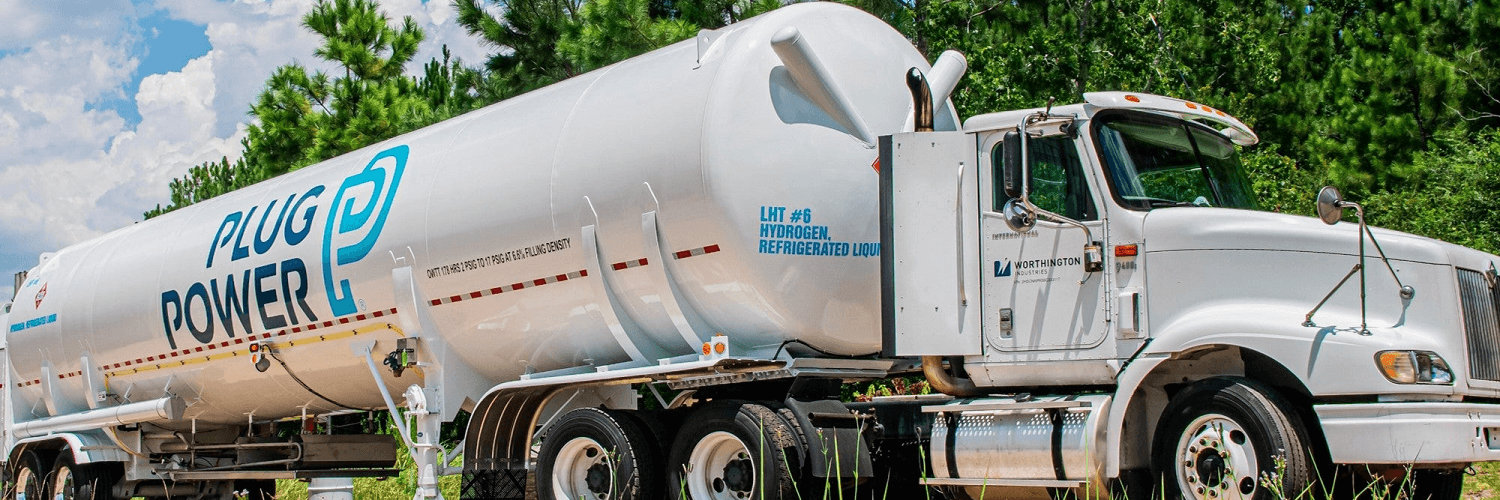

Plug Power Inc
NASDAQ:PLUG



Decide at what price you'd be comfortable buying and we'll help you stay ready.

|
Johnson & Johnson
NYSE:JNJ
|
US |

|
Berkshire Hathaway Inc
NYSE:BRK.A
|
US |

|
Bank of America Corp
NYSE:BAC
|
US |

|
Mastercard Inc
NYSE:MA
|
US |

|
UnitedHealth Group Inc
NYSE:UNH
|
US |

|
Exxon Mobil Corp
NYSE:XOM
|
US |

|
Pfizer Inc
NYSE:PFE
|
US |

|
Nike Inc
NYSE:NKE
|
US |

|
Visa Inc
NYSE:V
|
US |

|
Alibaba Group Holding Ltd
NYSE:BABA
|
CN |

|
JPMorgan Chase & Co
NYSE:JPM
|
US |

|
Coca-Cola Co
NYSE:KO
|
US |

|
Verizon Communications Inc
NYSE:VZ
|
US |

|
Chevron Corp
NYSE:CVX
|
US |

|
Walt Disney Co
NYSE:DIS
|
US |

|
PayPal Holdings Inc
NASDAQ:PYPL
|
US |
Q4-2025 Earnings Call
AI Summary
Earnings Call on Mar 2, 2026
Leadership: Jose Luis Crespo made his first call as CEO and reiterated a mandate to convert Plug's industry leadership into sustained profitable growth.
2025 Results: Plug delivered ~30% revenue growth in 2025 and turned Q4 gross margin positive at 2.4%, up 125 percentage points from Q4 2024 (-1.25%).
Profitability Roadmap: Management reiterated targets: positive EBITDA in Q4 2026, positive operating income in 2027, and full profitability in 2028.
Cash & Liquidity: Unrestricted cash ended 2025 at $368.5 million and management expects $275 million of proceeds from asset monetizations to close in H1 2026.
One-time Charges: Plug recorded a $763 million net charge in Q4 tied mainly to noncash impairments and capital transaction adjustments.
Electrolyzer momentum: Record electrolyzers revenue of $188 million in 2025; company has shipped over 300 MW of electrolysis and reported a roughly $8 billion electrolyzer funnel.
Demand drivers: Management expects 2026 revenue growth directionally similar to 2025, led by material handling (pedestal customers, refresh programs) and continued electrolyzer project conversions.
Confidence level: Management said it has high confidence (~77%–80%) in most of 2026 revenue and expects the remaining ~20% to close as projects finalize.
Management presented a clear multi-year financial roadmap: they expect positive EBITDA in Q4 2026, target positive operating income in 2027, and full profitability in 2028. The plan relies on continued top-line growth, further margin improvements from cost reduction programs, and monetization of certain assets.
Plug emphasized margin progress driven by Project Quantum Leap and product cost-down efforts. Q4 benefits came from lower unit service costs, overhead leverage from higher volumes, production-cost improvements at hydrogen facilities (including Louisiana), and tighter OpEx controls. Management expects further margin gains in 2026 as these actions mature.
Material handling is expected to be the primary 2026 growth driver. Management pointed to renewed investment and fleet refresh programs from large customers (e.g., Amazon, Walmart), new pedestal customers being signed, and the reinstated ITC improving economics for customers.
Plug reported record electrolyzer revenue ($188 million in 2025), >300 MW shipped globally, and an ~ $8 billion funnel. They highlighted European regulatory mandates and funded incentives as a structural tailwind and noted several projects moving toward FID, with BEDP work (hundreds of MW) signed recently.
Plug ramped hydrogen production capacity (three facilities including Louisiana) and reported improved fuel cost and efficiency from better plant utilization, network sourcing agreements, and site-level operational improvements. Management expects further fuel-cost and logistics gains with increased scale.
Plug ended 2025 with $368.5 million in unrestricted cash, has a planned $275 million monetization expected in H1 2026, and describes an effectively de-levered balance sheet after recent debt restructuring (cited cost of capital ~7%). Management believes existing resources plus monetization proceeds are sufficient to fund 2026 without new capital.
Q4 included a net $763 million of mostly noncash charges (impairments of PP&E, intangibles, PPA- and fuel-related assets) reflecting slower near-term market growth for certain products. Management noted these impairments will reduce future depreciation and amortization.
Management reiterated seasonality (roughly 1/3 of sales in first half, 2/3 in second half) and said ~77%–80% of the 2026 revenue outlook is high-confidence, with the remaining ~20% representing deals in advanced negotiation expected to close in the coming months.

Greetings, and welcome to the Plug Power Q4 and Year-End 2025 Earnings Conference Call and Webcast. [Operator Instructions] As a reminder, this conference is being recorded.
It's now my pleasure to turn the call over to Teal Hoyos, Vice President, Marketing and Communications. Please go ahead, Teal.
Thank you. Welcome to the 2025 Fourth Quarter Earnings Call. This call will include forward-looking statements. These forward-looking statements contain projections of our future results of operations, of our financial position or other forward-looking information. We intend these forward-looking statements to be covered by the safe harbor provisions for forward-looking statements contained in Section 27A of the Securities Act of 1933, and Section 21E of the Securities Exchange Act of 1934.
We believe that it is important to communicate our future expectations to investors. However, investors are cautioned not to unduly rely on forward-looking statements, and such statements should not be read or understood as a guarantee of future performance or results. Such statements are subject to risks and uncertainties that could cause actual results, or performance, to differ materially from those discussed as a result of various factors, including, but not limited to, risks and uncertainties discussed under Item 1A Risk Factors in our annual report, on Form 10-K for the fiscal year ending December 31, 2024. For quarterly reports on Form 10-Q for the quarters ended March 31, 2025, June 30, 2025, and September 31, 2025, as well as other reports we file from time to time with the SEC. These forward-looking statements speak only as of the day in which the statements are made, and we do not undertake or intend to update any forward-looking statements after this call, or as a result of new information.
At this point, I would like to turn the call over to Plug Power's new CEO, Jose Luis Crespo.
Good afternoon, everyone, and thank you for joining us. As many of you know, today is my first earnings call as CEO. I would like to begin by acknowledging the foundation I am inheriting. Andy led this company for almost 20 years with vision and determination, building Plug into a global leader in the green hydrogen ecosystem. That is a platform a few CEOs are fortunate to inherit and I am grateful for it.
My mandate is clear. I will work to convert this leadership position into sustained profitable growth. I have been part of building this company, setting and executing on its strategy. I deeply understand both the opportunity in front of us and the discipline required to realize it.
We entered 2025 focus on these objectives. Grow the top line, improved margins, targeting margin neutral in Q4, reduced cash usage, expand hydrogen production, including commissioning the Louisiana plant all while strengthening liquidity. We deliver against those objectives. In 2025, we achieved approximately 30% revenue growth while turning gross positive margin in the fourth quarter. Gross margin improved by 125 points, from negative [ 1.25% ] in Q4, 2024 to positive 2.4% in Q4, 2025. A 125 percentage point improvement in gross margin is a meaningful milestone in strengthening our operating performance.
The results we delivered were not accidental. They reflect ambition there with discipline, focused execution and the hard work of the entire Plug team. 2025 was a defining year for Plug. In a highly uncertain macroeconomic environment, we grew revenue at double-digit rates and achieved positive margin. A combination has been challenging for many companies in our sector. We believe this represents an inflection point.
Now that said, we are not done. We still have work to do to achieve sustained profitability while maintaining growth. My responsibility now is to build on this momentum and continue progressing toward profitability. In 2026, our focus remains on advancing toward profitable growth. We currently expect revenue growth in 2026 to be directionally comparable to 2025, driven primarily by our material handling and electrolyzer business.
In material handling, favorable conditions have emerged. The reinstatement of the investment tax credit in January, combined with increased demand from [indiscernible] customers such as Amazon and Walmart position us for renewed growth in this segment. We are seeing new developments and [ fleet refresh ] programs at key customer sites, activity increased across both new and repeat customers.
Our electrolyzers business continues to develop and expand globally. Today, the company has shipped over 300 megawatts of our [ Genco ] electrolysis globally, and are now deployed on 6 continents, demonstrating significant operating experience across multiple markets. In 2025, we delivered equipment for major projects, including a 25-megawatt project with Ibedrola [indiscernible] in Spain, and a 100-megawatt project with [indiscernible] in Portugal, resulting in a record $ 188 million in electrolyzers revenue.
Europe's regulatory mandates and funded incentive programs provide structural support for hydrogen adoption. We see significant opportunity in refinery decarbonization and in the production of [indiscernible] [ e-methanol ], synthetic jet fuel and ammonia. We estimate that meeting European mandates just for transportation could require 4 to 6 gigawatts of electrolyzer capacity by 2030, and we intend to compete for a meaningful portion of that opportunity. We remain focused on converting as much as possible of our approximately $8 billion electrolyzer funnel into revenue-generating projects that will support Plug's long-term growth.
In 2026 we expect to begin executing projects with [indiscernible] in the U.K., and we will continue progressing with [indiscernible] towards FID on the 3 gigawatt project in Australia, and the 2 gigawatt project in Uzbekistan. As an example of the activity in the market, over the last 2 months, we executed 350 megawatts of new basic engineering design packages agreements.
In 2026, we expect to see full year benefit of the [indiscernible] initiatives launched in 2025. These improvements are expected to be further supported by continued cost reductions and optimization efforts across the business. Together with revenue growth, these actions position us to achieve positive EBITDA in the fourth quarter of 2026, consistent with our previously stated targets.
We also intend to continue reducing cash usage in 2026. We ended 2025 with $368.5 million in unrestricted cash. We currently expect continued improvement in cash usage similar to the reduction achieved in 2025. With ongoing cash flow improvements and the planned $275 million proceeds from the monetization of assets, and associated rights announced in Q4, 2025, which we expect to close in the first half of 2026, we believe we are well positioned to support our operation plans through 2026.
In conclusion, we continue our journey towards profitability. 2025 was about margin progression, optimizing the platform we have built, enforcing cost discipline, strengthening infrastructure control, improving liquidity and sharpening our strategic focus. 2026 will be about continued sales growth and advancing the financial milestones outlined in our road map, including our target of achieving positive EBITDA in Q4, 2026, a milestone within our road map towards positive operating income in 2027, and full profitability in 2028.
With that, I will now turn the call over to Paul for a detailed review of the fourth quarter and full year financial results. Paul?
Thanks a lot, Jose Luis. Let me first expand on the margin results. The significant improvement we achieved stems from a culmination of efforts over the last 2 years to optimize and scale the investments we have made. We've made a conscious effort to really focus on margin and cash flow improvement. And this includes multiple actions undertaken within [ Project Quantum Leap ] and our overall product cost down road maps. More specifically, in Q4, the results benefited from significant improvements in the unit service costs, achieving rates almost half of what they were over -- a little over a year ago, ramping our hydrogen platform through our 3 facilities, including Louisiana that was turned on and scaled up this year. Scaling sales volumes increased sales provides tremendous incremental overhead leverage, and continued discipline and scrutiny over discretionary spending.
Equally important to these Q4 results is the fact that we see this progress as a platform to continue driving towards our 2026 financial targets. Regarding cash usage, we saw improvements throughout the year, and these actions were associated with [ Project Quantum Leap ] and included targeted price increases, labor optimization, rooftop consolidations, improvements in production costs and leveraging our hydrogen platform, and clear focus on reducing our OpEx resource investment. We expect 2026 to include a full year of benefits from these activities undertaken last year. In addition, we see significant upside to continue this optimization effort to drive even more leverage as we grow sales.
We anticipate continued improvement, incremental leverage from growth in equipment sales, given our capacity, continued improvements in our service cost profile, additional improvements in fuel efficiency and network leverage, and continued scrutiny over OpEx of resources. We continue to be laser-focused on driving growth in margins and cash flows in near term in achieving our Q4 goal of positive evidence.
Despite the progress we made as conveyed in our filing, we determined it was prudent for Plug to record a net $763 million in various charges associated predominantly with noncash charges asset impairments and the capital transactions we undertook in Q4. The impairment charges stem from multiple factors, including overall market conditions, resulting in slower growth and anticipated for certain products. In terms of impairments, this relates to property, plant and equipment, intangible assets, and assets associated with power purchase agreements and fuel. As a result of these impairments, it will reduce our future amortization depreciation '26 and onward.
In terms of liquidity, as Jose mentioned, we ended with over $368 million in unrestricted cash. We recently executed the first of 3 transactions associated with monetizing the $275 million for the data center project sales. We have an effectively unleveraged balance sheet, given our debt restructuring we undertook, which also lowered our cost of capital and extended the maturity. We have also significantly curtailed our CapEx expenses, and we believe we have the platform we need to deliver our financial goals, so we anticipate even lower CapEx rates in 2026. These factors, coupled with the focus on improvement in margin cash flows put us in a strong position to achieve our near-term and midterm financial goals, and fund our operating plan for '26.
GAAP EPS for Q4 '25 was $0.63 negative, compared to GAAP EPS of negative $1.48 for Q4 '24. But if we exclude the unusual charges in each period, adjusted EPS for Q4 '25 was negative $0.06, versus adjusted EPS for Q4 '24 of negative $0.29. And the progression is just another illustration of how operationally the company is making progress holistically in growing overall sales and margin profiles.
I'll now turn the call back over to Jose Luis.
Thank you, Paul. We will now open the call for questions.
[Operator Instructions] Our first question today is coming from Colin Rusch from Oppenheimer.
Congratulations on the progress here. So as you look at 2026 from a revenue growth perspective, can you just give us a bit more color around which drivers are actually moving the needle from a growth perspective? It looks like you're talking about low double-digit growth overall. I'm just curious if there's one part of the product business that's actually making an outsized impact on that growth?
So for 2026, as I mentioned, we are projecting similar growth as we saw in 2025. And the main drivers for that growth are going to be material handling. What we're seeing in material handling is our pedestal customers are going back to growth. We are also seeing refreshes. Some of the sites that we have with some of the [indiscernible] customers are sites that have been running between 5 and 6, 7 years, time to refresh. So we see an uptick on that.
We also see new customers. As you know, we signed [ Floor & Decor ] last year, but we see other customers coming online in 2026. And also the value proposition is just getting stronger when -- and I think we mentioned this during the symposium. Our customers are beginning to see also that the material handling fuel cell solution allows them to reduce their utility demand on their sites, which is really valuable for customers in days where we all know that utility and electricity availability is becoming more challenging.
But that's not the only area that we're going to see growth. As I mentioned, in the electrolyzer business, we also see growth and opportunities. We just signed, at the end of 2025, we announced that the agreement with [ Carlton Power ] for 55 megawatts. And we are looking at, in the next couple of months or so, signing a similar agreement from another project in Australia. We have -- a lot of the projects that we have in the funnel are beginning to move further into FID. So we are expecting to see also growth in the electrolyzer business. So those are going to be two main drivers for growth in 2026.
Excellent. And [indiscernible], when you look at the fuel margins and the cost of that fuel, I know you're getting better at optimizing some of the production costs, and timing around that. But I'm curious about how quickly you can start driving some of those margins closer to breakeven on the fuel side?
Yes. Thanks, Colin. I think just to clarify, if we kind of look back and we think about some of the things we've done, I mean, obviously, turning on these 3 plants and vertically integrate and puts us in a great position and we've seen that in the benefits in our results. We see that continuing to trend upwards. We've been on this maturity curve of optimizing those facilities. We hit all-time records in the Georgia plant for many of the months in 2025. And we've seen a progression in the utilization and efficiency of the newer plant in Louisiana, as we've turned that on this year and scaled that up. So one thing we expect for 2026 is obviously better leverage on those facilities now that we can take those learnings and run those plants even more efficiently.
Second thing is, obviously, we're adding, as Jose mentioned, more sites, more material handling customers. And a lot of that we're going to feed through those plants and so you get greater volume leverage, which is important. We've shown progression in our logistics network and how we can drive greater efficiency through that.
And then the last one of the other challenges we've been focused on and really made tremendous progress is the efficiencies at the sites in terms of how the systems offer, the recapture the gas, how do you make sure that you minimize any losses of the molecule through the system? So the combination of those things, coupled with the new agreement we signed with the third-party gas company last year that's reduced prices, but also put us on a platform of working with them to optimize the network with which sites were sourced from which plants. All of those factors are what's been driving the improvement and we're going to see additional improvement this year.
So I think we're going to directionally be moving there as we progress through the year. And part of it will be tied to -- the [indiscernible] timing of turning on some of these volumes and additional leverage out of those facilities as the year progresses. But we expect that we're -- we have been, and we expect that we're going to continue to move in the right direction in that regard for the course of the year.
Next question today is coming from Craig Irwin from ROTH Capital Partners.
So first one I wanted to ask about is just an update on the cash needs this year. So you guys did a great job last year, $368 million in restricted -- in unrestricted cash exiting the year. You got your cash burn down dramatically year-over-year. You've put in place the [ $275 million ] in asset sales. You're obviously continuing to execute on the restricted cash for your PPAs, your historical PPAs as those roll off? And I guess as you make new sales, which is good.
But can you maybe help us understand the tempo of cash needs across this year now that we don't have some of these big construction projects, and that you've taken all these other steps to put in place, the actions to get to positive EBITDA?
Thank you for the question, Craig. Paul, do you want to cover that?
Yes. Thanks, Craig. A couple of things. One, if you look at the progression in the last couple of years, just the improvements in margin and just overall profitability, and how that's been playing, as well as our leverage of our working capital, you've seen the reduction in operating cash flows and cash burn in general. You've also seen a big reduction in the CapEx.
I mean -- I think if you look at the Q4 rates, one of the lowest CapEx rates we've had in a long time. So it postures us really well because we expect certainly, as we talk about our financial targets this year and getting to EBITDA breakeven to positive in Q4, we expect a similar reduction in the cash burn that we've experienced the last couple of years. And so if you just look at that mathematically, coupled with a very nominal CapEx rate, it mathematically puts you in a position where the opening cash position we have is almost enough to cover it all, but obviously, the [ $275 million ] puts us in a great position to fund the year. So we sit today and our working plan is that we've got more adequate existing, capital and access to that capital that's coming in through those projects to fund this year without needing incremental capital.
I do have optionality. I have an unleveraged balance sheet. So it's not my preference to go out and get debt. But obviously, and now that we've restructured the debt, I've got an incredibly low cost of capital structure in place right now, that 7% range. And so I'm in a good spot overall, in terms of lots of other factors.
There's other positive things that are happening like we've gotten past through some of the acquisitions and the earnouts, and we've got some of those things behind us. We've really tempered the JV investments. A lot of things have just been very -- put us in a good position where just the overall cash needs have dropped substantially. So I guess in conclusion -- and if you look at seasonality of the sales, with the 1/3, 2/3, you can expect probably a little bit heavier burn in the first half. And as the volume grows in the second half when we convert those into collections, and leverage even more inventory, it will even be better in the second half.
And as we sit today, given the working capital position, for me, [indiscernible] as kind of a proxy of cash flows. So you could almost I think there's a decent chance we might even get to breakeven to positive cash flows in the Q4, not just the [ EBITDA's ] KPI as well. So I think, hopefully, that helps, Craig.
Fantastic. That's very helpful. So along the -- a similar theme, right. Your new project, new sales commitments that you're making today, obviously made with a different discipline than you than you had in the market a few years ago with the pricing changes and the complete focus on profitability now at Plug. Can you maybe just give us a little bit more color on the 750 megawatts new engineering design package agreements you signed in the quarter?
Are customers paying for these engineering packages upfront now? What do we see as a potential time line for some of these fresh new orders to come through and potentially materialize as bookings? And then revenue how do we look at these opportunities? And is this mostly a new set of customers? Or has this got significant overlap with the existing customer base?
Thank you. Just going to clarify is, focused on profitability through growth. So growth is a very important part of our strategy. And yes, the 750 megawatts of BEDPs that we have signed and started working in the last few months are all new projects. Some projects are in North America, a couple of them are in North America. We also have projects in Europe. The time line is a little bit different for each one of them. A couple of them are, at least at the moment, the FID time line is into [ 2017 ], but there is one project that actually we are replacing, an existing -- a prior electrolyzer company that is no longer going to be doing this project, and they have picked us to do this BEDP for them, you can infer probably what the company is. And that project is already pretty advanced. And what we're doing right now is basically doing a very quick BEDP. And that project has probabilities to be FID in 2026.
So a little bit of a different time line for the different projects, but all of them are in the next 12 to 24 months, in the current planning for the FIDs.
[Operator Instructions] Our next question is coming from Eric Stine from Craig Hallum.
This is Luke on for Eric. So first one here, just how do you expect activity on the hydrogen pipeline front in Europe to progress after last month's delivery announcement in the Netherlands? Is that -- should we expect to see further inroads there in 2026?
Luke, you mean like the deployment, or the development of the actual pipeline in the European market?
Yes. And just potential inroads that Plug might be making there in '26 and beyond.
So if I understand correctly the question, the pipeline that you're referring to is in the Netherlands, which was announced a couple of years ago that we're continuing to do the deployment in that pipeline. What Plug, and in general, the industry benefits from is that having a pipeline allows us to basically have a [ uptake ] for generation. And what we see, for example, in the Netherlands, we have several projects that we are discussing of companies that are looking to generating to put into that pipeline in particular. So it's a positive development in the industry, and it will help with projects going FID given that they can they can deliver hydrogen to that pipeline.
I don't know if that answers your question, Luke?
No, I think so. That's helpful. And just as a quick follow-up here. So just quickly on the data center opportunity. I mean you pointed out last quarter as having potential for hydrogen based backup power. Obviously, [indiscernible] is very early stages. Just wondering if you had any updated thoughts on potential use cases in this market?
For the particular case of the data center opportunity, we agreed with [indiscernible] that we were going to be working on potential applications. We have been concentrating with them right now on closing the deal itself, but open discussion on what we could use fuel cells for. So at this moment, we are concentrated in closing the deal. And in terms of applications, we're going to start discussing with them about what stationary applications we could -- we could launch together once the deal is closed.
Your next question today is coming from Jason [indiscernible] from Canaccord Genuity.
With regard to material handling, I think in the last call, you said this is a $14 billion opportunity overall. And you've only really started to scratch the surface with this. Obviously, the price and availability of hydrogen is clearly a major gating factor. I'm curious beyond that, what are some of the other things within your control that the company can do to sort of help capture an incrementally greater share of that opportunity going forward?
Well, we're working with all of our main customers [indiscernible] customers like Amazon and Walmart, making sure that they can extract as much value of the technology as possible. One of the things that we are seeing, I think I mentioned that before, is that many of our companies are seeing the value of the utility advantages of using fuel cells. For many of our customers, they need between 1 and 2 megawatts to power batteries, if they use batteries in their distribution centers. But when you use fuel cells, you open up that capacity for other uses or actually just to be able to reduce consumption and connection to the grid.
Those types of things are the type of things that little by little, we are [ decovering ] and working with customers, to understand better how they can take advantage of the technology and to make sure that the business case can be expanded to as many applications within material handling as possible. And we believe that as time goes by, we will be able to unlock further markets within the material handling business.
Great. That's very helpful. And one follow-up. In the release, you talked about launching multiple follow-on actions to continue reducing costs and improving cash flow in '26? Wondering if you could share little bit more about specifics of some of those initiatives?
Do you want to go over that, Paul?
Yes. I think we are constantly looking at things like our [indiscernible] of materials or designs. We have opportunities to look at our manufacturing processes and think about how to streamline those. We're thinking about how we -- where we deliver from a distribution standpoint, a [indiscernible] standpoint, our network for electrolyzers as an example. There's just -- we -- if you look at the last 10, 12 years, the things that we've done and from looking at -- working with vendors on the supply cost to structures that we have with how we manage the supply chain to our manufacturing processes, to even additional ways to optimize facilities as we continue to reduce inventory. We need less warehouses as an example.
So we look at it holistically. And there's -- we just -- we believe we're still very early in the curve of opportunities over the next couple of years. So those are just some of the examples and ideas of things that we have active efforts around. We've had some very conscious efforts in the last 2 years to deliver these specific targets and improvements. And we think that it's just themes that we can continue to optimize the overall company to continue driving the margin profile.
Next question is coming from Chris Dendrinos from RBC Capital Markets.
Maybe just to echo the congratulations on the positive EBIT -- positive gross margins this quarter. Following up on the last question, the press release, I think, also says that you're potentially looking at other asset monetizations that have been impaired. Can you maybe discuss what those might be potential time lines on those opportunities?
You want to?
Well, let me say it this way. If you think -- if you go back the last couple of years, the themes that we've been talking about in some of these markets, haven't kind of developed as fast as we thought. And so from an accounting standpoint, you do -- you go through your accounting exercises and then kind of you land on the conclusions of what you can include in your forecast and so forth that may or may not create those impairments. But we still -- we have incredible portfolio of assets and opportunities that we can either look for alternative ways to monetize it, like the data center sales, or we still have opportunities in the pipeline in these different markets that can manifest. And -- and as they start to manifest -- and we really believe it's a question of win.
I mean, I don't think anybody doesn't believe markets like mobility and high-power stationery, just to pick a few aren't going to happen. It's just a question of when. And so as those things start to unfold, we still have all of these assets that we can really, truly leverage. And so it could be a combination of sales in those spaces, or it could be a combination of alternative uses that we look at. So it happens. It's just one of the ways that we're really centering in with how do we think get the best value of this big asset portfolio in the short term.
Got it. And then I guess maybe as a follow-up here. You've got the $8 billion pipeline. And just trying to think through, maybe how much of this year's outlook is secured by that pipe, or maybe what's in the backlog? And just how you're thinking about, I guess, overall kind of confidence in the year, given kind of existing commitments?
So for the year, on the outlook that we just discussed, which it is a growth similar to what we saw in 2025, we have very high confidence of probably close to 80% of that revenue amount. And also high confidence that -- we were confident that we will be able to close the additional 20%. So entering the year with that high backlog, if you want to call it that way, it is a very good position to be able to project where we think we're going to end the year.
Obviously, years advance as they go. But at this moment, we feel pretty confident on the projection that we just gave on similar growth as 2025.
Our next question today is coming from Sherif Elmaghrabi from BTIG.
When you think about a potential hydrogen plant with New York versus the liquidity opportunity that presents, any insight you could share to how you balance that cash with your hydrogen fuel demand 2 years down the road, 5 years down the road?
Sherif, thank you for the question. So we have looked very carefully at our hydrogen needs and the potential, or the probability, or the possibility to monetize the assets like we did -- that we're planning to do in New York. We mentioned this also in the prior earnings call. What we have been able to is -- we have been able to get to an agreement with one of the largest [indiscernible] to provide hydrogen for us at reasonable cost, much better cost than we were getting before. And that added to the current capacity that we have right now, which is [ about 40 tons ] at a nominal capacity. And added to the possibility that we have also -- and we are discussing with some customers that are planning to do liquefaction to take some offtake from those potential projects. We're comfortable that we have a good path for -- to cover the demand in the next few years based on our projections for growth, especially in the material handling market.
So we found that the capability to be able to monetize those assets was something that it was more valuable for Plug at this moment than making the investment of building a plant in New York. We have not -- we put all those [ plans ] for growth for production on hold at this moment. That doesn't mean that in the future, we may not pick up some of these plans when we are able to show that we can perform financially, and maybe able to finance these projects in a much more efficient way. But at the moment, monetizing those projects, and with the hydrogen availability that we have visibility for, we feel that this is the best solution and the best path for growth for Plug.
Got it. And then the One Big Beautiful Bill Act reinstated tax credits, but it also introduced stricter requirements for eligibility, and that's something that's been a supply chain headache for some renewables players. So I'm wondering if Plug Power has had to retool its supply chain meaningfully?
So for the ITC, the investment tax credit, what we have seen is that the requirements to be able to take advantage of the tax credit were meaningfully simplified from what they were before the past -- last year in Congress. So at this moment, actually, this 30% tax credit has become even a simpler way for our customers to take advantage of. And we've been discussing with many of our customers on this and they agree on this point. So it's actually been an improvement on the credit process for our customers.
Your next question is coming from Sameer Joshi from H.C. Wainwright.
Congrats on the new role, officially the new role. So, I think, I just wanted to hit on two broad categories on revenues from material handling. Are we looking to add additional [ pedestal ] customers just like the flooring something that was at the symposium? And then how -- on the electrolyte plant -- electrolyzer front, the 8-gigawatt pipeline that you spoke about, how is that plan to be converted into orders?
So -- thanks Sameer. On the material handling side, we are talking to many new potential customers. I think we're going to see some new customers being signed. And some of them, like you mentioned, [indiscernible] can be multi-side, or what we call pedestal customers. So there is an open door for new pedestal customers in 2026 and beyond.
On the $8 billion funnel for electrolyzers, we continue working with many of the companies that we have in that funnel towards FID, towards the financial investment decision, final investment decision. What we're seeing in many cases is with some -- especially in the European market, but also, as I said, we saw -- we're going to see some new opportunities closing in Australia, and we closed the opportunity in the U.K. with [ Carton Power ] [indiscernible] at the end of last year, which will be executed this year.
What we're seeing in the European market is that the [ RED III ] regulation is being converted into law in many of the countries in Europe, which requires certain -- especially for the transportation sector, which requires a certain percentage of the hydrogen use for transportation purposes, including refineries, to convert to green hydrogen at a rate of about 1% by 2030. This means that refineries like [indiscernible] or other refineries in Europe are looking to ways to meet that -- those requirements. And this is what is accelerating the investment decision in many of these projects.
What we're going to see is in the next 12 to 24 months, as the mandate becomes law, we're going to see these projects coming to fruition, and we're expecting to take a [indiscernible] of that funnel. So that is kind of the time line that I'm looking at right now for conversion of the funnel.
And then on the margin front, I mean, really congratulations on the success on bringing margins down, especially on the services and also on the equipment. On the equipment sales going forward, should we continue -- like should we see what you -- positive gross margins, or because of lower revenues expected seasonally margins will be still in sort of negative teens?
Do you want to cover...
For equipment and specific...
Yes. Sameer, it's Paul. Yes. I would say if you just look at it mathematically with how Q1 typically is in relation to our annual sale in a seasonality standpoint and you kind of apply that to the math that Jose shared with looking at sales projections next year, I think we would see sequentially, it's coming down from Q4. It should be probably better than in that range of that same percentage from last year's Q1. But just sequentially with the lower volume equipment really is tied to leverage.
So -- and most of it is just timing of those sales. And so without that incremental volume in the quarter, comparatively speaking, it's definitely going to affect margin. So you probably see a bit of a dip on the absolute and on the equipment margin in particular. But there are some favorable events. We definitely -- all the rooftop consolidations, all the things we've been doing next year that play well in terms of mitigating some of that. So on the whole, yes, but probably directionally better -- certainly better than Q1 last year.
You're going to see progress both on sales and margin quarter-over-quarter -- I'm sorry, year-over-year on each quarter. So you probably -- but if you look at 1/3 of sales happen in the first half of the year, and 2/3 in the second half, a lot of it is tied to volume. And when you look at what we've talked about for Q4, in particular, getting to that EBITDA positive range with kind of a $300 million sales proxy, it just gets you a tone of how that might play for the year. So hopefully, that helps.
Yes. No, that is really helpful. And I wanted to reconfirm that you're still targeting -- or from where you sit right now, you still are seeing 2/3 of the sales in second half, right?
Yes.
Yes.
[Operator Instructions] Our next question is coming from [ Chris Sung ] from Wolfe Search.
Congrats Jose, on first day on the job. Yes, so most of my questions has already been asked. But I guess if you were to just provide some sort of guidance on your outlook for '26, are you able to share the segment mix? You're assuming across materials handling, electrolyzers fueling, et cetera?
So it's going to be similar to what we've seen in 2025. Probably we're talking in the -- I will have to get the numbers a little bit more detail in there. But probably material handling will be in the 30% to 40% of revenues, right?
Yes.
And then you're going to see a similar amount, probably a little bit less on electrolyzers, and then the rest is going to be our fuel and [indiscernible] business. So that's kind of the mix that we're going to see. Material handling is still going to be the largest revenue generator for the company in 2026.
Right. And that makes sense. And just a follow-up on one of your responses earlier about 80% of '26 kind of like firm, or high confidence in the other 20%. Is that kind of -- is the right way to think about that, the 20% are external factors for customers that are -- that need to hit like specific milestones? Or like outside of your control? Or how do you think about that?
That 20% is projects that we are in the process of closing right now. Probably we're looking into closing them in the next few months that will secure the revenue for 2026. The other 80%, 77% to 80%, is what I calculated that we have in high probability are projects that we either have a firm commitment from the customer, or it's being finalized the commitment. So that 20% is projects that are right now being negotiated, and we're expecting to close them. We think the year to be able to realize renew within the year as well.
Our next question today is coming from Ameet Thakkar from BMO Capital Markets.
Just one quick one for [indiscernible] congrats. Just you mentioned kind of momentum in kind of growing with your existing pedestal customers. One of your larger [indiscernible] customers, Walmart, you executed a release event license agreement with them earlier in this year. I was just wondering with your larger pedestal customers, to the extent they want to add more sites with you, do you anticipate kind of executing similar agreements with them before kind of doing so, and throughout 2026?
Yes, you're referring to the licensing agreement? No, that was a very specific agreement with Walmart that we executed. An agreement that actually will help us to continue building and growing the relationship with Walmart, but I'm not expecting any similar agreements with any of the customers in 2026.
Okay. And just maybe one quick follow-up on a different topic. I know [indiscernible] in Spain and [indiscernible] kind of green lit a fairly large electrolyzer project today. I was just wondering if you guys have any kind of role in that project, [indiscernible]
No, that was a project that was announced earlier in 2024. So it's been a project that has been out there for a while. It seems like when FID this week, today. And as far as I know, and I will have to kind of look at that, it is an alkaline project. It's a 300-megawatt alkaline project, and we are not part of that project.
We are talking to other -- and we're talking to refineries in Spain about projects as well, but that project, in particular, is a 2024 project that seems to be going FID at this moment. But I think it's good news in terms of the conversion that we're going to start seeing, as I was saying before, of projects to FID. These are projects that have been hanging for the last 24 months, and now they're coming to fruition. This is kind of what we're expecting to see in the near future with the projects that we have in our funnels.
We reached the end of our question-and-answer session. I'd like to turn the floor back over to Jose Luis for any further or closing comments.
Well, thank you, everyone, for the thoughtful questions and for your continued engagement, and for joining us on, my first, earnings call as the CEO. Let me leave you with this. 2025 mark a structural turning point for Plug. We demonstrated that we can grow revenue while restoring margin discipline, and that combination matters.
In 2026, our focus and targets are clear. Execute with discipline, reduce cash usage and deliver EBITDA positive in the fourth quarter. The foundation is in place. The cost structure is improving, and the demand drivers are strengthening. We really appreciate your support and look forward to updating you on our progress next quarter. And also, you are -- Friday, I'm going to be [ closing the bell ] at [ NASDAQ ]. So you can go to our website, and you're going to have a link to see me and a big part of the Plug team that has made the results this year in 2025 possible, closing the bell with me. Thank you, everyone. Really appreciate your time.
Thank you. That does conclude today's teleconference and webcast. You may disconnect your line at this time, and have a wonderful day. We thank you for your participation today.