
Enterprise Products Partners LP
NYSE:EPD



Enterprise Products Partners LP
Wide
Economic Moat
Enterprise Products Partners maintains a wide economic moat driven primarily by its large, integrated midstream footprint, long-term contracted cashflows, and cost advantages from scale and asset integration.
Enterprise Products Partners LP
Competitive Advantages
A large, interconnected pipeline and terminal network increases value as more producers and downstream customers connect, strengthening market access and volume flows.
Long-term dedicated and fee-based contracts with producers and shippers lock in volumes and create durable, predictable cash flows that are costly for customers to replace.
Regulatory approvals, acreage dedications, and strategically located export and fractionation capacity function as hard-to-replicate rights and relationships that protect franchise economics.
Scale and integration across gathering, processing, fractionation and export reduce unit operating and transportation costs, producing lower per-unit economics than smaller rivals.
Extensive, integrated midstream infrastructure (pipelines, processing, storage and export terminals across major U.S. basins) creates high barriers to entry and allows EPD to capture most incremental regional volumes.
Wide Economic Moat Companies
| Company | Last Price | Price Change | Market Cap | Economic Moat | |
|---|---|---|---|---|---|

|
NVIDIA Corp
NVDA
|
$177.84 |
+0.8%
|
$4.3T | Wide |

|
Apple Inc
AAPL
|
$256.65 |
+2.1%
|
$3.8T | Wide |

|
Alphabet Inc
GOOGL
|
$298.63 |
-0.2%
|
$3.6T | Wide |

|
Microsoft Corp
MSFT
|
$409.48 |
+1.1%
|
$3T | Wide |

|
Amazon.com Inc
AMZN
|
$213.72 |
+1.6%
|
$2.3T | Wide |

|
Meta Platforms Inc
META
|
$643.97 |
+0.1%
|
$1.6T | Wide |

|
Broadcom Inc
AVGO
|
$331.33 |
-1.9%
|
$1.6T | Wide |

|
Walmart Inc
WMT
|
$123.41 |
+0.6%
|
$983.6B | Wide |

|
Eli Lilly and Co
LLY
|
$987.42 |
-1.4%
|
$933.5B | Wide |

|
JPMorgan Chase & Co
JPM
|
$288.84 |
-0.2%
|
$794.2B | Wide |
| Company | Last Price | Price Change | Market Cap | Economic Moat | |
|---|---|---|---|---|---|
|
|
NVIDIA Corp
NVDA
|
$177.84 |
+0.8%
|
$4.3T | Wide |
|
|
Apple Inc
AAPL
|
$256.65 |
+2.1%
|
$3.8T | Wide |
|
|
Alphabet Inc
GOOGL
|
$298.63 |
-0.2%
|
$3.6T | Wide |
|
|
Amazon.com Inc
AMZN
|
$213.72 |
+1.6%
|
$2.3T | Wide |
|
|
Meta Platforms Inc
META
|
$643.97 |
+0.1%
|
$1.6T | Wide |
|
|
Broadcom Inc
AVGO
|
$331.33 |
-1.9%
|
$1.6T | Wide |
|
|
Walmart Inc
WMT
|
$123.41 |
+0.6%
|
$983.6B | Wide |
|
|
Eli Lilly and Co
LLY
|
$987.42 |
-1.4%
|
$933.5B | Wide |
|
|
JPMorgan Chase & Co
JPM
|
$288.84 |
-0.2%
|
$794.2B | Wide |

|
Visa Inc
V
|
$315.79 |
+0%
|
$604.5B | Wide |
Enterprise Products Partners LP
Glance View
Enterprise Products Partners LP stands as a formidable player in the midstream energy sector, weaving a complex web that interconnects the expansive North American energy landscape. Founded in 1968, this Houston-based company has evolved into one of the largest publicly traded partnerships in the United States. The company's foundational strength is rooted in its vast network of natural gas, natural gas liquids (NGLs), crude oil, and petrochemical pipelines. These pipelines stretch over tens of thousands of miles, connecting production sites to refining facilities, and ultimately the end markets, ensuring that energy products move seamlessly from the point of extraction to where they are most needed. The firm not only owns these pipelines but also storage facilities, processing plants, and export terminals, each playing a crucial role in making sure the energy products are accessible in local and international markets alike. The genius of Enterprise Products Partners' business model lies in its fee-based revenue structure. Instead of relying heavily on the often volatile commodity prices, the company earns stable, predictable cash flows by charging fees for the transportation, storage, and processing of energy resources. This strategy allows Enterprise to mitigate risks associated with market fluctuations while capitalizing on the steady demand for energy infrastructure. The firm continually invests in expanding and modernizing its infrastructure to meet growing market demands and regulatory standards, further entrenching itself as a critical component of the energy supply chain. Through a mix of strategic acquisitions and organic growth, Enterprise not only maximizes efficiencies but also unlocks new avenues for value creation, underscoring its reputation as an indispensable bridge in the American energy ecosystem.
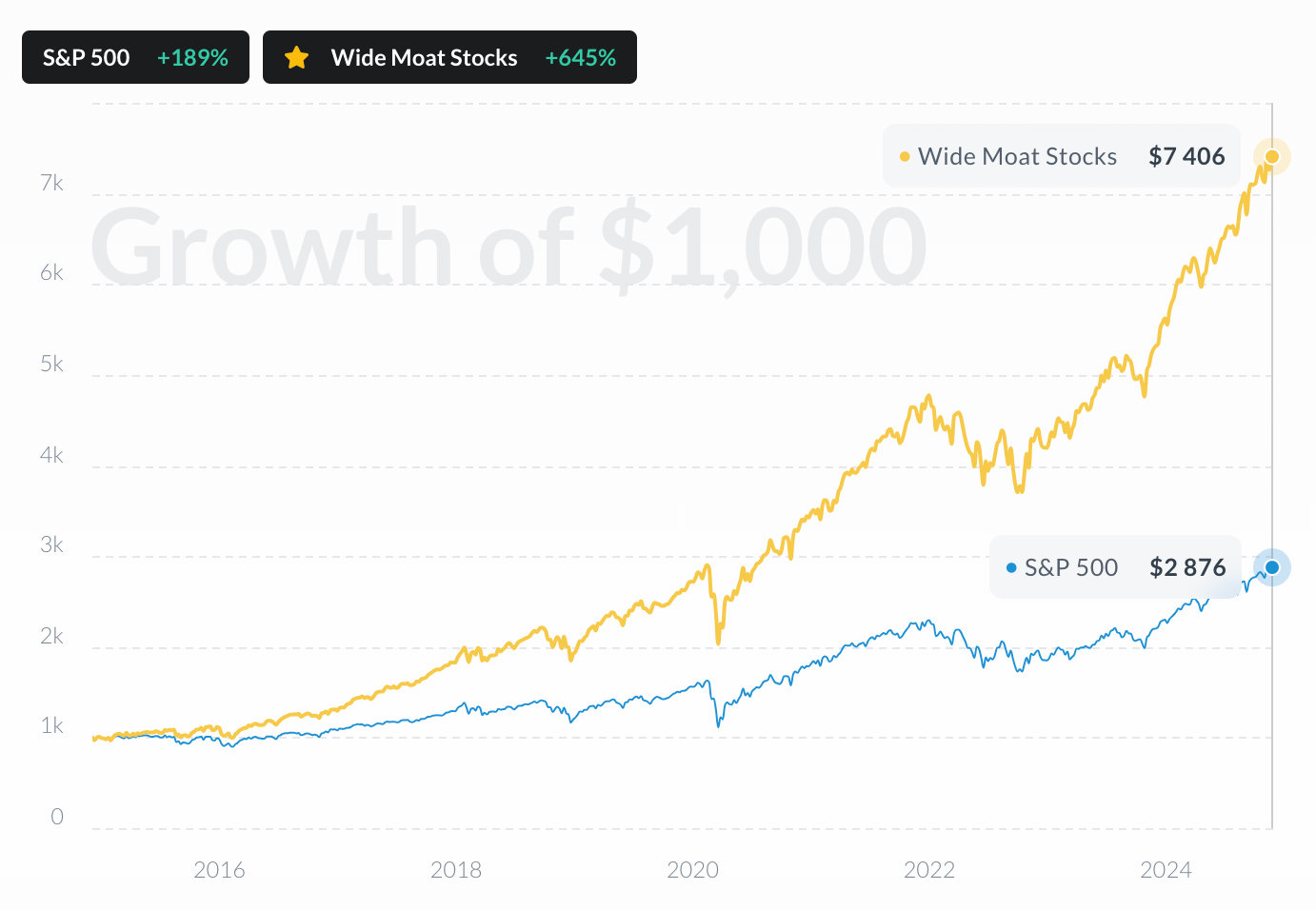
Our research into Economic Moat performance spans the past 10 years and focuses on companies with a wide economic moat. For this analysis, we calculated the average stock price returns of these companies, comparing them to the performance of the S&P 500 index over the same period.
The results were compelling: wide moat stocks achieved a remarkable +645% average return, compared to +188% for the broader market. This difference highlights the long-term benefits of investing in businesses that can maintain their market position and pricing power over time.
Note: This research does not account for survivorship bias. Past performance is not indicative of future results.
Economic Moat