
Advanced Micro Devices Inc
NASDAQ:AMD



Advanced Micro Devices Inc
Narrow
Economic Moat
Advanced Micro Devices Inc has a narrow economic moat, offering limited protection against competitors and some ability to sustain profitability.
Advanced Micro Devices Inc
Competitive Advantages
Wide Economic Moat Companies
| Company | Last Price | Price Change | Market Cap | Economic Moat | ||
|---|---|---|---|---|---|---|
|
|

|
NVIDIA Corp
NVDA
|
$177.84 |
+0.8%
|
$4.3T | Wide |
|
|

|
Apple Inc
AAPL
|
$256.65 |
+2.1%
|
$3.8T | Wide |
|
|

|
Alphabet Inc
GOOGL
|
$298.63 |
-0.2%
|
$3.6T | Wide |
|
|

|
Microsoft Corp
MSFT
|
$409.48 |
+1.1%
|
$3T | Wide |
|
|

|
Amazon.com Inc
AMZN
|
$213.72 |
+1.6%
|
$2.3T | Wide |
|
|

|
Taiwan Semiconductor Manufacturing Co Ltd
2330
|
NT$1 890 |
+2.5%
|
$1.6T | Wide |
|
|

|
Meta Platforms Inc
META
|
$643.97 |
+0.1%
|
$1.6T | Wide |
|
|

|
Broadcom Inc
AVGO
|
$331.33 |
-1.9%
|
$1.6T | Wide |
|
|

|
Walmart Inc
WMT
|
$123.41 |
+0.6%
|
$983.6B | Wide |
|
|

|
Eli Lilly and Co
LLY
|
$987.42 |
-1.4%
|
$933.5B | Wide |
Advanced Micro Devices Inc
Glance View
In the dynamic world of semiconductor manufacturing, Advanced Micro Devices, Inc. (AMD) stands as a formidable player, innovating relentlessly in the high-tech landscape. Founded in 1969, AMD has steadily carved out a prominent position in the marketplace by delivering cutting-edge microprocessors, graphics processing units (GPUs), and related technologies. The company's journey can be likened to a strategic chess game, where each move is meticulously planned to outwit larger rivals like Intel and NVIDIA. The core of AMD's business revolves around designing and selling advanced computer processors and graphics technologies used in everything from laptops and gaming consoles to servers and workstations. By leveraging its state-of-the-art architecture, notably the "Zen" core, AMD has managed to capture market share and redefine performance standards across various computing platforms. Under the leadership of CEO Dr. Lisa Su, AMD has shifted its focus towards high-performance computing and visualization. This pivot has been instrumental in the company's recent revenue growth. Their business model primarily hinges on licensing intellectual properties and selling integrated circuits to computer manufacturers and data centers, which are increasingly pivotal in today’s cloud-centric environment. AMD's revenue streams are primarily derived from two segments: Computing and Graphics, and Enterprise, Embedded, and Semi-Custom. The former focuses on consumer products such as PCs and graphics cards, while the latter abstracts the lucrative server and embedded solutions space. This dual-segment strategy not only diversifies AMD's offerings but also insulates it from the volatility sometimes observed in the consumer electronics market, allowing it to thrive even as macroeconomic challenges persist.
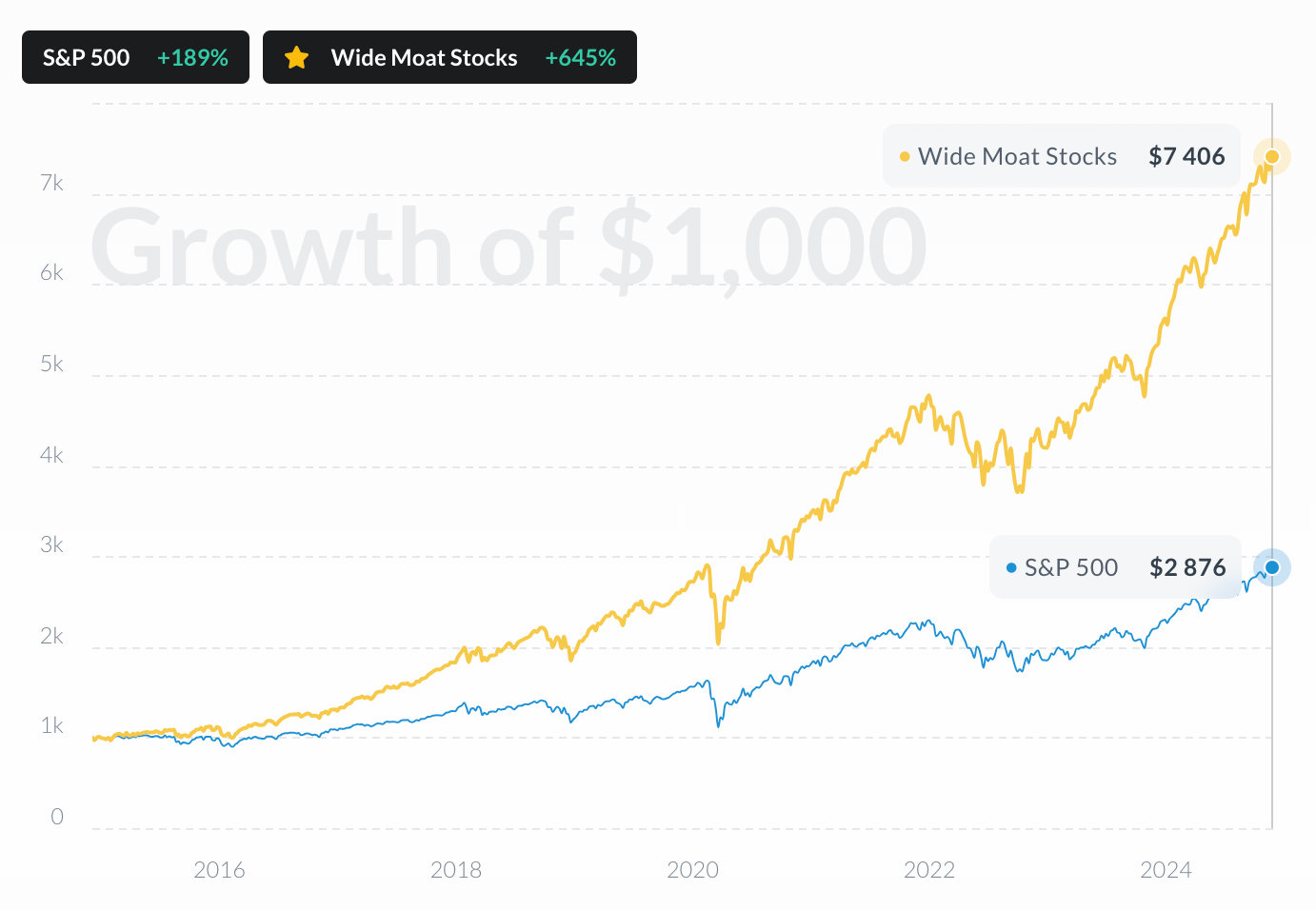
Our research into Economic Moat performance spans the past 10 years and focuses on companies with a wide economic moat. For this analysis, we calculated the average stock price returns of these companies, comparing them to the performance of the S&P 500 index over the same period.
The results were compelling: wide moat stocks achieved a remarkable +645% average return, compared to +188% for the broader market. This difference highlights the long-term benefits of investing in businesses that can maintain their market position and pricing power over time.
Note: This research does not account for survivorship bias. Past performance is not indicative of future results.
Economic Moat