
Ferrovial SA
MAD:FER



Decide at what price you'd be comfortable buying and we'll help you stay ready.
|
H
|
Heartsoft Inc
OTC:HTSF
|
US |
|
C
|
C&D International Investment Group Ltd
HKEX:1908
|
HK |

|
InterMetro Communications Inc
OTC:IMTO
|
US |
Ferrovial SA
No
Economic Moat
Ferrovial SA lacks an economic moat, leaving it vulnerable to competitive pressures and market challenges.
Ferrovial SA
Competitive Advantages
Wide Economic Moat Companies
| Company | Last Price | Price Change | Market Cap | Economic Moat | ||
|---|---|---|---|---|---|---|
|
|

|
NVIDIA Corp
NVDA
|
$177.64 |
+0.8%
|
$4.3T | Wide |
|
|

|
Apple Inc
AAPL
|
$258.86 |
+2.1%
|
$3.8T | Wide |
|
|

|
Alphabet Inc
GOOGL
|
$299.99 |
-0.2%
|
$3.6T | Wide |
|
|

|
Microsoft Corp
MSFT
|
$372.88 |
+1%
|
$2.8T | Wide |
|
|

|
Amazon.com Inc
AMZN
|
$212.79 |
+1.6%
|
$2.3T | Wide |
|
|

|
Taiwan Semiconductor Manufacturing Co Ltd
2330
|
NT$1 845 |
+2.4%
|
$1.5T | Wide |
|
|

|
Meta Platforms Inc
META
|
$573.02 |
+0.1%
|
$1.4T | Wide |
|
|

|
Broadcom Inc
AVGO
|
$314.43 |
-1.8%
|
$1.5T | Wide |
|
|

|
Walmart Inc
WMT
|
$126.79 |
+0.6%
|
$1T | Wide |
|
|

|
Eli Lilly and Co
LLY
|
$927.06 |
-1.3%
|
$876.4B | Wide |
| Company | Last Price | Price Change | Market Cap | Economic Moat | ||
|---|---|---|---|---|---|---|
|
|

|
AstraZeneca PLC
AZN
|
GBX15 316 |
-0.1%
|
$320.5B | Wide |
|
|

|
Kweichow Moutai Co Ltd
600519
|
¥1 435.98 |
+1.7%
|
$261.3B | Wide |
|
|

|
Novo Nordisk A/S
NOVO B
|
kr235.45 |
-1.8%
|
$164.9B | Wide |
|
|

|
Zhongji Innolight Co Ltd
300308
|
¥603.11 |
+2.2%
|
$97.4B | Wide |
|
|

|
Hindustan Aeronautics Ltd
HAL
|
₹3 787.8999 |
+0.8%
|
$27.9B | Wide |
|
|

|
Trent Ltd
TRENT
|
₹3 821.3 |
-0.2%
|
$14.9B | Wide |
|
|

|
ABB India Ltd
ABB
|
₹6 241.5 |
+1.9%
|
$14.6B | Wide |
|
|

|
Cummins India Ltd
CUMMINSIND
|
₹4 632.2998 |
+0.2%
|
$14.1B | Wide |
|
|

|
Solar Industries India Ltd
SOLARINDS
|
₹13 381 |
+0.8%
|
$13.3B | Wide |
|
|

|
Neurocrine Biosciences Inc
NBIX
|
$132.48 |
+2%
|
$13.2B | Wide |
Ferrovial SA
Glance View
Ferrovial SA, headquartered in Madrid, is a formidable player on the global stage of infrastructure development and management. Founded in 1952 by Rafael del Pino, it began as a small construction company but has transformed over decades into a diversified conglomerate with operations spanning across more than a dozen countries. The company's journey has been marked by strategic acquisitions and an unwavering focus on innovation. Whether it's the towering skyscrapers in the heart of urban centers or pivotal transportation networks like toll roads and airports, Ferrovial’s fingerprints can be found on projects that redefine the possibilities of infrastructure. The company is well-known for its work in building and maintaining highways and airports, such as the 407 ETR in Canada and Heathrow Airport in the UK. Ferrovial doesn't just construct; it capitalizes on the long-term operation of infrastructure assets, generating a steady stream of revenue. This business model, providing services over the lifespan of a project, ensures continuous cash flows and resilience against economic fluctuations. The company’s operations are divided mainly into four segments: Services, Toll Roads, Construction, and Airports. The Toll Roads segment is particularly lucrative, with Ferrovial earning from both construction fees and future toll revenues. Meanwhile, its Airports division manages airport facilities while enhancing passenger experiences, thus fostering revenue from aviation and retail services. Together, these segments not only diversify Ferrovial's income but fortify its standing as a linchpin in the world of infrastructure, seamlessly blending traditional engineering with modern sustainability practices.
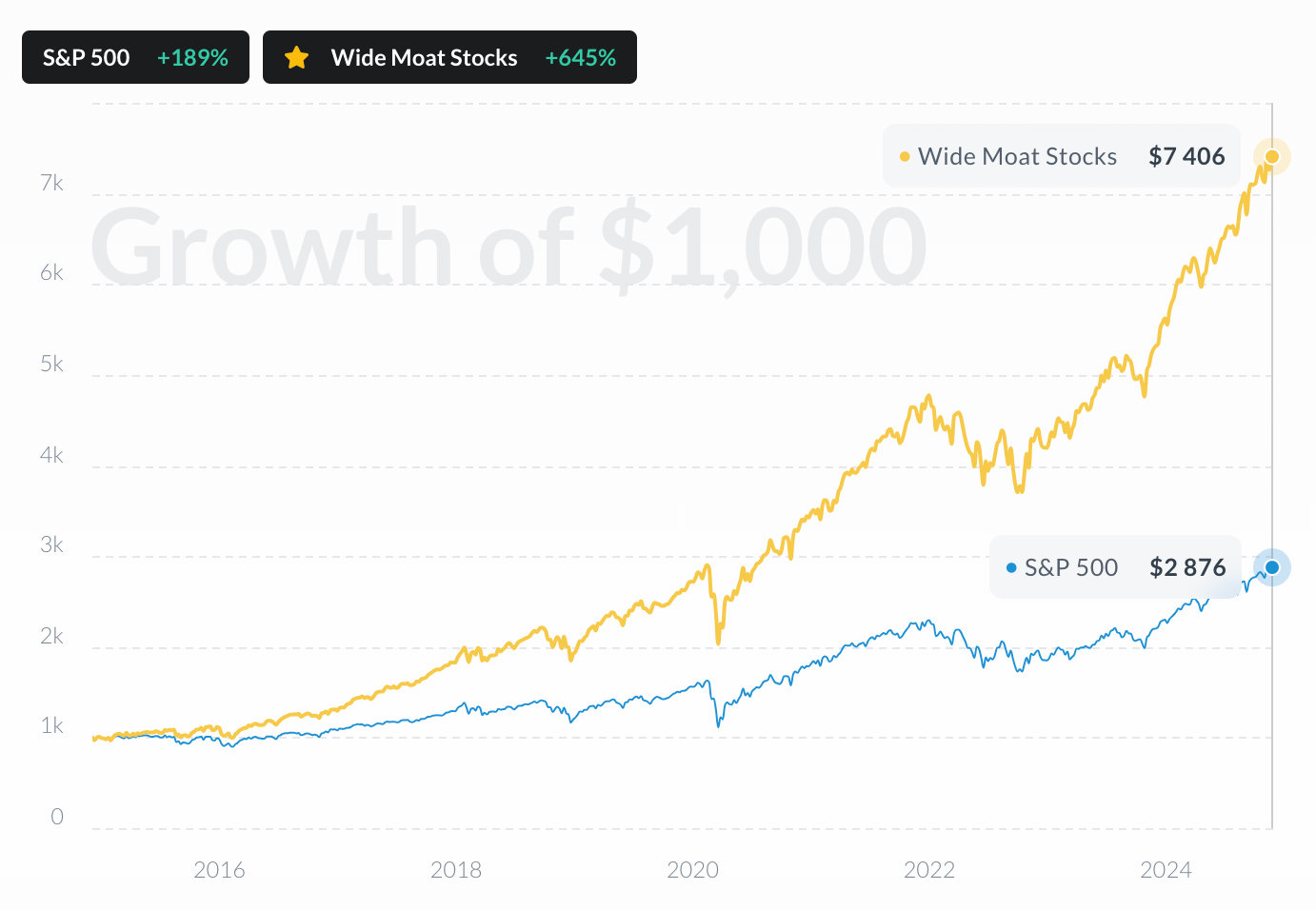
Our research into Economic Moat performance spans the past 10 years and focuses on companies with a wide economic moat. For this analysis, we calculated the average stock price returns of these companies, comparing them to the performance of the S&P 500 index over the same period.
The results were compelling: wide moat stocks achieved a remarkable +645% average return, compared to +188% for the broader market. This difference highlights the long-term benefits of investing in businesses that can maintain their market position and pricing power over time.
Note: This research does not account for survivorship bias. Past performance is not indicative of future results.
Economic Moat