
CP All PCL
OTC:CPPCY



Decide at what price you'd be comfortable buying and we'll help you stay ready.
|
P
|
PLDT Inc
F:PLO
|
PH |

|
PLDT Inc
NYSE:PHI
|
PH |
CP All PCL
None
Economic Moat
CP All PCL lacks an economic moat, leaving it vulnerable to competitive pressures and market challenges.
CP All PCL
Competitive Advantages
Wide Economic Moat Companies
| Company | Last Price | Price Change | Market Cap | Economic Moat | ||
|---|---|---|---|---|---|---|
|
|

|
NVIDIA Corp
NVDA
|
$228.52 |
+1%
|
$5.5T | Wide |
|
|

|
Apple Inc
AAPL
|
$340.8501 |
0%
|
$5T | Wide |
|
|

|
Alphabet Inc
GOOGL
|
$354.805 |
+0.6%
|
$4.3T | Wide |
|
|

|
Microsoft Corp
MSFT
|
$545.16 |
+0.7%
|
$4T | Wide |
|
|

|
Amazon.com Inc
AMZN
|
$259.707 |
+0.1%
|
$2.8T | Wide |
|
|

|
Taiwan Semiconductor Manufacturing Co Ltd
2330
|
NT$2 520 |
+1.2%
|
$2T | Wide |
|
|

|
Meta Platforms Inc
META
|
$765.35 |
+3%
|
$1.9T | Wide |
|
|

|
Broadcom Inc
AVGO
|
$358.355 |
+1%
|
$1.7T | Wide |
|
|

|
Eli Lilly and Co
LLY
|
$1 169.84 |
-1.1%
|
$1.1T | Wide |
|
|

|
Walmart Inc
WMT
|
$112.73 |
-0.3%
|
$897.1B | Wide |
CP All PCL
Glance View
CP All PCL runs the 7-Eleven convenience store network in Thailand. It sells ready-to-eat food, drinks, snacks, daily household items, and simple store-based services such as bill payment and top-ups. Its main customers are everyday consumers, office workers, travelers, and small neighborhood shoppers who want quick, close-by purchases. The company makes money mainly from retail sales in its stores. It also earns income from franchise-related fees and from the wider store network that supports the 7-Eleven brand in Thailand. Because the stores are small, high-traffic, and open long hours, CP All focuses on frequent, low-ticket purchases rather than big one-time sales. What makes CP All’s business model different is its role as the local operator of a very familiar convenience-store format. It sits between consumers and a large supply chain, using its stores as the front door for everyday spending. That gives it a steady, repeat-purchase business tied to routine needs instead of occasional shopping trips.
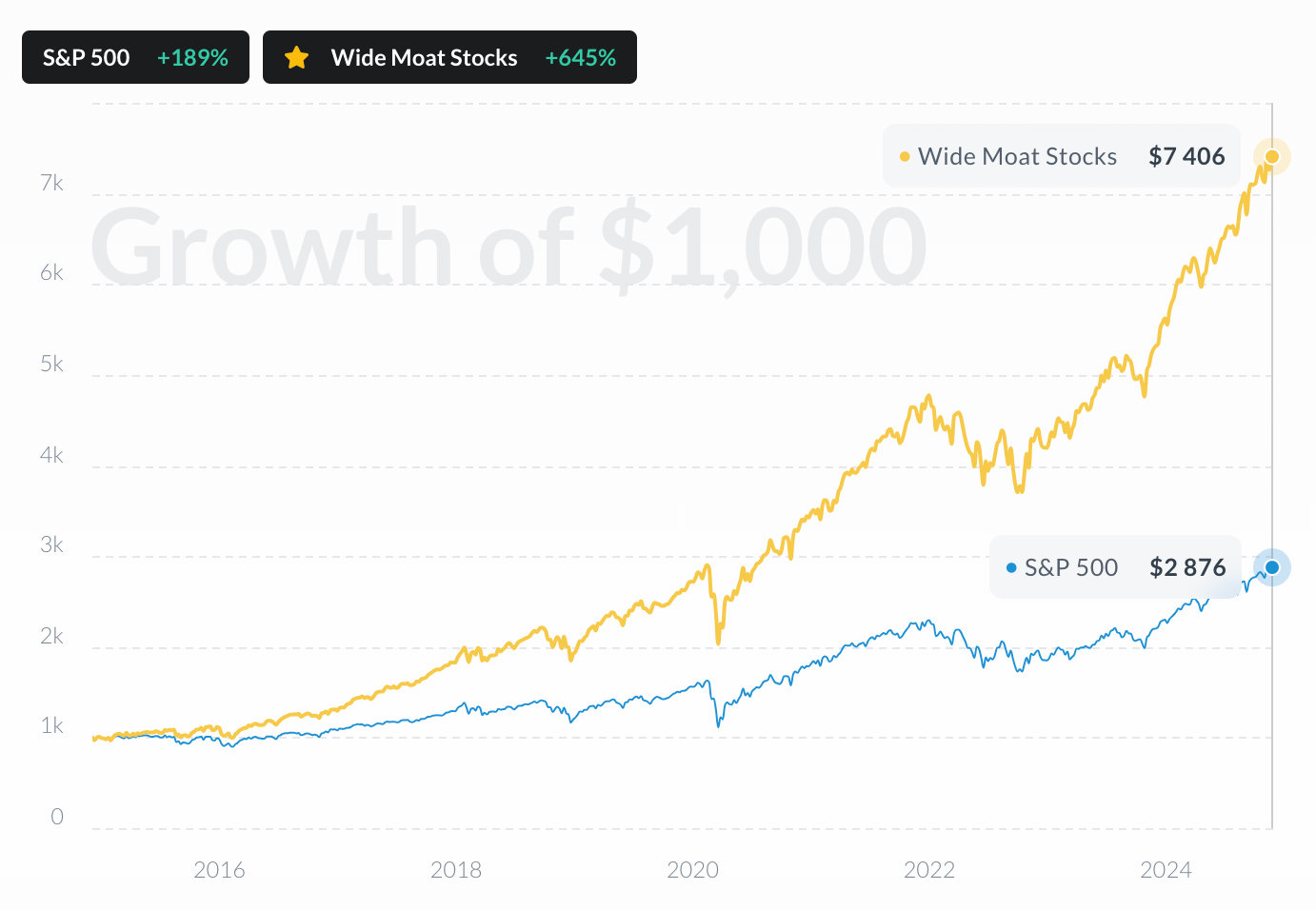
Our research into Economic Moat performance spans the past 10 years and focuses on companies with a wide economic moat. For this analysis, we calculated the average stock price returns of these companies, comparing them to the performance of the S&P 500 index over the same period.
The results were compelling: wide moat stocks achieved a remarkable +645% average return, compared to +188% for the broader market. This difference highlights the long-term benefits of investing in businesses that can maintain their market position and pricing power over time.
Note: This research does not account for survivorship bias. Past performance is not indicative of future results.
Economic Moat