

Boeing Co
XMUN:BCO



Decide at what price you'd be comfortable buying and we'll help you stay ready.
|
J
|
JD Food PCL
SET:JDF
|
TH |
|
C
|
Christiani & Nielsen Thai PCL
SET:CNT
|
TH |
|
C
|
Charn Issara Development PCL
SET:CI
|
TH |
|
R
|
Reach PLC
F:MRR
|
UK |

|
Eagle Filters Group Oyj
F:C72
|
FI |

|
Tenaris SA
BMV:TS
|
LU |
|
P
|
Pungkang Co Ltd
KOSDAQ:093380
|
KR |
|
A
|
Asiasoft Corporation PCL
SET:AS
|
TH |
|
L
|
L'Air Liquide Societe Anonyme pour l'Etude et l'Exploitation des Procedes Georges Claude SA
XMUN:AIL
|
FR |

|
Frontier Developments PLC
LSE:FDEV
|
UK |

|
Uniphar PLC
F:0NR
|
IE |
|
R
|
Recordati Industria Chimica e Farmaceutica SpA
F:RER1
|
IT |

|
Genius Metals Inc
XTSX:MCC
|
CA |
|
B
|
Bannerman Energy Ltd
F:BH6
|
AU |
|
K
|
Knight-Swift Transportation Holdings Inc
F:KSX
|
US |
|
A
|
Advanced Micro Devices Inc
XHAM:AMD
|
US |

|
Alamtri Resources Indonesia Tbk PT
F:A640
|
ID |

|
Environmental Clean Technologies Ltd
ASX:ECT
|
AU |

|
Boreo Oyj
LSE:0MPF
|
FI |

|
Corep Lighting SA
PAR:MLCOR
|
FR |

|
XTI Aerospace Inc
NASDAQ:XTIA
|
US |

|
Goldhaven Resources Corp
F:4QS
|
CA |

|
Flughafen Wien AG
F:FLW1
|
AT |
|
T
|
Thai-German Products PCL
SET:TGPRO
|
TH |
Boeing Co
Wide
Economic Moat
Boeing’s wide moat is supported by its large, integrated aftermarket and services network, entrenched customer relationships and operational commonality that raise switching costs, proprietary certifications and long-term defense contracts, and scale in production and services capacity.
Boeing Co
Competitive Advantages
Boeing Global Services operates a global parts and distribution network with access to over 15 million part numbers and localized hubs, making the platform more valuable as more customers and suppliers participate and easing operators’ logistics and inventory needs. ([services.boeing.com](https://services.boeing.com/parts?utm_source=openai))
Airlines face material, training and operational costs when changing aircraft families—type-rating and simulator training, spare-parts provisioning and maintenance tooling create meaningful multi‑year switching costs that favor incumbent OEM relationships. ([airmappr.com](https://airmappr.com/articles/flight-training/type-rating-guide?utm_source=openai))
Boeing holds proprietary design, certifications and long-term defense program relationships (e.g., multiyear PAC‑3 and other sustainment contracts) that embed the company in national procurement pipelines and protect revenue streams. ([investors.boeing.com](https://investors.boeing.com/investors/news/press-release-details/2025/Boeing-Awarded-Approximately-2-7-Billion-in-Multiyear-Contracts-for-PAC3-Seeker-Production/default.aspx?utm_source=openai))
Boeing’s large production and services scale—evidenced by rising delivery rates, a substantial Global Services backlog and record production outputs—lets it spread fixed costs across many programs and capture aftermarket margins. ([investopedia.com](https://www.investopedia.com/higher-deliveries-boosted-revenue-and-cut-losses-at-boeing-11780804?utm_source=openai))
Wide Economic Moat Companies
| Company | Last Price | Price Change | Market Cap | Economic Moat | ||
|---|---|---|---|---|---|---|
|
|

|
NVIDIA Corp
NVDA
|
$214.375 |
-1.3%
|
$5.2T | Wide |
|
|

|
Apple Inc
AAPL
|
$343.625 |
+0.5%
|
$5T | Wide |
|
|

|
Alphabet Inc
GOOGL
|
$340.08 |
-2.6%
|
$4.2T | Wide |
|
|

|
Microsoft Corp
MSFT
|
$525.435 |
-2.6%
|
$3.9T | Wide |
|
|

|
Amazon.com Inc
AMZN
|
$249.32 |
-2.1%
|
$2.7T | Wide |
|
|

|
Taiwan Semiconductor Manufacturing Co Ltd
2330
|
NT$2 430 |
-0.4%
|
$1.9T | Wide |
|
|

|
Meta Platforms Inc
META
|
$703.365 |
-4.5%
|
$1.8T | Wide |
|
|

|
Broadcom Inc
AVGO
|
$329.62 |
-4.3%
|
$1.6T | Wide |
|
|

|
Eli Lilly and Co
LLY
|
$1 256.08 |
+0.4%
|
$1.2T | Wide |
|
|

|
Walmart Inc
WMT
|
$118.7 |
+0.7%
|
$944.6B | Wide |
Boeing Co
Glance View
Boeing designs and builds large commercial airplanes, military aircraft, helicopters, satellites, and other aerospace systems. It also sells parts, maintenance, engineering support, and upgrades that keep aircraft flying over time. Its main customers are airlines, air forces, defense agencies, space and government buyers, and it earns money from aircraft sales, long-term service contracts, and defense and space programs. What makes Boeing different is that it sits near the center of the aerospace value chain. It does not just assemble planes; it also helps design the aircraft, supplies spare parts, and supports fleets for many years after delivery. That creates a business with both one-time sales and recurring service revenue tied to the installed base of aircraft already in use. For beginners, the key idea is that Boeing is a manufacturer and support provider for major transportation and defense hardware. Airlines buy its jets to move passengers and cargo, while governments buy its military and space products for defense and national security missions. Boeing makes money when it delivers those products and when customers come back for maintenance, parts, training, and technical support.
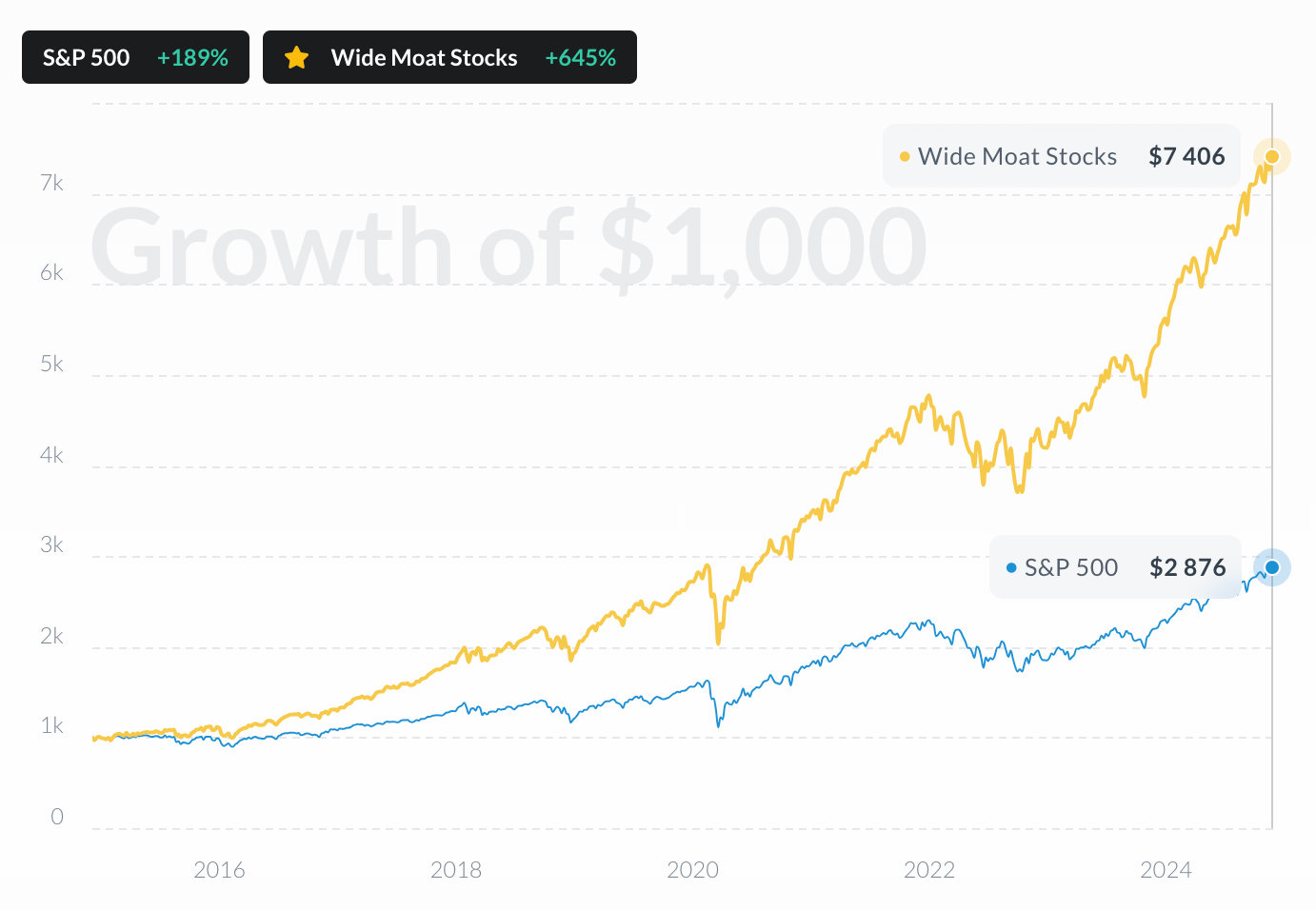
Our research into Economic Moat performance spans the past 10 years and focuses on companies with a wide economic moat. For this analysis, we calculated the average stock price returns of these companies, comparing them to the performance of the S&P 500 index over the same period.
The results were compelling: wide moat stocks achieved a remarkable +645% average return, compared to +188% for the broader market. This difference highlights the long-term benefits of investing in businesses that can maintain their market position and pricing power over time.
Note: This research does not account for survivorship bias. Past performance is not indicative of future results.
Economic Moat