Humana Inc
XMUN:HUM


Decide at what price you'd be comfortable buying and we'll help you stay ready.
|
E
|
Evonik Industries AG
DUS:EVK
|
DE |
|
D
|
Dominion Energy Inc
F:DOD
|
US |

|
MCH Group AG
F:MEF1
|
CH |
|
T
|
Telefonaktiebolaget LM Ericsson
XHAM:ERCB
|
SE |
|
H
|
Haranga Resources Ltd
ASX:HAR
|
AU |
|
B
|
Brunswick Corp
XMUN:BWI
|
US |
|
H
|
Home Depot Inc
XMUN:HDI
|
US |
|
Y
|
YJN Co Ltd
TPEX:3191
|
TW |
Humana Inc
Narrow
Economic Moat
Humana's moat is narrow, driven primarily by scale and concentrated market positions in Medicare Advantage plus customer/provider relationships and recognizable Medicare-focused assets, but it faces rating and membership volatility that limits a wider moat.
Humana Inc
Competitive Advantages
Humana’s large Medicare Advantage footprint creates scale-driven advantages—its plans were the largest insurer in 25% of U.S. counties and, with UnitedHealthcare, account for a plurality of MA enrollment, reinforcing plan availability and negotiating leverage. ([kff.org](https://www.kff.org/medicare/issue-brief/most-medicare-advantage-markets-are-dominated-by-one-or-two-insurers/?utm_source=openai))
Medicare Advantage enrollment stickiness and integrated care arrangements (including CenterWell primary care and value‑based provider partnerships) raise practical and administrative costs for beneficiaries and providers to switch plans or networks. ([healthworksai.com](https://healthworksai.com/market-research/by-the-numbers-analyzing-the-2025-medicare-advantage-market-a-comprehensive-overview-of-leading-payors/?utm_source=openai))
Humana’s Medicare-focused brand, long-standing plan operations and regulatory experience in administering MA/Part D benefits create specialized capabilities and governmental relationships that competitors must reproduce. ([kff.org](https://www.kff.org/medicare/medicare-advantage-enrollment-update-and-key-trends/?utm_source=openai))
Many county MA markets are effectively served by one or two large insurers; Humana’s position as a market leader in numerous counties yields an efficient-scale advantage where additional competitors are limited. ([kff.org](https://www.kff.org/medicare/issue-brief/most-medicare-advantage-markets-are-dominated-by-one-or-two-insurers/?utm_source=openai))
Wide Economic Moat Companies
| Company | Last Price | Price Change | Market Cap | Economic Moat | ||
|---|---|---|---|---|---|---|
|
|

|
NVIDIA Corp
NVDA
|
$217.09 |
+1.4%
|
$5.3T | Wide |
|
|

|
Apple Inc
AAPL
|
$342.675 |
-0.2%
|
$5T | Wide |
|
|

|
Alphabet Inc
GOOGL
|
$345.61 |
+1.5%
|
$4.2T | Wide |
|
|

|
Microsoft Corp
MSFT
|
$534.4 |
+1%
|
$4T | Wide |
|
|

|
Amazon.com Inc
AMZN
|
$263.03 |
+5.2%
|
$2.8T | Wide |
|
|
|
Taiwan Semiconductor Manufacturing Co Ltd
2330
|
NT$2 400 |
-0.8%
|
$1.9T | Wide |
|
|

|
Meta Platforms Inc
META
|
$706.06 |
-0.5%
|
$1.8T | Wide |
|
|

|
Broadcom Inc
AVGO
|
$336.0838 |
+2.2%
|
$1.6T | Wide |
|
|

|
Eli Lilly and Co
LLY
|
$1 248.175 |
-0.7%
|
$1.2T | Wide |
|
|

|
Walmart Inc
WMT
|
$118.79 |
0%
|
$945.3B | Wide |
Humana Inc
Glance View
Humana is a U.S. health insurance company that mainly sells Medicare Advantage plans and related medical coverage for older adults. It also offers prescription drug plans, dental and vision coverage, and some employer and military-related health benefits. In simple terms, Humana helps members pay for doctor visits, hospital care, medicines, and preventive care through insurance products and care programs. Its main customers are seniors eligible for Medicare, along with some employers, government programs, and people who buy supplemental coverage. Humana makes money by collecting premiums and government payments tied to the plans it manages, then paying doctors, hospitals, pharmacies, and other providers when members use care. It also earns fees from services such as pharmacy benefit management, care management, and home-based health services. What makes Humana different is that it sits between the insurance world and the care-delivery world. It does not just sell insurance cards; it also tries to steer members toward preventive care, chronic disease management, and lower-cost treatment settings. That mix makes Humana both a payer and a care coordinator, which is a common but important role in U.S. healthcare.
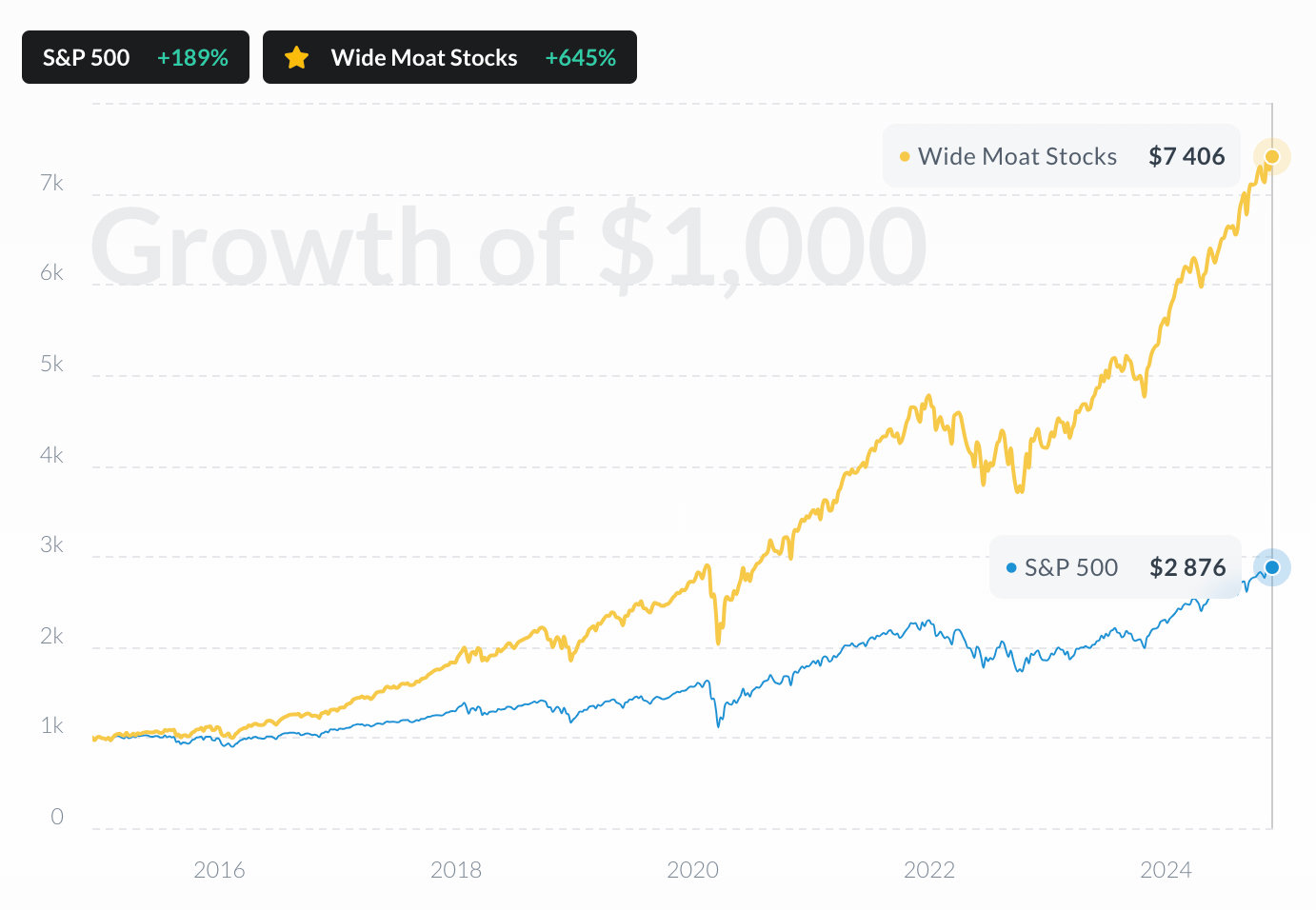
Our research into Economic Moat performance spans the past 10 years and focuses on companies with a wide economic moat. For this analysis, we calculated the average stock price returns of these companies, comparing them to the performance of the S&P 500 index over the same period.
The results were compelling: wide moat stocks achieved a remarkable +645% average return, compared to +188% for the broader market. This difference highlights the long-term benefits of investing in businesses that can maintain their market position and pricing power over time.
Note: This research does not account for survivorship bias. Past performance is not indicative of future results.
Economic Moat