
CME Group Inc
XMUN:MX4A


Decide at what price you'd be comfortable buying and we'll help you stay ready.
|
I
|
Impax Asset Management Group PLC
OTC:IPXAF
|
UK |
|
W
|
Weichai Power Co Ltd
XMUN:WI4
|
CN |
|
A
|
Automatic Data Processing Inc
F:ADP
|
US |

|
Biovaxys Technology Corp
F:5LB0
|
CA |
CME Group Inc
Wide
Economic Moat
CME Group’s wide moat is supported by its dominant clearing and trading infrastructure, regulatory status, and scale-driven advantages that create durable barriers to competitor entry.
CME Group Inc
Competitive Advantages
CME’s central clearinghouse and Globex trading venues concentrate liquidity and counterparties, making its markets deeper and more attractive for additional traders and liquidity providers.
Extensive client integrations—co‑location, proprietary connectivity protocols, market‑data feeds and clearing relationships—create high implementation and operational costs for participants to move to alternative venues.
Regulatory designations (DCO/DCM) and its recognized global brand confer legal entrenchment and trust that are difficult for new entrants to replicate.
Large fixed‑cost infrastructure and scale in clearing, market data and connectivity make CME the efficient provider for high‑volume derivatives trading, discouraging multiple competing operators in the same markets.
Wide Economic Moat Companies
| Company | Last Price | Price Change | Market Cap | Economic Moat | ||
|---|---|---|---|---|---|---|
|
|

|
NVIDIA Corp
NVDA
|
$217.09 |
+1.4%
|
$5.3T | Wide |
|
|

|
Apple Inc
AAPL
|
$342.675 |
-0.2%
|
$5T | Wide |
|
|

|
Alphabet Inc
GOOGL
|
$345.61 |
+1.5%
|
$4.2T | Wide |
|
|

|
Microsoft Corp
MSFT
|
$534.4 |
+1%
|
$4T | Wide |
|
|

|
Amazon.com Inc
AMZN
|
$263.03 |
+5.2%
|
$2.8T | Wide |
|
|
|
Taiwan Semiconductor Manufacturing Co Ltd
2330
|
NT$2 410 |
-0.4%
|
$1.9T | Wide |
|
|

|
Meta Platforms Inc
META
|
$706.06 |
-0.5%
|
$1.8T | Wide |
|
|

|
Broadcom Inc
AVGO
|
$336.0838 |
+2.2%
|
$1.6T | Wide |
|
|

|
Eli Lilly and Co
LLY
|
$1 248.175 |
-0.7%
|
$1.2T | Wide |
|
|

|
Walmart Inc
WMT
|
$118.79 |
0%
|
$945.3B | Wide |
CME Group Inc
Glance View
CME Group runs one of the world’s largest marketplaces for exchange-traded derivatives. It matches buyers and sellers in contracts tied to interest rates, stock indexes, foreign currencies, energy, metals, and agricultural products. Instead of making the underlying goods itself, the company provides the exchange, clearing, and risk-management infrastructure that lets banks, asset managers, corporations, and other traders hedge price moves or take positions on them. The company makes money mainly by charging transaction and clearing fees when those contracts are traded or settled, along with fees for market data and related services. Its customers are the financial firms, hedge funds, trading firms, commercial businesses, and institutions that use futures and options to manage risk or gain exposure to markets. Because these contracts are standardized and centrally cleared, CME sits at the center of the trading process and helps make these markets easier to use and safer to trade. What makes CME’s business different is that it acts as the market organizer and counterparty manager, not a product manufacturer or broker. Once a contract is listed, it can attract more trading from both hedgers and speculators, which helps make the exchange more useful to all participants. That network role, plus the importance of clearing and risk control, gives CME a central place in the global derivatives market.
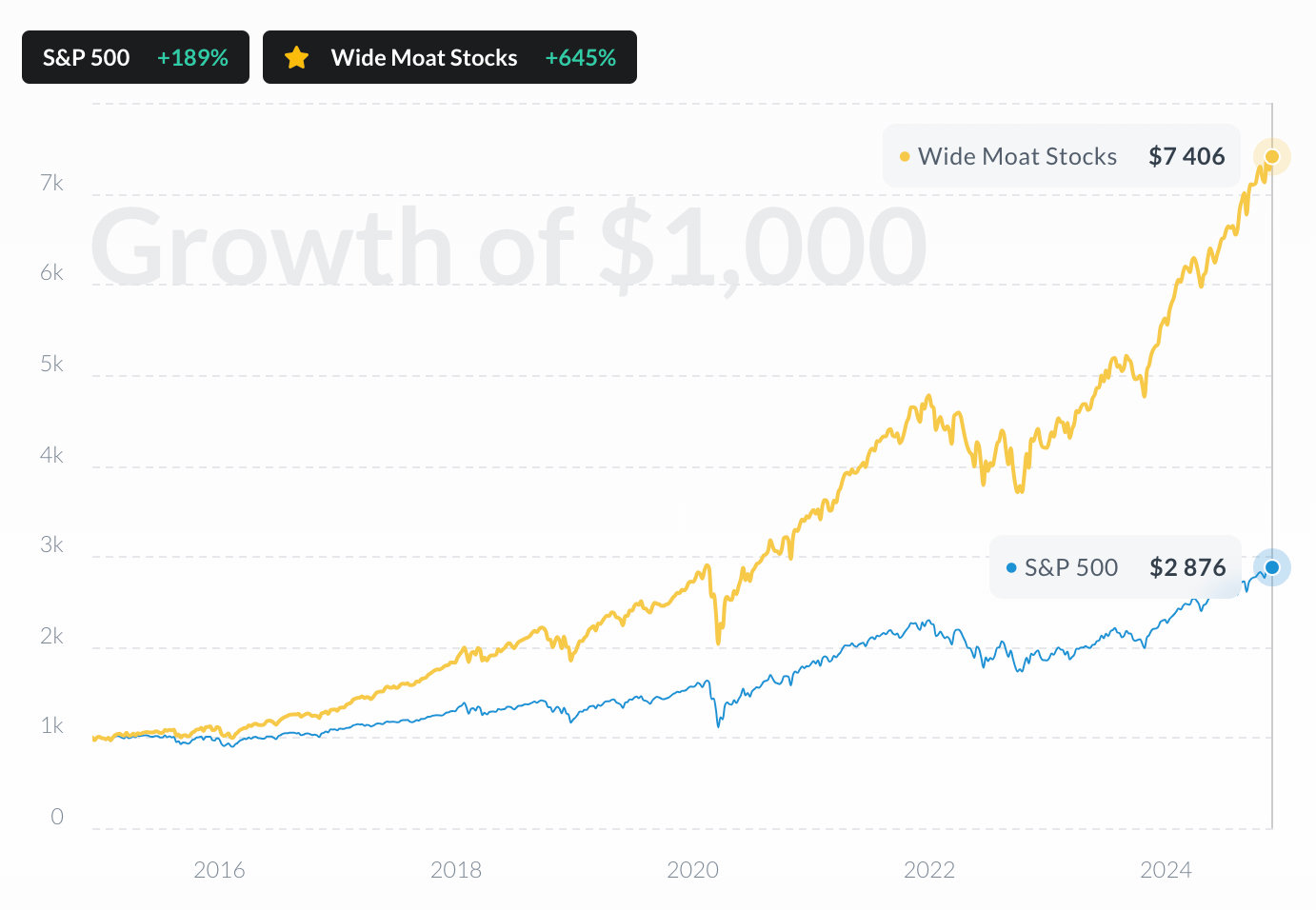
Our research into Economic Moat performance spans the past 10 years and focuses on companies with a wide economic moat. For this analysis, we calculated the average stock price returns of these companies, comparing them to the performance of the S&P 500 index over the same period.
The results were compelling: wide moat stocks achieved a remarkable +645% average return, compared to +188% for the broader market. This difference highlights the long-term benefits of investing in businesses that can maintain their market position and pricing power over time.
Note: This research does not account for survivorship bias. Past performance is not indicative of future results.
Economic Moat