
Walmart Inc
NASDAQ:WMT



Walmart Inc
Wide
Economic Moat
Walmart possesses a wide economic moat due to its low-cost production, efficient scale, and strong brand identity. These advantages collectively reinforce its market dominance and ability to sustain above-average returns on capital.
Walmart Inc
Competitive Advantages
Walmart has a strong brand identity recognized globally, which helps differentiate its value proposition from other retailers and enhances customer loyalty.
Walmart's economies of scale allow it to procure products at lower costs than many competitors, enabling it to offer low prices to consumers while maintaining superior profit margins.
Operating in a highly competitive retail environment, Walmart benefits from a market position where only a few major players can thrive effectively given the substantial capital investment required.
Wide Economic Moat Companies
| Company | Last Price | Price Change | Market Cap | Economic Moat | ||
|---|---|---|---|---|---|---|
|
|

|
NVIDIA Corp
NVDA
|
$172.7 |
+0.8%
|
$4.2T | Wide |
|
|

|
Apple Inc
AAPL
|
$247.99 |
+2%
|
$3.6T | Wide |
|
|

|
Alphabet Inc
GOOGL
|
$301 |
-0.2%
|
$3.6T | Wide |
|
|

|
Microsoft Corp
MSFT
|
$381.87 |
+1%
|
$2.8T | Wide |
|
|

|
Amazon.com Inc
AMZN
|
$205.37 |
+1.5%
|
$2.2T | Wide |
|
|

|
Taiwan Semiconductor Manufacturing Co Ltd
2330
|
NT$1 840 |
+2.4%
|
$1.5T | Wide |
|
|

|
Meta Platforms Inc
META
|
$593.66 |
+0.1%
|
$1.5T | Wide |
|
|

|
Broadcom Inc
AVGO
|
$310.51 |
-1.8%
|
$1.5T | Wide |
|
|

|
Walmart Inc
WMT
|
$119.02 |
+0.6%
|
$948.6B | Wide |
|
|

|
Eli Lilly and Co
LLY
|
$906.7 |
-1.3%
|
$857.2B | Wide |
| Company | Last Price | Price Change | Market Cap | Economic Moat | ||
|---|---|---|---|---|---|---|
|
|

|
Royal Bank of Canada
RY
|
CA$218.5 |
-0.3%
|
$223.3B | Wide |
|
|

|
Toronto-Dominion Bank
TD
|
CA$126.11 |
-0.5%
|
$156.2B | Wide |
|
|

|
Canadian Pacific Railway Ltd
CP
|
CA$107.6 |
+1.4%
|
$70.5B | Wide |
|
|

|
Canadian National Railway Co
CNR
|
CA$135.45 |
+0.7%
|
$61B | Wide |
|
|
|
Corteva Inc
CTVA
|
$77.33 |
+1.5%
|
$52.3B | Wide |
|
|

|
W W Grainger Inc
GWW
|
$1 041.95 |
+0.6%
|
$49.5B | Wide |
|
|

|
AMETEK Inc
AME
|
$209.37 |
+1.8%
|
$48.2B | Wide |
|
|

|
Yum! Brands Inc
YUM
|
$156.41 |
-0.5%
|
$43.4B | Wide |
|
|

|
Waste Connections Inc
WCN
|
CA$223.32 |
+1.6%
|
$41.7B | Wide |
|
|

|
Thomson Reuters Corp
TRI
|
CA$128.04 |
+10.4%
|
$41.6B | Wide |
Walmart Inc
Glance View
Walmart Inc., an enduring titan in the retail industry, began its journey in 1962 when Sam Walton opened the first Walmart store in Rogers, Arkansas. From these humble beginnings, Walmart has grown into a multinational colossus with thousands of stores spanning across various countries. At its core, Walmart operates on a straightforward yet powerful business model: providing customers with a wide array of goods at the lowest possible prices. It achieves this by leveraging its immense scale to negotiate favorable terms with suppliers, optimizing supply chain efficiencies, and maintaining rigorous cost control measures. This ensures that Walmart remains a dominant force in discount retailing, drawing millions of customers through its doors each week. The company's revenue streams are primarily derived from its vast network of physical retail locations, e-commerce channels, and membership-based wholesale stores like Sam's Club. Walmart effectively integrates its brick-and-mortar presence with a substantial digital platform, allowing it to cater to diverse consumer preferences and extend its market reach. Additionally, Walmart's entry into financial services, health and wellness sectors, and partnership with other businesses further diversifies its income. By constantly adapting to changes in consumer behavior and technological advancements, Walmart sustains its robust financial performance and remains a formidable player in the global retail landscape.
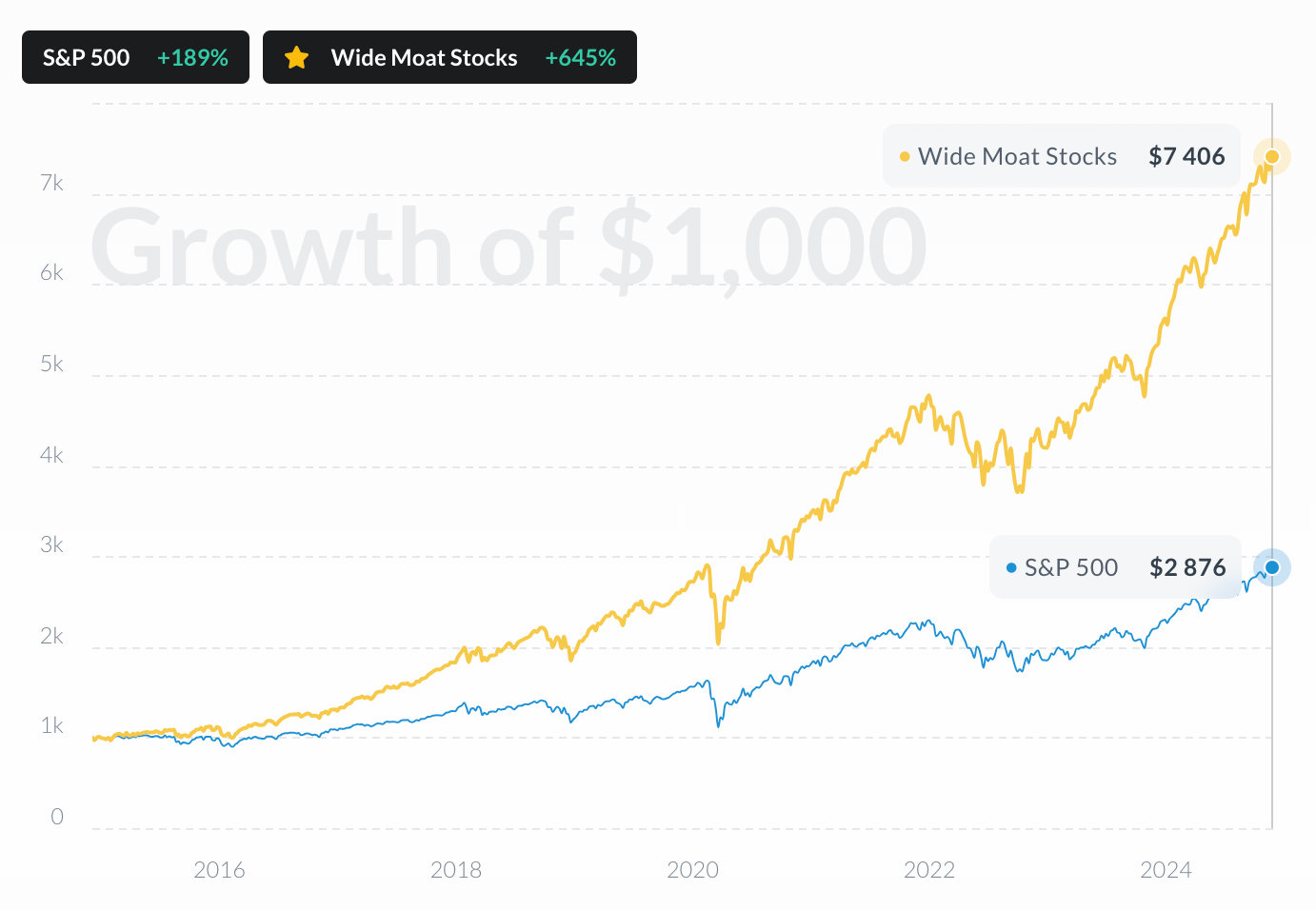
Our research into Economic Moat performance spans the past 10 years and focuses on companies with a wide economic moat. For this analysis, we calculated the average stock price returns of these companies, comparing them to the performance of the S&P 500 index over the same period.
The results were compelling: wide moat stocks achieved a remarkable +645% average return, compared to +188% for the broader market. This difference highlights the long-term benefits of investing in businesses that can maintain their market position and pricing power over time.
Note: This research does not account for survivorship bias. Past performance is not indicative of future results.
Economic Moat