






Morgan Stanley
NYSE:MS





| US |

|
Johnson & Johnson
NYSE:JNJ
|
Pharmaceuticals
|
| US |

|
Berkshire Hathaway Inc
NYSE:BRK.A
|
Financial Services
|
| US |

|
Bank of America Corp
NYSE:BAC
|
Banking
|
| US |

|
Mastercard Inc
NYSE:MA
|
Technology
|
| US |

|
UnitedHealth Group Inc
NYSE:UNH
|
Health Care
|
| US |

|
Exxon Mobil Corp
NYSE:XOM
|
Energy
|
| US |

|
Pfizer Inc
NYSE:PFE
|
Pharmaceuticals
|
| US |

|
Palantir Technologies Inc
NYSE:PLTR
|
Technology
|
| US |

|
Nike Inc
NYSE:NKE
|
Textiles, Apparel & Luxury Goods
|
| US |

|
Visa Inc
NYSE:V
|
Technology
|
| CN |

|
Alibaba Group Holding Ltd
NYSE:BABA
|
Retail
|
| US |

|
JPMorgan Chase & Co
NYSE:JPM
|
Banking
|
| US |

|
Coca-Cola Co
NYSE:KO
|
Beverages
|
| US |

|
Walmart Inc
NYSE:WMT
|
Retail
|
| US |

|
Verizon Communications Inc
NYSE:VZ
|
Telecommunication
|
| US |

|
Chevron Corp
NYSE:CVX
|
Energy
|

Utilize notes to systematically review your investment decisions. By reflecting on past outcomes, you can discern effective strategies and identify those that underperformed. This continuous feedback loop enables you to adapt and refine your approach, optimizing for future success.
Each note serves as a learning point, offering insights into your decision-making processes. Over time, you'll accumulate a personalized database of knowledge, enhancing your ability to make informed decisions quickly and effectively.
With a comprehensive record of your investment history at your fingertips, you can compare current opportunities against past experiences. This not only bolsters your confidence but also ensures that each decision is grounded in a well-documented rationale.
Do you really want to delete this note?
This action cannot be undone.

| 52 Week Range |
99.83
186.54
|
| Price Target |
|
We'll email you a reminder when the closing price reaches USD.
Choose the stock you wish to monitor with a price alert.
|
|
Johnson & Johnson
NYSE:JNJ
|
US |
|
|
Berkshire Hathaway Inc
NYSE:BRK.A
|
US |
|
|
Bank of America Corp
NYSE:BAC
|
US |
|
|
Mastercard Inc
NYSE:MA
|
US |
|
|
UnitedHealth Group Inc
NYSE:UNH
|
US |
|
|
Exxon Mobil Corp
NYSE:XOM
|
US |
|
|
Pfizer Inc
NYSE:PFE
|
US |
|
|
Palantir Technologies Inc
NYSE:PLTR
|
US |
|
|
Nike Inc
NYSE:NKE
|
US |
|
|
Visa Inc
NYSE:V
|
US |
|
|
Alibaba Group Holding Ltd
NYSE:BABA
|
CN |
|
|
JPMorgan Chase & Co
NYSE:JPM
|
US |
|
|
Coca-Cola Co
NYSE:KO
|
US |
|
|
Walmart Inc
NYSE:WMT
|
US |
|
|
Verizon Communications Inc
NYSE:VZ
|
US |
|
|
Chevron Corp
NYSE:CVX
|
US |
This alert will be permanently deleted.
Morgan Stanley
Narrow
Economic Moat
Morgan Stanley possesses a narrow economic moat supported by intangible assets, network effects, and efficient scale, which provide moderate protection against competitive pressures and allow it to sustain profitability in its industry.
Morgan Stanley
Competitive Advantages
Operating in the investment banking and wealth management sectors, Morgan Stanley benefits from the limited number of competitors capable of offering a similar scope and scale of services, reducing the intensity of competitive rivalry.
Morgan Stanley benefits from a strong brand identity and a reputable position in the financial services industry, which helps attract and retain clients. Additionally, regulatory approvals and licenses serve as significant intangible assets that provide some barrier to entry.
The firm's extensive client network and relationships enhance its ability to offer comprehensive financial solutions, where increased client participation can enhance the value and appeal of its services.
Wide Economic Moat Companies
Morgan Stanley
Glance View
In the bustling world of global finance, few behemoths capture the essence of Wall Street quite like Morgan Stanley. Tracing its roots back to 1935, the firm was born out of the Glass-Steagall Act, which mandated the separation of commercial and investment banking. Since then, Morgan Stanley has evolved into a leading financial services powerhouse, deeply woven into the fabric of global markets. Headquartered in New York City, the company plays a pivotal role in connecting ambitious corporations, discerning investors, and innovative entrepreneurs with capital markets and strategic opportunities. At its core, Morgan Stanley excels in synthesis — melding rigorous analysis with the skilled art of deal-making. Throughout its octane-fueled journey, Morgan Stanley has expanded its portfolio, deftly balancing its three main pillars: Institutional Securities, Wealth Management, and Investment Management. In Institutional Securities, the firm generates revenue from a diverse array of services, including underwriting, advisory, and trading. Underwriting helps companies raise the capital needed for growth, while advisory services guide them through complex mergers and acquisitions. Meanwhile, its Wealth Management division caters to individuals and families seeking optimized long-term financial strategies, generating income through fees and interest on client assets. Lastly, Morgan Stanley’s Investment Management arm operates like a maestro, orchestrating assets across diverse geographies and classes, securing fee-based revenues from skillfully managed funds. Together, these divisions not only drive Morgan Stanley’s financial engine but also craft its signature as a stalwart amid the dynamic landscape of global finance.
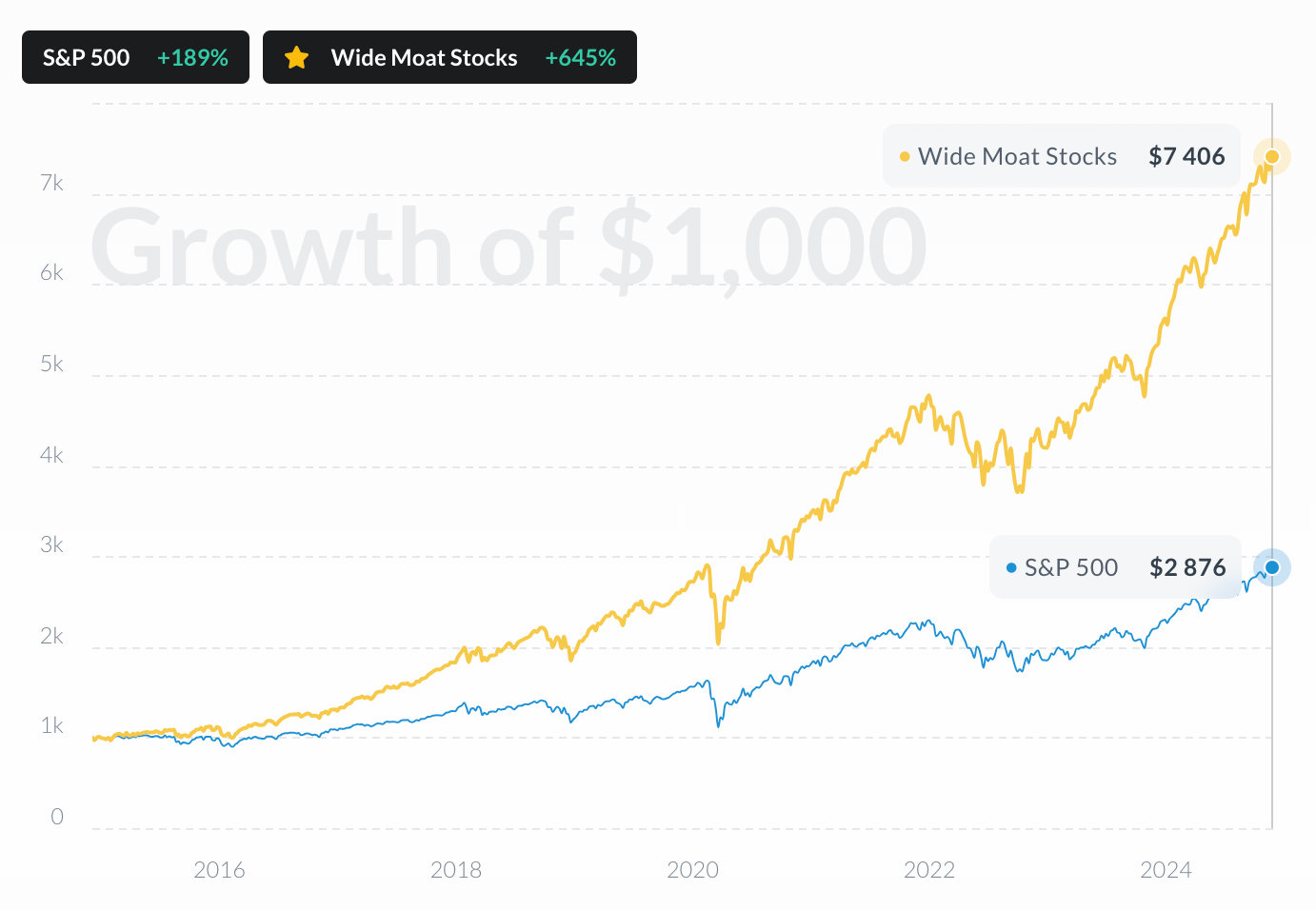
Our research into Economic Moat performance spans the past 10 years and focuses on companies with a wide economic moat. For this analysis, we calculated the average stock price returns of these companies, comparing them to the performance of the S&P 500 index over the same period.
The results were compelling: wide moat stocks achieved a remarkable +645% average return, compared to +188% for the broader market. This difference highlights the long-term benefits of investing in businesses that can maintain their market position and pricing power over time.
Note: This research does not account for survivorship bias. Past performance is not indicative of future results.
Economic Moat