

Badger Infrastructure Solutions Ltd
TSX:BDGI





| US |

|
Johnson & Johnson
NYSE:JNJ
|
Pharmaceuticals
|
| US |

|
Berkshire Hathaway Inc
NYSE:BRK.A
|
Financial Services
|
| US |

|
Bank of America Corp
NYSE:BAC
|
Banking
|
| US |

|
Mastercard Inc
NYSE:MA
|
Technology
|
| US |

|
UnitedHealth Group Inc
NYSE:UNH
|
Health Care
|
| US |

|
Exxon Mobil Corp
NYSE:XOM
|
Energy
|
| US |

|
Pfizer Inc
NYSE:PFE
|
Pharmaceuticals
|
| US |

|
Palantir Technologies Inc
NYSE:PLTR
|
Technology
|
| US |

|
Nike Inc
NYSE:NKE
|
Textiles, Apparel & Luxury Goods
|
| US |

|
Visa Inc
NYSE:V
|
Technology
|
| CN |

|
Alibaba Group Holding Ltd
NYSE:BABA
|
Retail
|
| US |

|
JPMorgan Chase & Co
NYSE:JPM
|
Banking
|
| US |

|
Coca-Cola Co
NYSE:KO
|
Beverages
|
| US |

|
Walmart Inc
NYSE:WMT
|
Retail
|
| US |

|
Verizon Communications Inc
NYSE:VZ
|
Telecommunication
|
| US |

|
Chevron Corp
NYSE:CVX
|
Energy
|

Utilize notes to systematically review your investment decisions. By reflecting on past outcomes, you can discern effective strategies and identify those that underperformed. This continuous feedback loop enables you to adapt and refine your approach, optimizing for future success.
Each note serves as a learning point, offering insights into your decision-making processes. Over time, you'll accumulate a personalized database of knowledge, enhancing your ability to make informed decisions quickly and effectively.
With a comprehensive record of your investment history at your fingertips, you can compare current opportunities against past experiences. This not only bolsters your confidence but also ensures that each decision is grounded in a well-documented rationale.
Do you really want to delete this note?
This action cannot be undone.

| 52 Week Range |
34.82
78.78
|
| Price Target |
|
We'll email you a reminder when the closing price reaches CAD.
Choose the stock you wish to monitor with a price alert.
|
|
Johnson & Johnson
NYSE:JNJ
|
US |
|
|
Berkshire Hathaway Inc
NYSE:BRK.A
|
US |
|
|
Bank of America Corp
NYSE:BAC
|
US |
|
|
Mastercard Inc
NYSE:MA
|
US |
|
|
UnitedHealth Group Inc
NYSE:UNH
|
US |
|
|
Exxon Mobil Corp
NYSE:XOM
|
US |
|
|
Pfizer Inc
NYSE:PFE
|
US |
|
|
Palantir Technologies Inc
NYSE:PLTR
|
US |
|
|
Nike Inc
NYSE:NKE
|
US |
|
|
Visa Inc
NYSE:V
|
US |
|
|
Alibaba Group Holding Ltd
NYSE:BABA
|
CN |
|
|
JPMorgan Chase & Co
NYSE:JPM
|
US |
|
|
Coca-Cola Co
NYSE:KO
|
US |
|
|
Walmart Inc
NYSE:WMT
|
US |
|
|
Verizon Communications Inc
NYSE:VZ
|
US |
|
|
Chevron Corp
NYSE:CVX
|
US |
This alert will be permanently deleted.



Ladies and gentlemen, thank you for standing by, and welcome to the Badger Daylighting Limited 2020 First Quarter Results. [Operator Instructions] Please be advised that today's conference is being recorded. [Operator Instructions]I would now like to hand the conference over to your speaker for today, Mr. Paul Vanderberg. Sir, you may begin.
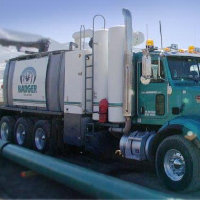
Thanks, Amitras, and good morning, everyone. Thanks for joining Badger's 2020 Q1 Investor Call. With me today is our Chairman, Glen Roane; our CFO, Darren Yaworsky; and Jay Bachman, our VP of Financial Operations. Badger's 2020 first quarter earnings, MD&A and financial statements were released after the market closed yesterday and are available on the Investors section of our website and SEDAR. We're required to note that some of the statements made on today's call may contain forward-looking information. In fact, all statements made today, which are not statements of historical fact are considered to be forward-looking statements. We make these forward-looking statements based on certain assumptions that we consider to be reasonable. However, forward-looking statements are always subject to risks and uncertainties, and undue reliance should not be placed upon them as actual results may differ materially from those expressed or implied. For more information about material assumptions, risks and uncertainties that may be relevant to such forward-looking statements, please refer to our Q1 press release and management discussion and analysis, along with Badger's 2019 annual MD&A and the 2019 AIF. Further, such statements speak only as of today's date, and Badger does not undertake to update such forward-looking statements.So Q1. Normally, we jump right into the operating results for the quarter, but due to the onset of COVID-19, we really need to begin with a discussion of health and safety. If there was ever a time that society has become aware of health and safety, 2020 is it. Safety is and remains a Badger core value and the underlying reason Badger service and operations exist.Work started on our pandemic response procedures in late February and continue to evolve through the month of March with employee and customer safety procedures as our primary focus. Our health and safety, human resources and operations team held daily coordination and planning calls to ensure we had appropriate plans to protect our employees, our customers and those in the broader communities where we serve.In addition to adhering the government mandates, we have implemented internal guidelines for on-site work, our office environments, travel, including social distancing and disinfecting. We've coordinated with scores of customers to provide them with our pandemic response plans, business continuity plans and to ensure we coordinate with their site-specific protocols and procedures. We have had several employees contracted virus, and thankfully, these employees have successfully recovered.Our early self-quarantine policies prevented these employees from returning to the workplace, so we've had some good catches. Sadly, several of our employees have lost family members due to the virus, and our thoughts have been with them. Overall, given that health and safety as Badger's overriding operating focus, I am very proud of the Badger team's response to the pandemic.So on to Q1 2020 comments. It seems like we've really had 2 separate Q1s this year. Regarding revenue, the first part of Q1 was the period up until March 10 prior to the onset of COVID-19. And the knock-on impact we've all seen has had on the economy, financial and energy markets. Revenue and customer activity levels in January and February had exhibited pretty much typical weather patterns in our normal markets with a range of regional activity levels due to part to regional economic conditions combined with typical ups and downs from winter weather patterns.Our energy-focused regions were softening continuing the trends that we saw in late 2019, with Western Canada continuing to be the slowest. And then the energy markets from the Dakotas right down through the Mountain states and into Texas and New Mexico also beginning to slow down. We did provide some emergency response work related to tornadoes in a number of markets, but this work did not have a material impact in the quarter.Excluding energy-focused regions, the majority of our operating areas were exhibiting a mix of consistent to higher revenue in the beginning of early spring activity. Early March revenue was trending up nicely from February, and it was evident that the spring construction season was getting underway. RPT was trending similar along to revenues. Of course, all of this changed dramatically on our -- on or about March 10, where the virus-related shutdowns -- and with the virus-related shutdowns resulting in the second half March revenue at approximately 70% of the run rate we saw last year.Market activity reflected thousands of individual customer responses to ensure employee safety and changing their job site operating practices just like Badgers practices and procedures changed. Often, we would see customers halt work until they had their procedures in place and then continue. We saw a wide variety of customer responses with some customers implementing extended shutdowns, while other customers continue to work right on through.We saw our customer activity levels least impacted as it relates to essential infrastructure and we're getting certain projects started up or in some cases, getting them completed was critical. Individual customer shutdown decisions were then overlaid, as we've all seen by governmental mandated shutdowns. There's been a range of regional shutdown practices. Just like now, we're seeing a range of regional practices to restart the economy.We saw positive trends in April activity relative to March, April revenue trended at approximately 80% of last year, an improvement from March as customers have procedures in place now for work sites and continue to want to get back to work. Just as a note, that the percentages I'm quoting here today really tracks activity to previous year rather than to previous month because of seasonality. As you know, spring is the season when Badger's volumes ramp up for the summer construction season, with Q2 and Q3 historically being our busiest quarters.In April, we had on average 930 trucks working with 470 trucks idled. For those trucks that worked, the average RPT was just over $30,000. And we found this encouraging as utilization goes hand-in-hand with our ability to manage direct labor costs with steady work supporting better manpower planning. I can tell you that getting the fleet back working and especially getting our operators back working is a top focus for our sales and management team.We're now seeing the beginning of regional processes to reopen the economy, which will, of course, include all forms of construction. Although it's still early, as it relates to reopening, we continue to see modest improvement in activity levels like we saw last month.It is important to also note that the vast majority of the work we do is on projects that are approved, that are also permitted and financed. And we all know in construction that completing a project is what drives start-up of the related infrastructure, and the start-up of the related infrastructure is what drives the cash flow. So we expect that owners will want to get going as soon as it's practical. Just like we did in early March with pandemic planning, we're actively planning the processes required to bring our operators back to work, so they're available when customers require service. Let's talk about cost management. The impact of the virus has been widespread. Badgers reacted quickly, and we believe prudently to make the changes required to our cost structure. As I previously noted, in mid-March, we began to see decline in activity. And since then, we have made, and we're still executing on significant changes to the business to stay ahead of the unprecedented market changes that have occurred. The business focus areas we started 2020 with have certainly been shifted these past 8 weeks.We'll return to Badger's focus areas in a minute, but let's first review activity over the last 8 weeks. What have we been up to? We focused on actions and executed on actions to: number one, manage cost; number two, preserve capital; and number three, further enhance Badger's strong financial position.On operating costs, we knew that with the revenue decline, we had to really get on top of cost quickly. We went through the income statement top to bottom and address costs were needed given existed and the anticipated economic conditions. Given the unprecedented uncertainty that we were and largely are still faced with and the many difficult people decisions that were required, we started by cutting senior management and Board of Directors' compensation. On April 1, I took a 40% salary cut, and the Board took a 40% cash compensation cut, and our VPs all took a 20% salary cut. On May 1, our senior operations managers and staff took a 15% salary cut and all other salaried staff took a 10% cut. These reductions have been implemented for an initial 90-day period, and we'll, of course, review them in light of conditions at the end of that period. Unprecedented times require significant changes and every one of us at Badger has skin in the game, and we are committed to Badger's success.Q1 is the time our operations typically get ready for spring work. And in March, we were set up and ready to go all areas across the business from operators to sales, to support functions in order to service the anticipated ramp-up in summer and spring activity levels. Prior to the shutdowns, throughout the Q1, we had hired and we're training just under 250 new operators, and they're in the process of onboarding and training. Of course, the economic shutdown required, we change all of this, which we did as quickly as we could. You can imagine the chaos that would assume with that.Our operators, as everyone knows, are called in and paid based on the flow of work. So unfortunately, many have not been called in. When dramatic market changes come so quickly, there is definitely a lag in making adjustments to our labor costs. And as a result, direct labor took a number of weeks to align with changing activity levels. This process continued into April. We found that the last 8 weeks have been the most challenging time ever in planning for and managing our largest cost, which is direct labor. It's also been very challenging and personal for our operators who only get paid, as I said, when they work. The entire team is staying close to our customers to ensure that we're there to work for them, and we can bring our operators back on when customer activity is ready to start again.In the shutdown process, some jobs were transitioned to a logical shutdown point customer by customer. But as I mentioned, many have just shut down until new operating procedures were put in place. The word chaos is really the operative word, and it really created a lot of inefficiency. Operators were also called in or even got to the job site to find that customer plans have changed. Our ops team performed extremely well in managing through this chaos, little notice, evolving and changing customer requirements made it almost impossible to effectively plan day-to-day. These inefficiencies were obviously in our Q1 results, with margins being negatively impacted versus the prior year.As I said, it's good to see improvement in April, and we're closely monitoring labor costs to align local activity levels and staffing. This is a branch-by-branch process, and is a daily process.In addition to changes in salaries, we laid off or terminated approximately 30% of the nonoperator workforce. The 30% figure is the overall percentage and includes staff that we account for in both direct costs and in G&A. We broke out the estimated financial impact of these cost-cutting actions in the press release and MD&A in order to provide direction on the mix of these activities between direct cost and G&A. Cost reductions were implemented across all geographies and all staff functions.A number of the announced job cuts were driven by implementation of shared services, and the administrative consolidation, both of which that flow from the new ERP system implementation. As you know, our ERP go-lives were successfully completed in late January and since then, we pushed to complete shared services consolidation and have accelerated actually in the downturn, other ERP-related initiatives. The acceleration is really because of slower volumes and the slower volumes actually helped us mitigate implementation risk associated with moves like the shared service center implementation.As a result of the operational changes and restructuring, we will recognize a onetime provision of approximately $4 million, but this will be in the second quarter because our activities were all in April. Of that $4 million provision, $2.4 million will impact G&A, with the remaining $1.6 million recognized in direct costs. We anticipate that the restructuring activities will result in an annualized run rate savings of approximately $25 million, with $10 million of that related to G&A and $15 million related to direct costs. As a result of the cost reductions, we anticipate a 2021 annualized run rate for G&A of approximately $40 million.So preservation of capital, another major focus area. With the lower anticipated volumes, there's no need in the short-term to be adding new badgers to the fleet. Accordingly, we curtailed production at the plant on April 14. We timed the curtailment with the planned completion of the production run of our Generation 4 design Badgers. As discussed last November at Investor Day, we were planning a production transition at the plant to the next-generation Badger, which we call Generation 5 at the end of Q1. We completed our Gen 4 production on April 12 prior to the workforce reductions and will ramp up production with Gen 5 when market demand dictates. This timing has allowed for a clean supply chain and production cutoff. But also very, very challenging to stick handle during the type of challenges we've seen with the volume reductions, and the plant has done a great job. Our Q1 build rate was 58 units with the previously communicated 2020 build rate of 200 to 230 units. The plant was set up to produce these volumes and also while making the Gen 4 to Gen 5 transition. You can imagine the gyrations required to cut the volumes while also transitioning to a new generation while making also all the supply chain changes required. The manufacturing team performed excellently in making all of these changes and the people reductions.Based on current revenue run rates, we expect that production will remain curtailed except for a limited number of specialty units and a small number of the Generation 5 units that we'll be building in order to ramp up and streamline our plant processes. We've retained essential staff who are working on these units and also on decommissioning of retired units. We are well positioned from the plant and supply chain perspective to ramp up production to meet demand as our markets recover.Just a final note on manufacturing. It's very interesting that -- to note, that since we began production of the Generation 4 Badger design in November of 2016, we built just over 600 Generation 4 units. It was a great run over a period of 42 months, and it really reminds me that the strengths of our manufacturing team and the strength of Badger's integrated business model.So some comments now on financial position. The third major focus area since the onset of the virus has been maintaining Badger's financial flexibility. Badger continues to maintain a strong financial position. As of May 7, the company had approximately $300 million in total liquidity through a combination of cash on hand of approximately $100 million and $200 million in committed credit facilities. At the end of Q1, Badger's total debt less all cash on hand to EBITDA was 1.3x, well within the financial covenant of 4.0x under our credit facility.We'd like to thank our lending group for their support during this unusual time. As disclosed in our earnings release, Badger implemented into a supplemental $100 million, 1-year credit facility earlier this week to provide the company with enhanced liquidity and the financial flexibility for anything that might come along. The $100 million of additional liquidity is included in the number of $300 million of total liquidity I mentioned just a minute ago.Although we don't presently see the need to utilize the additional liquidity, we thought it was prudent to have the facility in place in light of the range of uncertainty and the potential for knock-on impacts that might be unanticipated in financial and credit markets. Issues that we saw similar to 2009.We also continue to focus on management of receivables in light of the broader economic environment. We continue to implement internal operational and process changes, leveraging improved visibility into our operations from our new ERP system to improve our management of the receivables portfolio. Managing receivables has and continues to be a top priority for the team. As we previously communicated, we are optimistic that we will see improvements in our AR metrics in the back half of 2020.Badger's existing NCIB program expires on May 20. At this time, the Board is not renewing the program. A prudent decision based on the uncertainty of the economy and in financial markets.So to close, and before we open it up for questions. These are unprecedented times. For those of us who operate a business in an environment like the last 8 weeks, forces a laser focus on what is essential to protect the company and the interest of all of its stakeholders. That's what we've been doing in the last 8 weeks. We've taken a range of actions to manage through this environment, which we believe are required and prudent. We're positioning cost to make the most of whatever market opportunity is available. We're preserving capital to ensure that in the near term, capital is utilized as efficiently as we can and to also ensure that in the longer term, capital is available to support the future growth that we continue to see in our end-use markets.Nothing in the last 8 weeks causes us to change our view of Badger's solid business model, which is supported by our operating scale, diversification of end-use in geographic markets, a strong operating track record across all stages of the economic cycle and the significant opportunity that exists in the U.S. market. And additionally, over the last 18 months, we've underpinned all of this and underpinned our operations and supporting future growth with the implementation of the new ERP system.One result of the pandemic is that all of us and everyone across society has become much, much more aware of health and safety. It's likely that this awareness will continue. We've all learned and we all continue to learn from the crisis. Heightened health and safety awareness bodes very well for the safety aspects of the nondestructive excavation services that Badger offers.Despite the near-term economic disruption, Badger remains focused on generating profitable long-term sustainable growth to drive shareholder returns. At our November 2009 Investor Day, we updated and confirmed our long-term strategic, financial and operational milestones, which consist of doubling the U.S. business over a period of 3 to 5 years, targeting adjusted EBITDA growth of an average of 15% over 3 to 5 years, targeting annualized adjusted EBITDA margins of 28% to 29% over that period and targeting revenue per truck per month of over $30,000.So with those comments, let's turn it back to Amitras for questions.
[Operator Instructions] Your first question comes from the line of Yuri Lynk with Canaccord Genuity.
Paul, in past downturns, there was always a market where Badger could relocate trucks, and that's one of the reasons why I like the story so much. You could adjust pretty quickly. Are there any such end markets or regions in this environment? Or is my sense is that this is completely different, and you're just going to have to wait and park a lot of trucks until things reopen.
Yes. Great question. Let me reverse the order of your question. I mean when you look at what's happened with this economic downturn, we happen to time our conference call with the U.S. job report this morning. So I'm sure everyone is looking at that on their screens. But this is an unprecedented economic slowdown, basically caused by governmental shutdowns to control a virus. So we've never seen anything like this before in any of our business experience. So it does have a broader impact across all segments of the economy, unlike past economic downturns. So it's very broad-based. But at the same time, we still see opportunities. And again, we're through our first 8 weeks of responding to lots of hits in trying to figure out how to reposition things in the short term. But looking past that, we continue to see really good opportunities for geographic growth. We continue to operate -- sorry, to open new locations in Q1 despite all the challenges. And we see new location opportunities for the rest of the year. And we also see opportunities to continue to improve our penetration in existing markets. And those sales and marketing activities continue. So we don't see a whole lot of change in geographic and market penetration opportunity growth. And that's actually a big part of our focus for the remainder of the year as our operations folks have gotten through this short-term restructuring.
Okay. That's what I thought and helpful. As I sit in front of my model for Q2, I've got a big blank cell for my gross profit margin assumption goes. Do you -- I know you've taken a lot of action, as you outlined since Q1. And I think you understandably caught by the speed of the downturn. Just directionally, Paul, should we see gross margin percentage improve in Q2, given -- I mean excluding some of the one-timers that you talked about, but have you -- do you feel you've adjusted enough to be able to make a sequential improvement?
Yes. No, that's -- well, it's -- basically, we're all thinking about the same thing right now, Yuri. So where I am this morning, at least this is my view, we really scrambled in March and well into April. And things are starting to settle in. But I can tell you, the demand continues to be spotty. And our biggest challenge, as you know, is managing direct labor. I commented on that a minute ago. So when you have steadier volume, you can plan for that better. So April has continued to be spotty. We're pleased with the improved volumes over March, but April still has a lot of noise in the early part of it. Just because we've continued to really scramble as our customers are scrambled. So I don't think we'll really get a better view on our direct cost, run rates versus revenues until May when we get a clean month. That's on the direct labor side. And I'll make some comments on more of the G&A and the indirect cost side and the branches. We did all of our restructuring in the third week of April. So April is really going to be a noisy month for us internally. So that should all be settled in for the month of May, and we'll have our first decent look at not only direct costs but also how G&A and indirect, direct costs settle in, in the month of May. I wish I knew all that now, but I don't.
Last, just a quick clarification. The April revenue performance was down 20%. So just to clarify, that's year-on-year, right?
That would be versus last April, yes.
Your next question comes from the line of Maggie MacDougall with Stifel GPM (sic) [ Stifel GMP ].
So I wanted to just touch on the restructuring work that you did, which obviously is somewhat in response to the current operating environment. But would be curious to know how much of that was planned to be done over time as a result of the common business platform initiative? And if there's any more opportunities that come out of the ERP/CBP that you may take advantage of throughout this year?
Yes. Thanks, Maggie. I can tell that GMP is still implementing their work at home initiatives. So good on you. It takes me back about 25 years in my own life. So that's good. But no, a great question. We did implement the majority of the restructuring in April. And things like shared services are in a transition period, but we did announce it and talk to the affected employees. There'll be a 2, 3-month transition to transfer that knowledge from Red Deer down to our Brownsburg admin center. So we announced it, but the work continues. But we're not done. We're going to -- our intent is to take full advantage of this downturn to really take a look at the business top to bottom and drive whatever efficiencies we can. It's the right thing to do. It's the thing we need to do. And also, it's a chance to really do a reset and to think differently about the business. The thing that the timing of the ERP implementation that's really interesting is our timing is great. We went live in January. So it gives us a really new chance to look at the business and really change things. So thank goodness, we're not in the middle of the go-live when all this happened. But we're going to continue to look at that, and we'll continue to tweak things as we go.
Thanks, Paul. Appreciate it. Yes, it's been an interesting work from home period for sure. So the other question I had related to the competitive environment. I'm wondering if you've seen a change in terms of how your competitors are responding. And whether or not you think there may be some opportunities to pick up market share through the downturn, if you do see some other smaller players struggling?
Yes. No. We totally expect that there will be challenges for competitors. And a lot of times, our smaller competitors have narrower customer list than we do. So if they have a smaller number of customers and 2 or 3 of those customers are not working, that creates a bigger problem then for Badger, where we're much more diversified. So I think we're going to see some of that. We're watching that very closely. But it's still early days. And we expect that typically, like we've seen in past downturns, people try to hold on and hold on until they can't anymore. So I think we'll see that coming. Would not be surprised in that at all. And we'll certainly benefit from that in picking up customer list from customers where we share clients in various markets. So we definitely think there'll be opportunities there. We're seeing it in oil and gas already in our oil and gas markets. And it just depends on how long the downturn continues in some of these other markets.
And then just one final question. I noted that you didn't review the NCIB. Obviously, I can understand that capital preservation of paramount importance. But I was wondering if given the circumstances we're in and with the additional capacity on your revolver, you could update us in terms of your priorities for capital deployment or preserving capital.
Yes. No, that's a great one, Maggie. This is one that we've considered very carefully, and we're still in an environment with an extraordinary amount of uncertainty. And 8 weeks into this is still very early days. I don't think anyone really knows what potential knock-on effects there might be in the economy, and we all watch statistics of all kinds. And there's a wide range of opinions about what's going to happen next. And whether it's a U or an L or a V and what happens here, but our prudent approach so far has been to make sure we're preserving capital at Badger and liquidity. We're in great shape on all that. And this is not just a short-term preservation of capital. It's not just a short-term strategy. It's also a long-term strategy because our opportunity is significant in our markets, and it's also long term. So we want to make sure that the capacity is there to support growth for an extended period of time. And we're in great shape on the short-term liquidity concerns, but we're also looking at the long term, and we see great long-term opportunities. So we don't want that to be impinged. We would obviously change our view on all that based on conditions and based on how uncertainty gets removed over time.
[Operator Instructions] Your next question comes from the line of Jeff Fetterly with Peters & Co.
Just a couple of clarifications around some of the revenue run rate statements you've made. So when you talk about revenue run rate in the press release, is that revenue on an absolute terms? Or is that an RPT measure?
That would be absolute revenue dollars.
And so breaking it into pieces. So you mentioned earlier, for the first part of the quarter or up until the tenth of March, give or take, your revenue run rate was approximately flat on a year-over-year basis. Did I hear that correctly?
Yes. That was generally the case up until mid-March, yes.
So can you give us a sense of the to's and fro's were to get to that number? I'm just trying to reconcile it with the fact that your fleet count was 13% higher on a year-over-year basis as well. So what would be driving your RPT down by 10% to 15% year-over-year prior to all of the COVID stuff happening?
Yes. Well, the RPT, and we talked about this a little bit in the last quarter would have been impacted by typical regional up and downs. We -- that's very normal at Badger. We have stronger regions and less strong regions. You might have a big job in a particular quarter in 1 region that didn't occur or you may have one starting up so those are all very normal. The one drag we did have, which has been consistent for the last couple of quarters, was in our oil and gas areas, and that's been reflected in our Canadian RPT. We've seen a lower Canada RPT the last several quarters than in the U.S. So that continued in the quarter. And of course, as you said, we did add units to the fleet, and that goes into the denominator. As soon as the truck is built, it goes into the RPT calculation.
On the Canadian side, given that WCSB activity was 10% to 15% higher year-over-year in Q1. Is the weakness that you saw in oil and gas related to customer mix? Or what factors would cause Badger's oil and gas revenue in Canada to be down relative to industry being up?
Yes. It would be the mix of our business. We had a lot of Line 3 work that was in play last year that did not have a counterpart this year. That's -- and there were some other big projects that we would have had last year that weren't recurring.
Okay. And then the commentary on April, so as you mentioned earlier, you had about 70% of your units running in April at an RPT over 30,000 on average. In the press release, you talked about how, on a year-over-year basis, your revenue run rate was down about 20%. So am I correct in implying that RPT was higher on a year-over-year basis then to reconcile units down 30%, but revenue only down 20%?
Okay. So the 70% year-over-year run rate applied to the back half of March, our month of April...
But you said earlier that you ran an average of 930 trucks in April with an RPT on average above 30,000. So that would imply about 70%, give or take, of your fleet was running in April, but your revenue run rate was only down about 20% year-over-year. I'm just trying to reconcile those 2 numbers.
Okay. So I might have misspoken the speaking notes, but our April revenue was approximately 80% of our revenue in April last year. Within the month, we operated the 970 trucks and had the remainder of the fleet idle. The trucks we operated on average had RPT just over 30,000 for those trucks that operated.
Okay. And I know it's a little granular, and I apologize, but when we look at April, as you said, activity is choppy, but would your revenue run rate have been any better at the end of April versus the beginning of April? And/or is it today in the first week of May any better than it would have been a month ago?
Yes. I'm not going to comment on May. We did increase our granularity of our Q1 reporting because it's such an unprecedented time, but we'll be commenting on our run rate on a quarterly basis and the go forward.
And I think everyone appreciates the granularity you've given in terms of March and April. So thank you for that. It's very helpful. Just last question in terms of liquidity side. How long do you expect to be carrying the excess cash on the balance sheet?
Well, for right now, it feels pretty good. And when you look at what happened a few weeks back, when Darren took down the line, we had a lot of the financial markets frozen, and that was before the Federal Reserve stepped in with their extraordinary support. It's amazing how the view changes in a few short weeks, but we'll be monitoring things, and we'll adjust accordingly, just like the adjustments Darren had made in a very proactive way over the last 6 or 8 weeks.
And I'm just trying to understand, recognizing, obviously, your credit facility has a fairly wide covenant, but your notes have a little bit tighter covenants associated with them, and you don't get full credit for that cash. So when you look at the 2.75x covenant tied to your notes, should we expect that you might look at redeeming those notes ahead of time in order to push the covenant more towards the 4x? Or how do you manage the excess cash on the balance sheet relative to the 2.75x covenant?
Yes. Darren, I've been talking a lot. This is one that Darren loves to talk about. So why don't you go ahead, Darren.
Yes. So Jeff, we have a carve-out arrangement in our senior credit facilities for that exact point. So if we were to trip up the covenant with Prudential, we'd have the ability to refinance that with the credit facility, and that's why we've expanded the credit facility for that opportunity. To your specific question about covenants, you're right, the senior notes have a covenant of 2.75x. I think at the end of Q1, we calculated our position to be around 1.7x, 1.8x. So we still have ample room within that covenant in that threshold. And just for everyone's benefit, the senior notes allows us to deduct $10 million worth of cash.The other nuance in the notes is the make-whole provision. So at this point in time, it's not economical for us to take the notes out, but we want to make sure that we have belts and suspenders in place should the opportunity change.
So is it reasonable to assume then that as your TTM EBITDA comes down and you get closer to that 2.75x, if you were to approach it or trip it, you would essentially just redeem the notes and roll them into the credit facility?
Yes. That's the way we designed the credit facilities last year, actually.
Your next question comes from the line of Matthew Weekes with Industrial Alliance Securities.
I just wanted to start by talking about the truck builds a little bit. And I know that the guidance had been withdrawn and truck builds are on suspension. I am wondering if the previous guidance provided around truck retirements is still more or less good, though? And if trucks are being retired at the same rate that they were planned on?
Yes. Thanks for that. The truck retirements are based on the demographics in the fleet in general. And I wouldn't see those changing dramatically. And we don't want to age the fleet out. And you don't want to have a period that goes by where you don't renew your fleet because what happens then in the longer term is that our second biggest operating cost, which is maintenance repair on the fleet, will tend to go up. So that's always the balancing act on retirements, but we don't see that changing significantly.
Okay. Second question, focusing on the U.S. and revenue there. Looking at the -- sorry, the activity you typically get from municipalities are you seeing any kind of slowdown there as maybe they're seeing some pressure and collecting less sales tax due to the economic slowdown. Are you seeing a bit of a slowdown in municipality segments?
Yes, that's a great question. We're watching that very issue across our regional markets. It's a little early days to identify that specific type of trend, but we're watching it very closely. What we found in general is as customers with essential infrastructure have powered through this more than customers that are more on the construction side of things. So that would include the utility and municipal segment. And your question about where revenues of various governments come from is a really good one. Municipalities tend to have a higher percentage of their revenues from property tax to a lesser extent, sales tax. States have more sales tax. So we're watching that very closely. And what we found, just to provide a little more background over the last 8 weeks is we have every single customer has their own process of how they're going to handle the downturn and handle the virus. And then that's overlaid with governmental restrictions. We see that as far as our reopening, going the opposite way. So each and every customer has their own set of circumstances, and that would, of course, for reopening the subject to government overlays. So we're watching that very closely, and it's amazing, but we don't see -- there's no regional -- major regional trends. It's really a customer and "infrastructure owner by infrastructure owner" trend that we're really seeing as the most prevalent out there.
Okay. Great. Last question for me, and I know this was touched on a little bit earlier, trying to manage the days receivables outstanding and utilizing the ERP for that. Are you, at this point, seeing any stretching of receivables as the pandemic has hit in the early days here?
Yes. We haven't seen any major trends. We have seen some stretching in receivables over the last 2 quarters, but that has been more part of the transition from our old legacy systems to our new ERP system and internal admin processes with that. We -- that is well identified, and there's a very close focus on all of that. But this is something we're watching on a weekly basis. And that's the concern that I think all of us have and trying to identify if there might be economic knock-on effects that come from this artificial shutdown of the economy. I think we're probably in the same position as just about every other company and monitoring that.
Your next question comes from the line of Jonathan Lamers with BMO Capital Markets.
Paul, I believe you mentioned $15 million of annual cost that have been taken out. Just to clarify, does that include pay for variable revenue hours that would normally go down with revenue? Or is that purely fixed cost?
Yes. Are you thinking about pay for operators that would be on the trucks? Is that your question, Jonathan?
Yes. I'm trying to figure out the impact to direct costs and gross margins.
Yes. No, that would not include operators that are laid off. That would be non -- all those actions were taken from the nonoperator workforce.
Okay. So the -- okay. And how are you communicating with your frontline employees? Like how quickly do you believe that you can bring people back to staff, the 400-plus inactive trucks once demand is there?
Yes. No, that's -- Tracey Wallace is here with me this morning, and that's something near and dear to her heart and her staff's heart. But we're staying very close to our laid off employees. And when you look at operators, those are folks that -- we have not terminated them, they're laid off. And a layoff can go for a 30-day period, after which you either have to move to a termination or you renew those layoffs. And we continue with people laid off to be on benefits. So we maintain that connection. And our local managers are staying in very close contact with those operators. So we're doing everything we can to have that flexibility. And we feel very good about our ability to be able to ramp back up. Our operators want to work. They want their 50 hours a week plus. That's the sweet spot for them, and we are very focused on helping get them back up as soon as we can. But it's all based on what our customer needs are, and we're also staying very, very close to our customers to make sure when they're ready to go, we're there for them.
And a follow-up question on that. I know historically, the company has operated 1 operator per truck in some markets and 2 operator per trucks in other markets where the customers require them to. Are you seeing any shift in those customer requirements from 2 operator to 1 operator?
Yes. Great question. We've really worked hard the last 8 weeks with our customers to push 1 operator per truck. It's really required and it has been required from the social distancing perspective. And that's been part of our Badger operating protocol. We've made some progress with a number of customers in accepting 1 person on the truck versus their past procedures that required 2. For those customers over the last 8 weeks that have required 2 on the site, we've been sending out the second operator in a chase vehicle and charging accordingly. But what we've had is an opportunity over the last 8 weeks to show these customers that have always wanted to that Badger can work safely and efficiently with 1 man on the truck. And that's really been the advantage of us designing and building our own trucks because we design them to work safely and efficiently with 1 operator. And we think we've made some progress on that. And we've shown that we can do that successfully and safely. So, so far, so good. And you always try to take advantage of anything the markets give us, and that's been an opportunity we've had the last little while.
Okay. And switching, one last topic, for CapEx, just a technical question. The cost per truck in Q1 seemed abnormally low. Could you explain why that was?
Well, I didn't think it was abnormally low. I thought it was great. And we built 58 trucks in the quarter, and it basically reflects the efficiencies you get when the plant gets up and running. So I think the guys did a great job. And so I think that's basically where we are.
I'm just asking if it's reflective of a longer-term run rate for cost per truck out to future years once demand returns to normal levels.
Yes. I think that it's good -- that's going to remain to be seen. I mean we've curtailed the operation now just down to a very low level of some specialty units and a few Gen 5s. But as we start back up, again, we're going to have to walk through those steps yet again, Jonathan. But the plant's proven that the efficiencies are there. And I would expect that the performance will be there longer term. The team has proven it.
And for 2020 and the 2020 quarters, would the level of maintenance CapEx in Q1 be reflective of a good run rate to use for the remainder of the year?
Yes. As far as retirements are concerned?
Correct.
Yes. Well, the retirements, I mean we'll be retiring trucks, but we -- obviously, with the build down, we're not going to be having the additions or the net additions that we might have otherwise. So I think with the downturn like we've seen in 2020, there's probably going to be a little blip in our fleet additions here. Our net additions that will just go into our future demographics of our fleet similar to what we saw in the downturn in 2010. I just hope it's not that long a downturn.
Your next question comes from the line of Elias Foscolos with Industrial Alliance Securities.
And sorry if I -- this question has been asked. I've been jumping between a number of calls. I've got a question regarding the salary reductions, both at the Senior Board level, Senior Management Board level and sort of the employee level. These reductions are wider and deeper than I've seen in most companies in kind of the epicenter of the crisis, that being energy -- energy service companies. I'm curious, was this initiated by the Board, management or both?
Yes. Well, this was a joint discussion between myself and the Board. And you got to remember that these were the first changes we made before we did any other restructuring or layoffs or curtailment of the plant. And we wanted to make sure that everyone inside and outside the company knows that the senior group has skin in the game and is committed, and we're not going to ask anyone to make a sacrifice that myself and the Board and our VP-level employees are not making themselves. So we started there. And we wanted to be aggressive, and we intend to continue to be aggressive in managing our costs. So you got to start with yourself, Elias, and that's where we started.
At this time, I would like to turn the conference back over to management.
Okay. Thanks, everyone. We appreciate the participation in the call this quarter. And as we close off, I'd like to remind our fellow shareholders and any other interested parties that our 2020 Annual General Meeting takes place at 1:30 p.m. Mountain Time this afternoon at our Badger office. Based on the Alberta health guidelines and as we previously communicated in our press releases, attendance in person is not recommended. In fact, we don't have any food or drink today, but we encourage participation through the webcast or the conference call, and that will be set up and details for that are included in our Q1 press release.So with that, on behalf of all of us, we thank our customers, employees, our suppliers and shareholders for the ongoing support that you have and what that really drives Badger's success. So Amitras, thank you. You may end the call.
Ladies and gentlemen, this concludes today's conference call. Thank you for participating. You may now disconnect.